

Benign Essential Blepharospasm
Uncontrollable eyelid squeezing can make a person functionally blind during spasms even when the eyes themselves see normally.
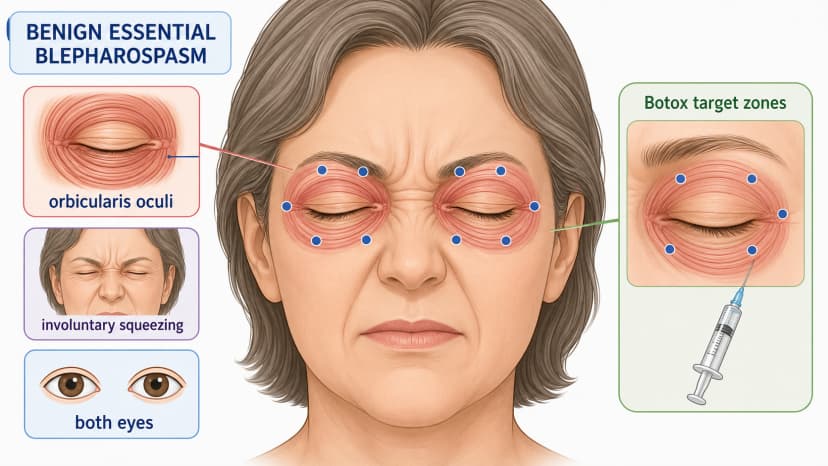
In benign essential blepharospasm (BEB), the eyes may be structurally healthy but the eyelids close involuntarily. The muscles around the eyes contract in repeated spasms or sustained closure, sometimes long enough to interfere with walking, reading, or driving. BEB is a neurologic movement disorder, not anxiety and not voluntary eyelid closure.
Key Takeaways
- The eyelids close involuntarily, from brief blinking bursts to sustained closure
- Vision can test normal; the problem is access to vision when the lids will not stay open
- This is neurologic, not psychological, and patients are not doing it on purpose
- Botulinum toxin injections are the main treatment for most people
- Dry eye and light sensitivity can aggravate spasms
- Daily activities can be substantially affected, but many people improve with regular treatment
Understanding Blepharospasm
BEB is a focal dystonia-a movement disorder affecting specific muscles. In BEB, the orbicularis oculi muscles (which close the eyelids) contract involuntarily and forcefully. The cause is dysfunction in brain circuits controlling movement, not a problem with the eyes themselves.
Symptoms
Eyelid Spasms
- Involuntary forced eye closure
- May start as increased blinking
- Progresses to sustained spasms
- Both eyes usually affected (bilateral)
- Cannot voluntarily keep eyes open during spasms
- May be intermittent initially, becoming more frequent
Triggers and Aggravating Factors
- Bright lights (photophobia)
- Stress
- Fatigue
- Reading
- Driving
- Wind
- Dry eyes
- Watching TV or screens
Sensory Tricks (Geste Antagoniste)
Some patients find relief through:
- Touching the face
- Wearing glasses (even non-prescription)
- Talking or singing
- Chewing gum
- Pulling on eyelid skin
These maneuvers provide temporary relief for some patients, but they do not work for everyone.
Associated Conditions
- Dry eye-very common, may precede or coexist
- Photophobia-light sensitivity
- Lower facial spasms-Meige syndrome
- Apraxia of eyelid opening-difficulty initiating eye opening
Progression
- Often begins with increased blinking
- May be attributed to dry eye or stress initially
- Gradually worsens over 1-2 years
- Usually stabilizes at plateau level
- Rarely remits spontaneously
Causes
The exact cause is unknown, but:
- Basal ganglia dysfunction-brain circuits controlling movement
- Not psychological-it's organic brain dysfunction
- Not caused by stress-though stress can worsen symptoms
- Genetic factors may play a role
- Secondary causes should be ruled out (medications, other neurological conditions)
Diagnosis
Clinical Diagnosis
Diagnosis is based on clinical features:
- Bilateral, symmetric eyelid spasms
- Involuntary forced eye closure
- No other explanation found
Rule Out Secondary Causes
- Review medications (some can cause dystonia)
- Exclude other neurological conditions
- Eye examination (rule out eye surface disease as sole cause)
- Neurological examination
Important Distinctions
| Condition | Features |
|---|---|
| Blepharospasm | Forceful closure, both eyes, no twitching |
| Hemifacial spasm | One side only, twitching, includes other facial muscles |
| Eyelid myokymia | Brief twitching, usually one lid, benign |
| Dry eye | Blinking, irritation, responds to lubrication |
| Ptosis | Drooping (not spasm), can open eyes voluntarily |
Treatment
Botulinum Toxin Injections
First-line treatment-highly effective
- Botox injections into orbicularis oculi muscles
- Weakens overactive muscles
- Effects last 3-4 months typically
- Repeat injections needed
- 90%+ of patients benefit
What to expect:
- Small needle injections around eyes
- Takes several days to work
- May need dose adjustment
- Side effects: temporary drooping, dry eye, bruising
Oral Medications
Limited effectiveness, but may be tried:
- Benzodiazepines (clonazepam)
- Anticholinergics
- Baclofen
- Often used as adjuncts
Other Treatments
FL-41 tinted glasses
- Rose/amber tint
- May reduce light-triggered spasms
- Worn indoors and out
Treatment of dry eye
- Often coexists
- May reduce triggers
- Artificial tears, prescription drops
Surgery (Rarely Needed)
Myectomy
- Surgical removal of eyelid muscle
- Reserved for treatment-resistant cases
- Good results in experienced hands
- May still need Botox afterward
Living with Blepharospasm
Practical Tips
- Keep eyes lubricated
- Wear wrap-around sunglasses
- Use FL-41 tinted lenses
- Manage stress and fatigue
- Take breaks during visual tasks
- Inform employer if needed
Driving
- May be unsafe during severe spasms
- Discuss with doctor
- May need to avoid driving in certain conditions
- Botox often restores driving ability
Support
- Benign Essential Blepharospasm Research Foundation (BEBRF)
- National Spasmodic Dystonia Association
- Support groups
Prognosis
- Most patients achieve good control with Botox
- Chronic condition requiring ongoing treatment
- Daily life often gets much easier once spasms are controlled
- Does not worsen vision (eyes are healthy)
- May spread to lower face in some (Meige syndrome)
Frequently Asked Questions
Is blepharospasm caused by stress?
No. Stress can worsen symptoms but doesn't cause BEB. It's a neurological movement disorder, not a psychological condition. This misconception unfortunately delays diagnosis for many patients.
Will I go blind?
No-your eyes are healthy. The problem is involuntary eyelid closure, not vision loss. However, untreated BEB can cause "functional blindness" because you can't keep your eyes open.
Do I have to get Botox injections forever?
BEB is typically a chronic condition, and most patients need ongoing Botox every 3-4 months. Some patients find they can extend intervals over time, but the condition rarely resolves completely.
Are there side effects from Botox?
Temporary drooping of the eyelid or brow can occur but usually resolves. Dry eye and bruising at injection sites are possible. Serious side effects are rare when performed by experienced practitioners.
Why does touching my face help temporarily?
This is called a sensory trick (geste antagoniste) and is common in focal dystonias. The sensory input seems to temporarily reset the brain circuits controlling the muscles. It doesn't work for everyone and usually becomes less effective over time.
Where can I find a doctor experienced with blepharospasm?
Blepharospasm requires a neuro-ophthalmologist experienced with botulinum toxin injection techniques specific to eyelid dystonia. Injection placement and dosing vary significantly between practitioners. Hashemi Eye Care specializes in the diagnosis and ongoing management of blepharospasm.
References
Medical Disclaimer: This information is for educational purposes only and does not replace professional medical advice, diagnosis, or treatment. If you have concerns about blepharospasm or any symptoms, please consult a qualified healthcare provider.
Sources:
- Hallett M, et al. Update on blepharospasm. Neurology. 2008;71(17):1275-1282.
- Anderson RL, et al. Botulinum toxin for blepharospasm. Am J Ophthalmol. 1984;98(3):357-358.
- Benign Essential Blepharospasm Research Foundation. Patient Resources.
- American Academy of Ophthalmology EyeWiki. Blepharospasm.