

Ocular Myasthenia Gravis
An autoimmune condition causing muscle weakness that fluctuates, often affecting the eyes first with droopy eyelids and double vision.
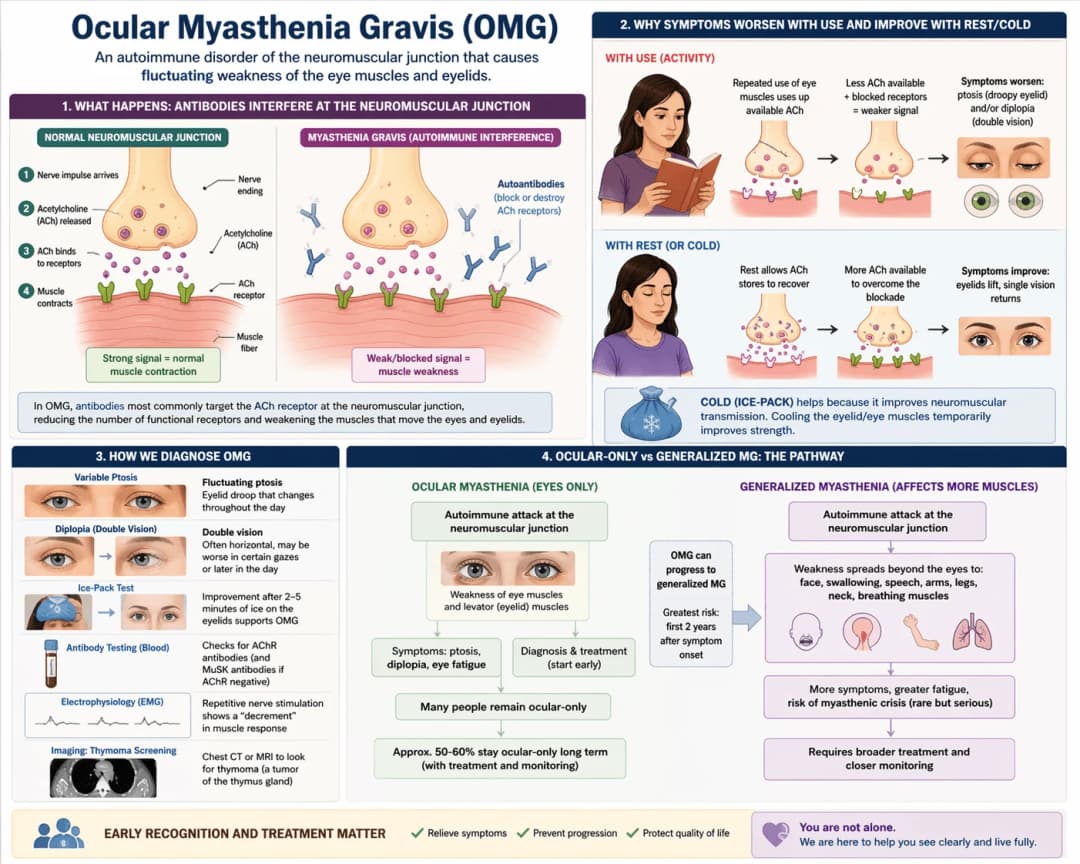
Myasthenia gravis (MG) is an autoimmune disorder where antibodies attack the connection between nerves and muscles, causing muscle weakness that worsens with activity and improves with rest. The eyes are affected first in over half of patients, causing droopy eyelids (ptosis) and double vision.
Key Takeaways
- Eyes often affected first with ptosis and diplopia that fluctuate
- Weakness worsens with use and improves with rest-hallmark feature
- Can remain ocular or progress to generalized weakness
- Treatable with medications and immunotherapy
- Ice pack test may help diagnose-cold improves symptoms
Understanding Myasthenia Gravis
In MG, antibodies block or destroy receptors at the neuromuscular junction-where nerves signal muscles to contract. The most common target is the acetylcholine receptor (AChR). This disrupts communication between nerves and muscles, causing weakness.
Types of Ocular Involvement
Ocular MG
- Symptoms limited to eyes (ptosis, diplopia)
- About 50% stay ocular only
- 50% progress to generalized MG within 2 years
Generalized MG with ocular involvement
- Eye symptoms plus weakness elsewhere
- May affect limbs, breathing, swallowing
Symptoms
Eye Symptoms
Ptosis (droopy eyelid)
- May affect one or both eyes
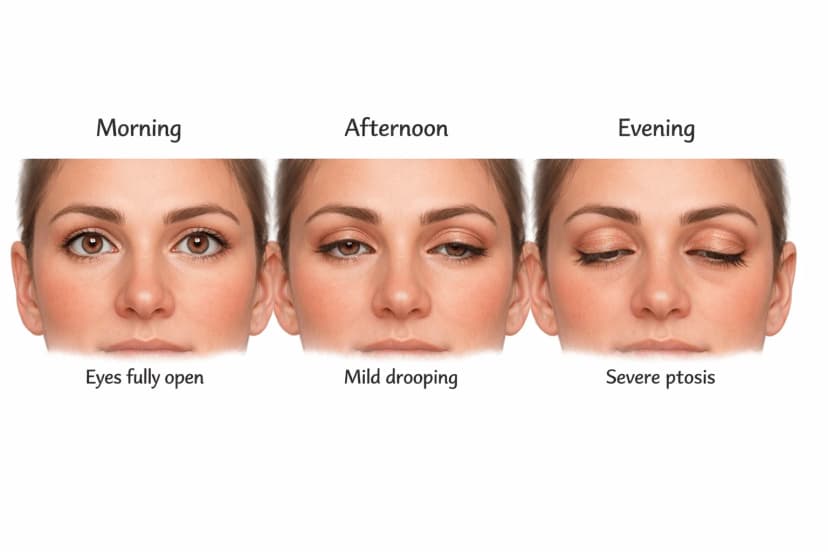
- Varies throughout the day
- Worse in evening or with fatigue
- May alternate between eyes
- Improves with rest or cold
Double vision (diplopia)
- Can mimic any nerve palsy pattern
- Varies with direction of gaze
- Fluctuates throughout day
- Worse with sustained gaze
Characteristic Features
- Fluctuation-symptoms vary hour to hour, day to day
- Fatigability-worse with prolonged use, better with rest
- Diurnal variation-often worse in evening
- Cold improves symptoms (basis of ice pack test)
Generalized Symptoms
If MG spreads beyond eyes:
- Weakness in arms and legs
- Difficulty chewing and swallowing (dysphagia)
- Slurred speech (dysarthria)
- Facial weakness
- Neck weakness
- Breathing difficulty-myasthenic crisis (emergency)
Warning Signs
Call 911 immediately if you have:
- Difficulty breathing
- Severe trouble swallowing
- Choking
- Rapid worsening of weakness
Myasthenic crisis is life-threatening and requires emergency respiratory monitoring and treatment.
Diagnosis
Clinical Features
- Ptosis and/or diplopia that fluctuate
- Weakness worsening with activity
- Improvement with rest
- Variable pattern not fitting typical nerve palsies
Bedside Tests
Ice pack test
- Apply ice to closed eyelid for 2 minutes
- Cooling improves neuromuscular transmission
- Ptosis improvement suggests MG
- Simple, non-invasive
Fatigability testing
- Sustained upgaze for 1-2 minutes
- Look for increasing ptosis
- Look for developing diplopia
Laboratory Tests
Acetylcholine receptor (AChR) antibodies
- Positive in 80-90% of generalized MG
- Positive in only 50-60% of ocular MG
- Highly specific-a positive test strongly supports diagnosis in the right clinical context
MuSK antibodies
- Check if AChR negative
- Different form of MG
- Different treatment implications
LRP4 antibodies
- Newer test for seronegative cases
Electrodiagnostic Tests
- Most sensitive test
- Shows "jitter" in neuromuscular transmission
- Useful when antibodies negative
Repetitive nerve stimulation
- Shows decremental response
- Less sensitive than SFEMG
Imaging
- Looking for thymoma (thymus gland tumor)
- Present in 10-15% of MG patients
- Thymic abnormalities common
- Needed even when symptoms seem eye-only, because finding a thymoma changes treatment planning
Treatment
Symptomatic Treatment
- Improves nerve-muscle transmission
- First-line for symptom control
- Effect lasts a few hours
- Side effects: cramping, diarrhea, excess saliva
Immunosuppressive Treatment
- First-line immunosuppressive therapy
- Effective but many side effects
- May temporarily worsen symptoms when starting
- Often used as bridge to other treatments
Steroid-sparing immunosuppressants:
- Azathioprine (Imuran)
- Mycophenolate (CellCept)
- Rituximab - B-cell depleting therapy. Considered an early option for MuSK-antibody-positive MG, where responses tend to be rapid and substantial. In AChR-antibody-positive MG, it is typically reserved for refractory disease after other immunosuppressants have been tried.
- Take months to work (except rituximab, which may work faster)
- Allow steroid dose reduction
Other Treatments
- Surgical removal of thymus gland
- Recommended for thymoma
- Proven benefit in generalized MG without thymoma (MGTX trial); role in purely ocular MG is less established
- Can lead to remission
Intravenous immunoglobulin (IVIG)
- For acute worsening
- Short-term effect
- Removes antibodies from blood
- For acute worsening or crisis
Ocular MG Considerations
- Symptomatic treatment with pyridostigmine often helps
- Prisms for diplopia if stable
- Eyelid crutches or tape for ptosis
- Immunosuppression if severe or progressing
Living with Myasthenia Gravis
For comprehensive guidance on managing ocular myasthenia gravis-including daily coping strategies, medication tips, and warning signs of generalization-see our complete patient guide: Living with Ocular Myasthenia Gravis - Patient Guide.
Lifestyle Adjustments
- Rest when fatigued
- Plan activities for when you're strongest (often morning)
- Use ice packs for temporary symptom relief
- Wear sunglasses to reduce squinting
Medications to Avoid
Many medications can worsen MG. Always inform healthcare providers about your diagnosis. Examples of problematic drugs:
- Certain antibiotics (aminoglycosides, fluoroquinolones)
- Beta blockers
- Magnesium
- Some cardiac medications
- Certain anesthetics
Monitoring
- Regular follow-up with neurologist
- Pulmonary function testing
- Watch for signs of generalization
- Medication adjustment as needed
Prognosis
Ocular MG
- About 50% remain ocular only
- 50% progress to generalized (usually within 2 years)
- Early immunosuppression may reduce progression
With Treatment
- Most patients achieve good control
- Remission possible in some
- Quality of life usually good with appropriate treatment
- Lifetime condition requiring ongoing management
Frequently Asked Questions
Will my eye symptoms get worse or spread?
About half of patients with ocular MG stay ocular. The first 2 years are highest risk for generalization. Early treatment may reduce this risk.
Why do my symptoms change so much?
Fluctuation is the hallmark of MG. Weakness depends on how much neurotransmitter is available, which varies with activity, rest, temperature, stress, and other factors.
Is MG hereditary?
MG itself is not directly inherited, but there may be genetic susceptibility to autoimmune conditions. Tell your doctor about family history of autoimmune diseases.
Can I drive with MG?
It depends on your symptoms. If ptosis covers your pupil or diplopia is significant, driving may be unsafe. Discuss with your doctor and consider eye patching strategies.
What triggers myasthenic crisis?
Infections, surgery, stress, and certain medications can trigger crisis. Respiratory infections are common triggers. Seek care early if sick.
Why do I need chest imaging if my symptoms are only in my eyes?
MG can be associated with thymoma, and thymoma can be present even when symptoms begin as ptosis or double vision. Chest CT helps rule this out and guides whether thymectomy or oncology/thoracic-surgery evaluation is needed.
Does MG affect life expectancy?
With modern treatment, most people with MG have normal or near-normal life expectancy. The key is proper diagnosis, treatment, and avoiding complications.
Where can I find a neuro-ophthalmologist for myasthenia?
Ocular myasthenia can be subtle and is frequently misdiagnosed or missed. A neuro-ophthalmologist experienced with myasthenia can identify clinical signs, coordinate antibody testing, and manage long-term treatment. Hashemi Eye Care evaluates and manages ocular myasthenia gravis including diagnostic workup and treatment coordination.
References
Medical Disclaimer: This information is for educational purposes only and does not replace professional medical advice, diagnosis, or treatment. If you have concerns about myasthenia gravis or any symptoms, please consult a qualified healthcare provider.
Sources:
- Gilhus NE, et al. Myasthenia gravis. Nat Rev Dis Primers. 2019;5(1):30.
- Sanders DB, et al. International consensus guidance for management of myasthenia gravis. Neurology. 2016;87(4):419-425.
- Narayanaswami P, et al. International consensus guidance for management of myasthenia gravis: 2020 update. Neurology. 2021;96(3):114-122.
- Myasthenia Gravis Foundation of America. Patient Resources.
- MedlinePlus. Myasthenia Gravis.