

Visual Field Test (Perimetry)
A test that maps your peripheral and central vision to detect blind spots and patterns of vision loss.
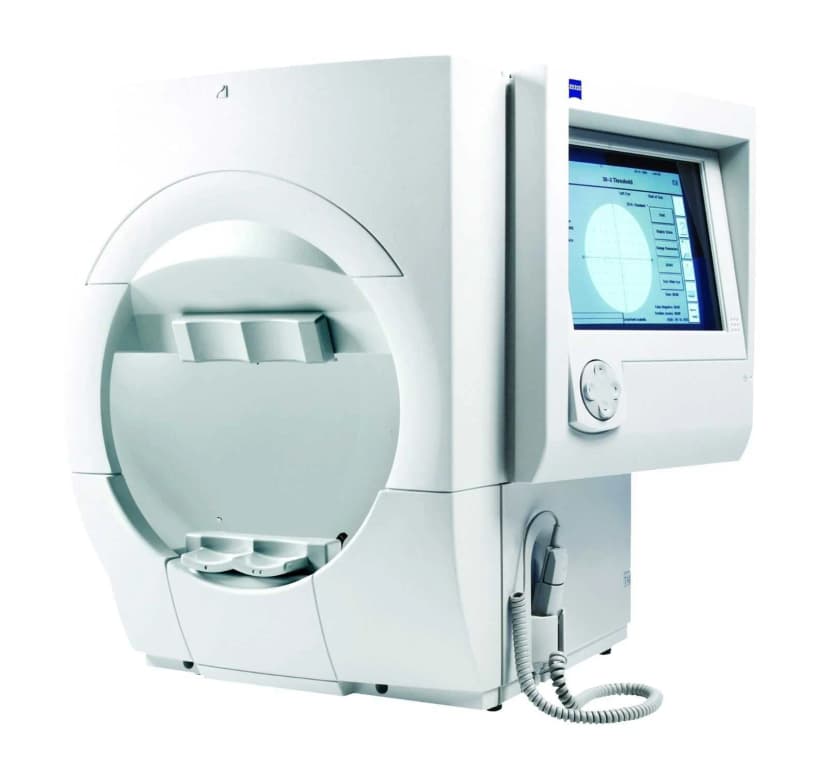
Visual field testing (perimetry) maps sampled points in selected areas of your vision-not just what you see looking straight ahead, but also parts of your peripheral (side) vision depending on the test pattern. The pattern of visual field loss provides crucial diagnostic information about conditions affecting the eyes, optic nerves, and brain. It's one of the most important tests in neuro-ophthalmology.
Key Takeaways
- Maps sampled points in selected areas of your visual field, depending on the test pattern
- Detects blind spots (scotomas) and patterns of vision loss
- Key test for glaucoma, optic nerve diseases, and brain conditions
- Requires your active participation-you must press a button when you see lights
- Results help locate the problem along the visual pathway from eye to brain
- Monitors progression and treatment effectiveness over time
Why Visual Field Testing Is Done
Conditions It Helps Diagnose
Optic nerve conditions:
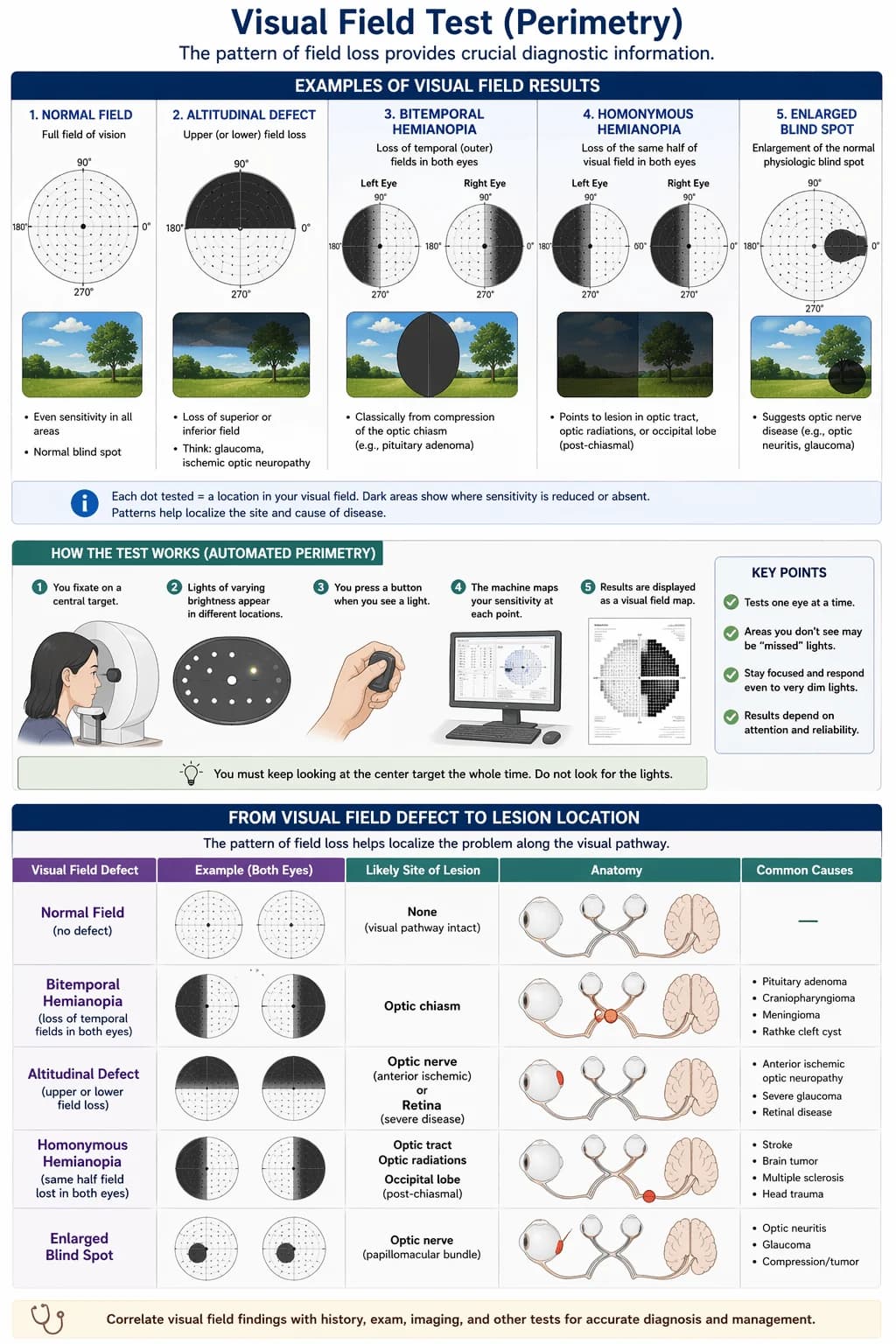
- Optic neuritis-central scotoma
- Ischemic optic neuropathy-altitudinal defects
- LHON-central/cecocentral scotomas
- Glaucoma-arcuate defects, nasal steps
Intracranial conditions:
- Papilledema and IIH-enlarged blind spot, peripheral constriction
- Pituitary tumor-bitemporal hemianopia
- Stroke-homonymous hemianopia
- Compressive optic neuropathy
Retinal conditions:
- Retinal detachment
- Retinal vascular occlusions
- Retinitis pigmentosa
Monitoring Disease
- Track progression or improvement over time
- Assess treatment effectiveness
- Guide treatment decisions (e.g., when to intervene in IIH)
How Visual Field Testing Works
The Basic Principle
A visual field test determines the dimmest light you can see at each location in your field of vision. Areas where you need brighter light to see (or can't see at all) represent decreased sensitivity-potential field defects.
Technical Background
The test measures threshold sensitivity at multiple points across your visual field:
- Threshold: The dimmest light you can detect 50% of the time
- Sensitivity: Measured in decibels (dB)-higher numbers mean better sensitivity
- Normal sensitivity varies by location (highest in center, lower peripherally)
Types of Visual Field Tests
Automated Perimetry
Humphrey Visual Field (HVF)
- Most common automated test
- Computer-controlled, standardized
- Several testing strategies available:
- 24-2: Tests central 24 degrees (most common)
- 30-2: Tests central 30 degrees
- 10-2: Tests central 10 degrees (for advanced disease)
- Standard for glaucoma and neuro-ophthalmology
Octopus perimetry
- Another automated system
- Similar capabilities to Humphrey
Manual Perimetry
Goldmann kinetic perimetry
- Technician-operated
- Moving targets of varying size and brightness
- Better for:
- Very low vision patients
- Mapping unusual defects
- Patients who struggle with automated testing
- Neurological field loss
Screening Tests
Confrontation visual fields
- Quick bedside/office screening
- Doctor compares patient's field to their own
- Can miss subtle defects
- Good for detecting gross abnormalities
Frequency doubling technology (FDT)
- Fast screening test
- Good for detecting glaucoma
- Less detailed than full perimetry
What to Expect
Before the Test
- Glasses or contact lenses: Bring your current prescription; a lens will be placed in front of your eye based on your prescription
- Dilating drops: Usually NOT required for visual field testing
- Caffeine: Best to avoid excessive caffeine before testing
- Each eye is tested separately
During the Test
- Chin on rest, forehead against bar
- Cover one eye (patch or occluder)
- Look straight ahead at central fixation target
- Lights flash at various locations in the bowl
- Press button whenever you see a light, however dim
- Don't move your eye from center-use peripheral vision
- Takes 5-15 minutes per eye depending on test type
Tips for Accurate Results
- Blink normally-don't try to keep eyes wide open
- Stay focused on the central target
- Press even when uncertain-better to err on side of pressing
- Take breaks if needed-you can pause the machine
- Relax-anxiety affects results
- Don't "search" for lights-let them come to you
- It's normal to miss some-the test expects you to miss some lights
What You'll Experience
- Lights appear at different locations and brightnesses
- Some lights are easy to see, some are very dim
- You'll miss some lights-this is expected and normal
- The test intentionally shows lights you can't see to map your threshold
- A "learning effect" is normal-second tests often better than first
Understanding Your Results
The Printout
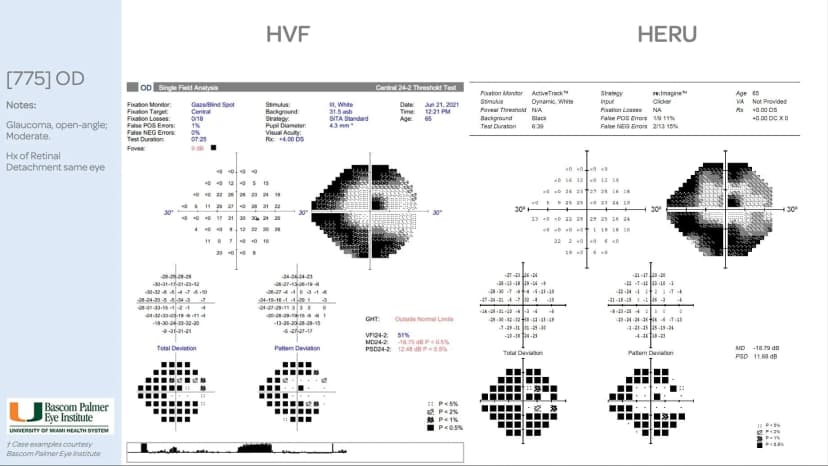
A visual field printout contains several elements:
Grayscale map: Visual representation where darker areas indicate vision loss
Numeric display: Sensitivity at each tested point in decibels (dB)
Total deviation: Compares your results to normal for your age
Pattern deviation: Highlights localized loss (filters out generalized depression)
Reliability indices:
- Fixation losses: Were you looking at center? (<20% is good)
- False positives: Did you press without a light? (<15% is good)
- False negatives: Did you miss lights you should see? (<33% is good)
Mean deviation (MD): Overall average loss from normal
Pattern standard deviation (PSD): How much variation exists (localizes defects)
Visual field index (VFI): Percentage of normal field remaining (used for glaucoma)
Common Patterns and What They Mean
| Pattern | Typical Cause |
|---|---|
| Central scotoma | Optic neuritis, macular disease |
| Cecocentral scotoma | Optic nerve disease, toxic/nutritional |
| Arcuate defect | Glaucoma, ischemic optic neuropathy |
| Altitudinal defect | Ischemic optic neuropathy, retinal vascular |
| Nasal step | Glaucoma |
| Enlarged blind spot | Papilledema, optic disc drusen |
| Bitemporal hemianopia | Pituitary tumor, chiasmal lesion |
| Homonymous hemianopia | Stroke, brain tumor (post-chiasmal) |
| Peripheral constriction | Glaucoma, retinitis pigmentosa, advanced papilledema |
| Generalized depression | Media opacity (cataract), uncorrected refraction, fatigue |
Localization: Where Is the Problem?
The visual pathway travels from eye to brain. The pattern of field loss indicates where the damage is:
Optic nerve (before chiasm): Affects one eye only
- Central scotomas
- Altitudinal defects
- Arcuate defects
Optic chiasm: Affects temporal fields of both eyes
- Bitemporal hemianopia (classically from pituitary tumor)
After chiasm (tract, radiations, cortex): Affects same side of both eyes
- Homonymous hemianopia
- Quadrantanopia (partial involvement)
Limitations of Visual Field Testing
Patient-Related Factors
- Attention and concentration affect results
- Fatigue causes worse performance
- Learning effect-first test often worse than subsequent
- Ptosis (droopy eyelid) can block upper field
- High refractive error needs proper correction
Test-Related Factors
- Only tests presented points-can miss between-point defects
- Threshold variability-some variation is normal
- Long test duration in some protocols
- Artifacts from lens rim, brow, nose
Interpreting Reliability
If reliability indices are poor:
- High fixation losses → patient wasn't looking at center
- High false positives → patient pressing randomly ("trigger happy")
- High false negatives → patient not responding appropriately, or real disease
Unreliable tests may need to be repeated.
Frequently Asked Questions
Is the test painful?
No. It involves looking at lights-no touching of your eye, no drops (usually), no discomfort.
How often do I need visual field testing?
It depends on your condition. Glaucoma patients may need testing every 3-6 months initially, then annually if stable. For neurological conditions, your doctor will determine the schedule based on your situation.
I felt like I was missing a lot-does that mean something's wrong?
Not necessarily. The test deliberately shows lights at or below your threshold, so you're expected to miss some. The computer analyzes the pattern of what you see and miss.
Why does one eye seem harder to test than the other?
There may be a real difference between your eyes, or it could be fatigue (the second eye tested is often "harder"). Discuss this with your doctor.
Can I fail the visual field test?
There's no pass or fail-it's a measurement of your vision. However, unreliable results (from poor attention or technique) may require repeat testing.
My results look worse than last time-should I be worried?
Some variation between tests is normal. Your doctor looks at trends over multiple tests, not just one test in isolation. Genuine changes are distinguished from normal variability over time.
Can I drive after the test?
Yes. Unlike many eye exams, visual field testing usually doesn't require dilating drops, so your vision should be normal afterward.
References
Medical Disclaimer: This information is for educational purposes only and does not replace professional medical advice, diagnosis, or treatment.
Sources:
- American Academy of Ophthalmology EyeWiki. Standard Automated Perimetry.
- Keltner JL, Johnson CA. Effectiveness of automated perimetry in following glaucomatous visual field progression. Ophthalmology. 2012;119(11):e53-e59.
- Wall M, et al. Threshold Amsler grid testing in IIH. J Neuroophthalmol. 2011;31(2):188-191.
- BrightFocus Foundation. Understanding the Visual Field Test.
- Heijl A, et al. The Field Analyzer Primer. 4th ed. Carl Zeiss Meditec; 2012.