

Argyll Robertson Pupils
Small, irregular pupils that constrict to near focus but not to light. A classic sign of neurosyphilis, though now rare.
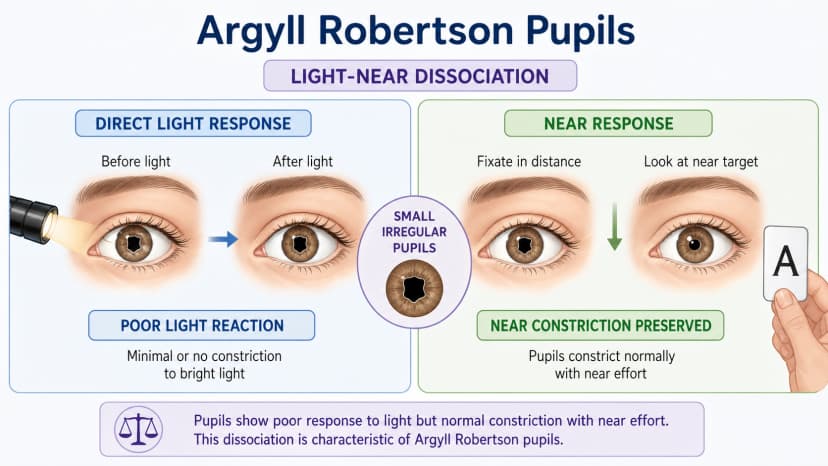
Argyll Robertson pupils are a classic neurological finding characterized by small, irregular pupils that fail to constrict to light but constrict normally when focusing on near objects. This pattern, called "light-near dissociation," is historically associated with neurosyphilis but can occur with other conditions affecting the brainstem.
Key Takeaways
- Small, irregular pupils that don't react to light
- React normally to near focus-"light-near dissociation"
- Classic sign of neurosyphilis
- Now rare due to syphilis treatment
- Other causes exist but uncommon
Understanding Argyll Robertson Pupils
The pupil normally constricts to both light and near focus (accommodation). These reflexes use similar pathways but are not identical. In Argyll Robertson pupils, the pathway for the light reflex is damaged while the near reflex pathway remains intact. The result is pupils that respond to looking at something close but not to a bright light.
Characteristics
Classic Features
- Small pupils (miosis)
- Irregular pupil shape
- Bilateral (both eyes affected)
- Poor or absent light response
- Preserved near response
- Poor dilation in dark
Remembering the Pattern
The hallmark pattern is "accommodate but don't react": the pupils constrict normally when focusing on a near target (accommodation) but fail to constrict to light. This is the defining feature of light-near dissociation.
Symptoms
Visual Symptoms
- Often none-many patients don't notice
- Possible photophobia in bright light
- Difficulty seeing in dim light (pupils don't dilate well)
Associated Symptoms (Depend on Cause)
With neurosyphilis:
- May have other neurological symptoms
- Cognitive changes
- Balance problems
- Lightning pains
Causes
Classic Cause
Neurosyphilis (tertiary syphilis)
- Now rare due to antibiotic treatment
- Still occurs in untreated cases
- Other syphilis manifestations may be present
Other Causes
- Diabetes mellitus (diabetic pupil)
- Lyme disease (neuroborreliosis)
- Herpes zoster
- Encephalitis
- Multiple sclerosis (rarely)
- Midbrain lesions
Diagnosis
Clinical Examination
- Observe pupil size and shape
- Test light response (should be absent/minimal)
- Test near response (should be preserved)
- Slit lamp examination for pupil details
Testing for Syphilis
- RPR/VDRL (screening tests)
- Treponemal tests (FTA-ABS, TP-PA)
- Lumbar puncture if neurosyphilis suspected (CSF VDRL)
Other Testing
- Blood glucose (diabetes)
- Lyme serology
- MRI brain if structural cause suspected
Treatment
Treat Underlying Cause
For neurosyphilis:
- IV penicillin
- Treatment may stabilize but not reverse pupil findings
For other causes:
- Treat underlying condition
- Diabetes management
- Appropriate antibiotics for infections
Symptomatic Treatment
- Dark glasses if photophobia
- Generally no specific treatment for the pupils
Prognosis
Variable
- Pupil findings often permanent even with treatment
- Importance lies in identifying and treating underlying cause
- Neurosyphilis can progress if untreated
Historical Context
Argyll Robertson pupils were first described in 1869 and became an important diagnostic sign for syphilis before serological testing was available. With modern antibiotic treatment, classic Argyll Robertson pupils have become rare, but the finding remains clinically relevant.
Frequently Asked Questions
Does this mean I have syphilis?
Not necessarily. While Argyll Robertson pupils are classically associated with syphilis, other conditions can cause similar findings. Your doctor will test for syphilis and other potential causes.
Will treatment fix my pupils?
Usually not. Even with treatment of the underlying cause, the pupil abnormalities often persist. However, treatment prevents progression of the underlying disease.
Is this dangerous?
The pupil findings themselves are not dangerous. However, they may indicate an underlying condition (like syphilis or diabetes) that needs treatment.
References
Medical Disclaimer: This information is for educational purposes only and does not replace professional medical advice, diagnosis, or treatment. If you have concerns about your pupils or any symptoms, please consult a qualified healthcare provider.
Sources:
- Thompson HS. Light-near dissociation of the pupil. Ophthalmologica. 1984;189(1-2):21-23.
- Dacey RG, et al. Relative afferent pupillary defects in anterior visual pathway disease. Arch Ophthalmol. 1979;97(9):1685-1688.
- Marra CM. Neurosyphilis. Curr Neurol Neurosci Rep. 2004;4(6):435-440.
- American Academy of Ophthalmology EyeWiki. Argyll Robertson Pupils.
- StatPearls [Internet]. Argyll Robertson Pupil.