
Slit Lamp Examination
A detailed examination of the eye structures using a specialized microscope with adjustable light, allowing magnified views of the eye's front and back.
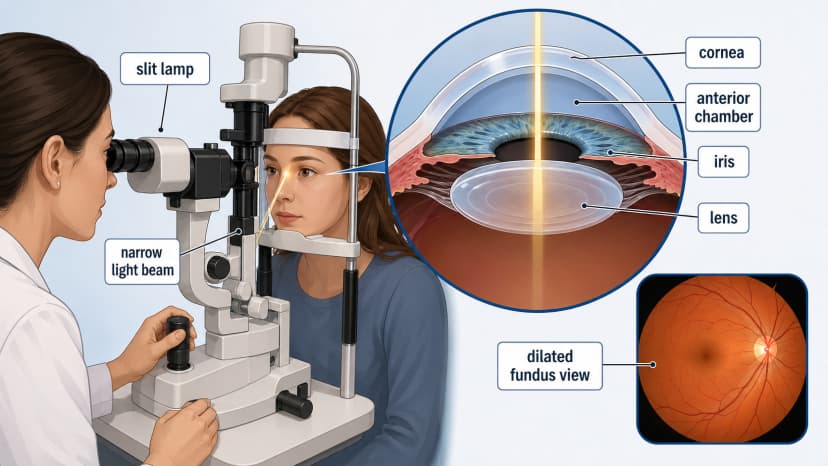
The slit lamp examination uses a specialized microscope called a slit lamp (or biomicroscope) to examine the eye in great detail. The instrument provides a magnified, three-dimensional view of eye structures using an adjustable beam of light.
Key Takeaways
- Detailed microscopic examination of the eye
- Adjustable light beam and magnification
- Views both front and back of eye
- Essential for many eye conditions
- Painless and non-invasive
What Is a Slit Lamp?
The slit lamp combines:
- Microscope for magnification (6x to 40x)
- Adjustable light source that can be narrowed to a "slit"
- Chin rest to stabilize patient's head
The "slit" of light allows the doctor to see thin cross-sections of eye structures, similar to how a flashlight beam shows dust particles in the air.
Structures Examined
Front of the Eye (Anterior Segment)
Eyelids and lashes
- Inflammation, infections
- Abnormal growths
- Lash problems
Conjunctiva
- Redness, inflammation
- Growths or lesions
- Dryness
Cornea
- Clarity and shape
- Abrasions, ulcers
- Dystrophies
- Infections
Anterior chamber
- Inflammation (cells, flare)
- Bleeding
- Depth
Iris
- Shape and color
- Inflammation
- Pupil abnormalities
- Argyll Robertson pupils
Lens
- Cataracts
- Position
- Clarity
Back of the Eye (With Additional Lenses)
With special lenses, the slit lamp can also examine:
- Vitreous
- Retina
- Optic nerve
- Macula
Common Uses
Routine Eye Examination
- Part of comprehensive eye exam
- Checking eye health
Specific Conditions
- Dry eye evaluation
- Contact lens fitting
- Infection diagnosis
- Inflammation (uveitis) assessment
- Cataract evaluation
- Glaucoma assessment (with gonioscopy)
After Eye Procedures
- Post-surgical monitoring
- Laser treatment follow-up
The Procedure
Preparation
- Usually no special preparation
- Remove contact lenses
- May have dilating drops placed
During the Exam
- Sit at the instrument with chin on rest
- Forehead against the bar
- Keep both eyes open
- Look straight ahead or as directed
- Bright light will be shone into eye
- Exam takes a few minutes
What You'll Experience
- Bright light (may be uncomfortable but not painful)
- Doctor looking closely at your eye
- May feel air puff if pressure measured (tonometry)
- May have dye drops (fluorescein) placed
Special Techniques
Fluorescein Staining
- Orange dye drops placed on eye
- Shows corneal damage, dry areas
- Used for contact lens fitting
Gonioscopy
- Special lens placed on eye
- Views drainage angle for glaucoma
- Numbing drops used first
Fundus Examination
- High-magnification lens used
- Detailed view of optic nerve and retina
- Better detail than ophthalmoscope alone
In Neuro-Ophthalmology
Slit lamp exam helps evaluate:
- Pupil abnormalities
- Uveitis causing light sensitivity
- Optic nerve appearance (with lens)
- Argyll Robertson pupils
- Eye movement abnormalities
After the Exam
- No restrictions usually
- If dilated, temporary light sensitivity
- If fluorescein used, may have orange tears briefly
- Can usually drive unless dilated
What the Doctor Is Looking For
| Finding | May Indicate |
|---|---|
| Corneal infiltrates | Infection, inflammation |
| Cells in anterior chamber | Uveitis |
| Irregular pupil | Prior inflammation, trauma |
| Lens opacity | Cataract |
| Disc swelling | Papilledema, optic neuritis |
| Pale disc | Optic atrophy |
Medical Disclaimer: This information is for educational purposes only and does not replace professional medical advice, diagnosis, or treatment.
Sources:
- American Academy of Ophthalmology. Slit Lamp Examination.
- Wikipedia. Slit lamp.