

Giant Cell Arteritis (Temporal Arteritis)
A serious inflammatory condition of blood vessels that can cause sudden blindness if not treated immediately. Learn the warning signs and why urgent treatment is critical.
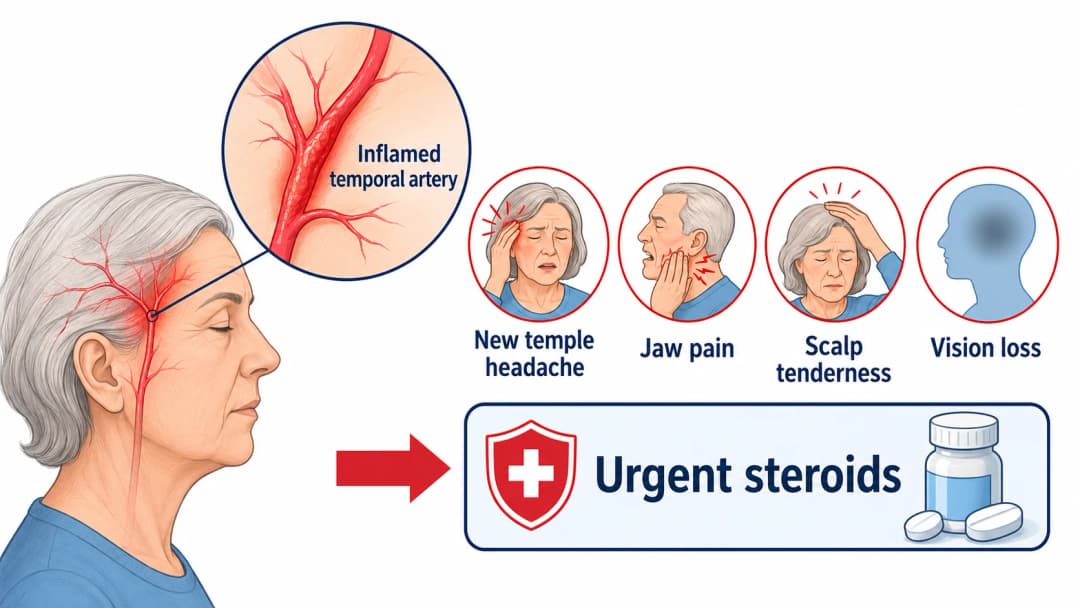
Giant cell arteritis (GCA), also known as temporal arteritis, is an inflammatory condition affecting medium and large arteries, particularly the temporal arteries (near the temples) and the arteries supplying the eyes. GCA is a medical emergency because it can cause permanent blindness if not treated promptly.
Key Takeaways
- GCA is a medical emergency-can cause permanent blindness within hours to days
- Occurs almost exclusively in people over 50, usually over 70
- Warning signs: new headache, scalp tenderness, jaw pain with chewing, vision changes
- Treatment with steroids must start immediately-don't wait for biopsy results
- Vision loss in one eye means the other eye is at very high risk without treatment
Patient Awareness Guide
If you're over 50, knowing the warning signs of GCA could save your sight. For detailed information about recognizing symptoms and understanding the urgency of treatment, see our guide: Eye Symptoms After 50 - Giant Cell Arteritis Awareness Guide.
Warning Signs
Call 911 immediately if you are over 50 and have sudden vision loss, transient vision blackouts, new double vision, or stroke symptoms such as face droop, arm weakness, speech trouble, confusion, or trouble walking.
Go to the emergency department the same day if you are over 50 and have possible GCA symptoms without those 911 symptoms:
- New or different headache
- Scalp tenderness (hurts to brush hair, wear glasses, lie on pillow)
- Jaw pain or fatigue when chewing (jaw claudication)
- Unexplained fatigue, weight loss, or fever
Every hour counts. Blindness can occur suddenly and is usually permanent.
Symptoms
Eye Symptoms (Ophthalmic)
- Transient vision loss-warning sign; brief episodes of vision blacking out
- Permanent vision loss-ischemic optic neuropathy or central retinal artery occlusion
- Double vision-from ischemia to eye muscles
- Vision loss is typically sudden and painless
- Without treatment, other eye often affected within days
Headache and Scalp Symptoms
- New headache or change in usual headache pattern
- Often located at temples
- Scalp tenderness-hurts to touch, comb hair, wear hat
- Visible or tender temporal arteries
- Arteries may feel thickened or have reduced pulse
Jaw Claudication
- Pain or fatigue in jaw muscles when chewing
- Caused by inadequate blood flow to jaw muscles
- Very specific for GCA when present
- More common with prolonged chewing
Systemic Symptoms
- Fatigue, malaise, feeling unwell
- Low-grade fever
- Weight loss
- Night sweats
- Shoulder and hip stiffness (polymyalgia rheumatica in 40-60%)
Who Gets GCA?
- Almost never occurs under age 50
- Average age at diagnosis: 70-75 years
- Women affected 2-3 times more than men
- More common in Northern Europeans
- Incidence increases with age
Diagnosis
Blood Tests (Urgent)
- ESR (erythrocyte sedimentation rate)-usually markedly elevated (often >50-100)
- CRP (C-reactive protein)-usually elevated
- CBC-may show anemia, elevated platelets
Important: Normal ESR/CRP doesn't completely rule out GCA in suspicious cases
Temporal Artery Biopsy
- Can provide tissue confirmation when positive
- Removes small segment of temporal artery
- Shows inflammation of artery wall if positive
- Can be done under local anesthesia
- Should be done within 2 weeks of starting steroids
- Do NOT delay treatment waiting for biopsy
Imaging
- Temporal artery ultrasound-"halo sign" suggests inflammation
- MRI or PET scan-may show large vessel involvement
- May help if biopsy is negative but suspicion remains high
Treatment
Emergency Steroid Treatment
Start immediately if GCA is suspected - do not wait for biopsy results or inflammatory markers.
Any vision symptom counts as "vision involvement":
This includes brief episodes of vision loss that have already resolved (amaurosis fugax), blurred vision, a curtain or shadow that came and went, new double vision, or a visual field defect - not just ongoing blindness. Any of these presentations triggers the IV pathway below.
- IV methylprednisolone 1 gram daily for 3-5 days
- Then transition to oral prednisone (60-80 mg daily)
For GCA without any vision symptoms:
- High-dose oral prednisone (40-60 mg daily)
- Some physicians still use IV steroids initially
Long-Term Treatment
Steroid taper:
- Very slow reduction over 1-2 years typically
- Guided by symptoms and inflammatory markers
- Relapses common if tapered too quickly
Steroid-sparing agents:
- Tocilizumab (Actemra)-FDA-approved for GCA
- Allows faster steroid tapering
- Given as weekly injection or monthly infusion
- Reduces steroid side effects
- Methotrexate-may allow steroid reduction
- Recommended by EULAR when tocilizumab is unavailable or contraindicated
- Supported by meta-analysis of randomized trials
Bone protection:
- Calcium and vitamin D
- Bisphosphonate medication
- Important because of prolonged steroid use
Monitoring
- Regular blood tests (ESR, CRP, blood sugar, etc.)
- Monitor for steroid side effects
- Watch for relapse symptoms
- Taper slowly based on clinical response
Complications
Visual Complications
- Permanent vision loss-most feared complication
- Ischemic optic neuropathy-most common
- Central retinal artery occlusion-sudden complete vision loss
- Ischemic cranial nerve palsies-double vision
Other Complications
- Aortic aneurysm-late complication, monitor with imaging
- Stroke-from involvement of intracranial arteries
- Limb claudication-from large vessel involvement
- Treatment complications-diabetes, osteoporosis, infections from steroids
Prognosis
With Prompt Treatment
- Prompt treatment greatly reduces the risk of further vision loss
- Prompt treatment greatly reduces risk to the other eye, but does not guarantee protection
- Symptoms typically improve within days
- Most people can eventually taper off medication
Without Treatment
- High risk of second eye blindness (often within days)
- Risk of stroke and other vascular complications
- Vision loss in affected eye rarely recovers
Living with GCA
During Active Treatment
- Take medications exactly as prescribed
- Don't stop steroids suddenly
- Report any new symptoms immediately
- Attend all follow-up appointments
- Be aware of steroid side effects
Long-Term
- Regular monitoring even after treatment stops
- Watch for signs of relapse
- Periodic imaging to check for aortic aneurysm
- Healthy lifestyle to offset steroid side effects
Frequently Asked Questions
Why must treatment start before the biopsy?
Because vision loss can occur suddenly and is usually permanent. The risk of waiting (potential blindness) far outweighs the risk of starting steroids. The biopsy can still be positive up to 2 weeks after starting treatment.
What should I say in the emergency department?
Say: "I am over 50 and I have possible giant cell arteritis symptoms." Mention any jaw pain with chewing, scalp tenderness, new headache, transient visual blackouts, double vision, fever, weight loss, or shoulder/hip stiffness. Ask whether ESR, CRP, CBC, urgent steroid treatment, and temporal artery biopsy or ultrasound are needed. Testing should support the diagnosis, not delay treatment when suspicion is high.
If my biopsy is negative, does that mean I don't have GCA?
Not necessarily. GCA can affect arteries in a patchy pattern, so the biopsy may miss involved areas (false negative). If clinical suspicion is high despite negative biopsy, treatment may continue. Other tests like ultrasound or PET scan may help.
How long will I need to take steroids?
Typically 1-2 years, with very gradual tapering. Trying to reduce too quickly often leads to relapse. Tocilizumab may allow faster steroid reduction in some patients.
What if I've already lost vision in one eye?
Treatment is still urgent to protect the other eye. Without treatment, there's a very high risk of the second eye being affected, often within days. Vision in the already-affected eye rarely improves.
Can GCA come back after I finish treatment?
Relapse can occur, especially if steroids are tapered too quickly. Long-term monitoring is important. Some people need to stay on low-dose steroids or other medications indefinitely.
References
Medical Disclaimer: This information is for educational purposes only and does not replace professional medical advice, diagnosis, or treatment. If you have concerns about GCA or any symptoms, please consult a qualified healthcare provider.
Sources:
- Hellmich B, et al. 2018 Update of the EULAR recommendations for the management of large vessel vasculitis. Ann Rheum Dis. 2020;79(1):19-30.
- Maz M, et al. 2021 American College of Rheumatology/Vasculitis Foundation guideline for the management of giant cell arteritis and Takayasu arteritis. Arthritis Rheumatol. 2021;73(8):1349-1365.
- Stone JH, et al. Trial of tocilizumab in giant-cell arteritis. N Engl J Med. 2017;377(4):317-328.
- Weyand CM, Goronzy JJ. Giant-cell arteritis and polymyalgia rheumatica. N Engl J Med. 2014;371(1):50-57.
- American Academy of Ophthalmology EyeWiki. Giant Cell Arteritis.
- Vasculitis Foundation. Giant Cell Arteritis.