
Ischemic Optic Neuropathy
Sudden optic nerve blood-flow loss. The urgent question is whether giant cell arteritis is involved, because the other eye may be at risk.
Sudden optic nerve blood-flow loss requires urgent evaluation for giant cell arteritis, especially in adults over 50. Arteritic ischemic optic neuropathy can cause rapid, permanent vision loss in the other eye unless corticosteroid treatment is started promptly. The more common form, NAION, has a different risk profile and no proven vision-restoring treatment. Distinguishing the two is clinically urgent.
Key Takeaways
- Sudden painless vision loss in one eye is the classic presentation
- Arteritic disease means GCA until proven otherwise, and that is an emergency
- Immediate steroids can protect the other eye when GCA is the cause
- NAION is more common, but no treatment has reliably restored lost vision
- Risk-factor work still matters for NAION: sleep apnea, diabetes, hypertension, smoking, and vascular risk
- Adults over 50 with sudden vision loss need urgent GCA screening rather than observation without evaluation
Types of Ischemic Optic Neuropathy
Arteritic Anterior Ischemic Optic Neuropathy (AAION)
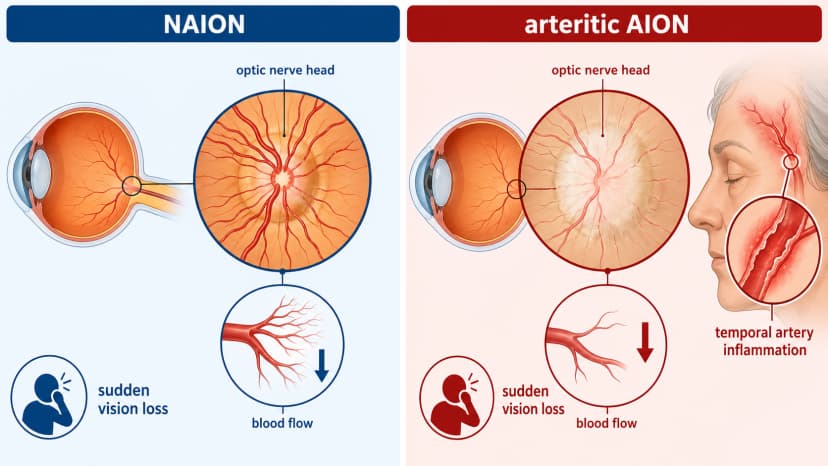
Caused by giant cell arteritis (GCA):
- Medical emergency-can cause blindness in both eyes if untreated
- Usually in patients over 70
- Associated symptoms: headache, scalp tenderness, jaw claudication, fatigue
- Vision loss often severe
- Requires immediate high-dose steroids
Non-Arteritic Anterior Ischemic Optic Neuropathy (NAION)
More common form:
- Not caused by inflammation
- Related to vascular risk factors (diabetes, hypertension)
- Vision loss typically less severe than arteritic
- No proven treatment
- "Disc at risk" anatomy often present
Posterior Ischemic Optic Neuropathy
- Affects optic nerve behind the eye
- Less common
- Optic disc appears normal initially
- Various causes including surgery, severe blood loss
Symptoms
NAION Symptoms
- Sudden vision loss upon waking is classic
- Usually noticed first thing in morning
- One eye affected
- Typically painless
- Altitudinal visual field defect-loss of upper or lower half of vision
- Vision loss variable-from mild to severe
Arteritic (GCA) Symptoms
All NAION symptoms plus:
- Headache-especially new or different headache
- Scalp tenderness-hurts to brush hair or lie on pillow
- Jaw claudication-jaw pain/fatigue when chewing
- Fatigue, weight loss, fever
- Polymyalgia rheumatica-shoulder/hip stiffness
- Vision loss often more severe
- May have transient vision loss as warning
When to Seek Emergency Care
Call 911 immediately for sudden vision loss with BE-FAST stroke symptoms, transient blackouts, or severe sudden headache.
Go to the emergency department the same day if you have:
- Sudden vision loss AND you are over 50 years old
- Any vision loss with headache, scalp tenderness, or jaw pain
- Any sudden painless vision loss-don't wait to see if it improves
For suspected GCA: Steroids must be started immediately, even before biopsy. Every hour counts in preventing vision loss in the other eye.
Diagnosis
Urgent Blood Tests (Same Day)
- ESR (erythrocyte sedimentation rate)-elevated in GCA
- CRP (C-reactive protein)-elevated in GCA
- CBC-may show anemia or elevated platelets in GCA
Eye Examination Findings
NAION:
- Swollen optic disc with hemorrhages
- Disc often "small and crowded"
- RAPD present
Arteritic:
- Swollen, pale optic disc
- May be more pale than NAION
- Often more severe vision loss
Confirmatory Tests
For suspected GCA:
- Temporal artery biopsy-can provide tissue confirmation when positive
- Should be done within 2 weeks of starting steroids
- Don't delay steroids waiting for biopsy
- May need temporal artery ultrasound
Imaging:
- MRI not usually needed for typical NAION
- May be done to rule out other causes
- OCT shows nerve fiber layer changes
Treatment
For Arteritic (GCA)-EMERGENCY
Immediate treatment:
- High-dose IV methylprednisolone (1 gram/day for 3-5 days)
- Or high-dose oral prednisone (60-100mg) if IV not available
- Start BEFORE biopsy-do not wait
Long-term treatment:
- Prolonged steroid taper (often 1-2 years)
- Tocilizumab (Actemra) may allow steroid reduction
- Bone protection (calcium, vitamin D, bisphosphonate)
- Monitor for steroid side effects
For NAION
No proven treatment, but:
- Control of vascular risk factors essential
- Aspirin (evidence unclear but commonly used)
- Discuss blood pressure medication timing with your doctor - nocturnal hypotension may contribute to NAION, but changes to medication timing should only be made under medical supervision
- Sleep apnea evaluation and treatment
- If you have had NAION in one eye, do not start or restart phosphodiesterase inhibitors (Viagra, etc.) without discussing it with your clinician - while a causal link is not definitively established, these medications are generally avoided after a prior NAION event
What doesn't work:
- Steroids (no proven benefit for NAION)
- Optic nerve decompression surgery (may be harmful)
Risk Factors
NAION Risk Factors
- "Disc at risk" (small, crowded optic disc)
- Diabetes
- Hypertension
- Sleep apnea
- Nocturnal hypotension (blood pressure dropping at night)
- Cardiovascular disease
- Smoking
GCA Risk Factors
- Age over 50 (almost never occurs younger)
- Female sex (2-3x more common)
- Northern European ancestry
- Polymyalgia rheumatica
Prognosis
NAION
- Vision usually stabilizes within weeks
- Some improvement possible but often limited
- 15-20% risk of fellow eye involvement over 5 years
- Focus on preventing second eye involvement
Arteritic
- Without treatment: High risk of second eye blindness (often within days)
- With prompt treatment: Good chance of preserving other eye
- Vision in affected eye rarely recovers
- Requires long-term monitoring and treatment
Frequently Asked Questions
Will my vision recover?
For NAION, some patients have modest improvement, but significant recovery is uncommon. The vision usually stabilizes at the level it reaches in the first few weeks. For arteritic ION, vision in the affected eye rarely improves, but treatment protects the other eye.
Will my other eye be affected?
For NAION, the risk is about 15-20% over 5 years. For untreated GCA, the risk is very high (up to 50% within days). This is why urgent treatment of GCA is essential.
Why did this happen to me?
NAION is related to blood flow to the optic nerve, often influenced by anatomical factors (small optic disc) and vascular risk factors. GCA is an autoimmune inflammatory condition of blood vessels. Neither is caused by anything you did.
Can I prevent this from happening to my other eye?
For NAION: Control vascular risk factors, treat sleep apnea, discuss blood pressure medication timing with your doctor, and if you have had NAION in one eye, discuss phosphodiesterase inhibitor use with your doctor. For GCA: Continue your immunosuppressive treatment as prescribed.
Is ischemic optic neuropathy the same as a stroke?
It's similar in concept-both involve blood flow problems. NAION is sometimes called a "stroke of the optic nerve." However, the treatment and implications are different from brain stroke.
What should I tell the emergency clinician?
Say whether you are over 50, whether the vision loss was sudden and painless, and whether you have new headache, scalp tenderness, jaw pain with chewing, fever, weight loss, or shoulder/hip stiffness. Those details determine how urgently the team treats for giant cell arteritis while arranging ESR, CRP, CBC, eye exam, and temporal artery biopsy or ultrasound.
References
Medical Disclaimer: This information is for educational purposes only and does not replace professional medical advice, diagnosis, or treatment. If you have concerns about vision loss or any symptoms, please consult a qualified healthcare provider.
Sources:
- Biousse V, Newman NJ. Ischemic optic neuropathies. N Engl J Med. 2015;372(25):2428-2436.
- Hayreh SS. Ischemic optic neuropathy. Prog Retin Eye Res. 2009;28(1):34-62.
- North American Neuro-Ophthalmology Society. Non-Arteritic Anterior Ischemic Optic Neuropathy.
- MedlinePlus. Optic Nerve Atrophy.