

Glaucoma
Optic nerve damage, usually tied to eye-pressure risk, that can steal peripheral vision before many people notice. Exams and pressure-lowering treatment protect remaining sight.
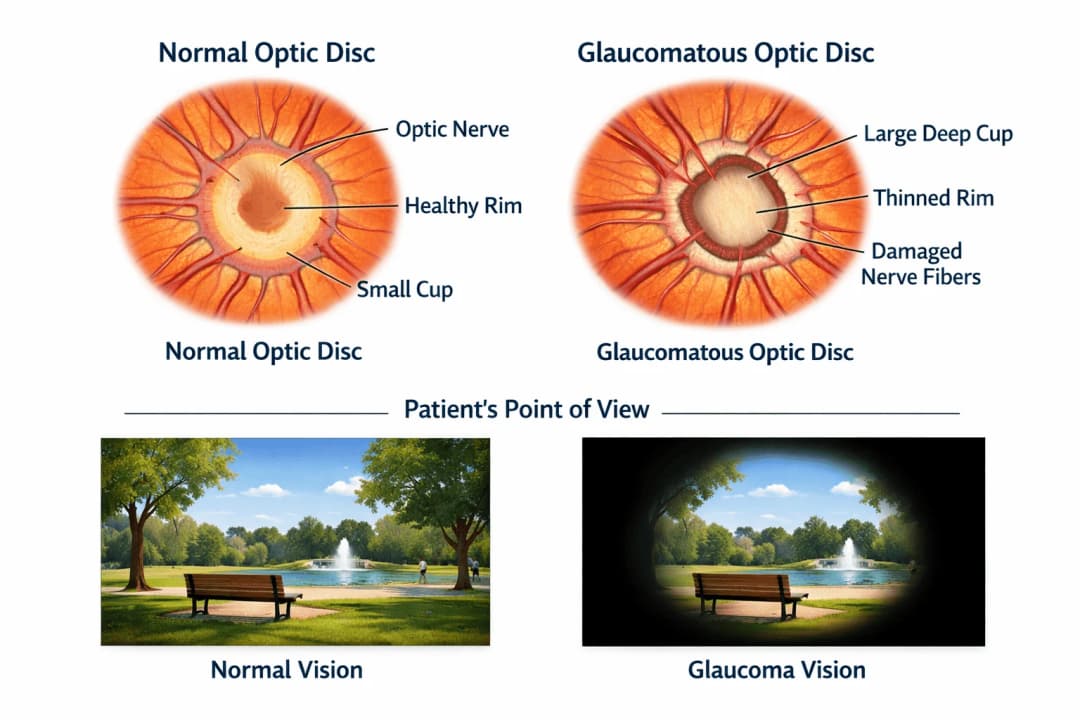
Glaucoma can damage the optic nerve before a person notices symptoms. The optic nerve carries visual information from the eye to the brain; once nerve fibers are lost, the resulting vision loss is generally irreversible. Eye pressure is the major modifiable risk factor, but glaucoma can occur even when pressure is in the statistically normal range. Early detection and pressure-lowering treatment help protect remaining vision.
Key Takeaways
- Glaucoma injures the optic nerve, usually starting with peripheral vision
- Symptoms may be absent for years, which is exactly why screening matters
- Eye pressure is the main modifiable risk factor, though normal-pressure glaucoma exists
- Optic nerve exam, OCT, and visual field testing show whether damage is present or progressing
- Treatment protects remaining vision by lowering pressure with drops, laser, or surgery
- Lost glaucoma vision does not come back, so the win is stopping more loss
Types of Glaucoma
Primary Open-Angle Glaucoma (POAG)
- Most common type (90% of cases)
- Drainage angle is open but doesn't function efficiently
- Develops slowly over years
- Usually no symptoms until advanced
- Affects peripheral vision first
Angle-Closure Glaucoma
Chronic angle-closure:
- Gradual narrowing of drainage angle
- May be asymptomatic initially
Acute angle-closure:
- Medical emergency
- Sudden, severe eye pain
- Headache, nausea, vomiting
- Halos around lights
- Red eye, blurred vision
- Requires immediate treatment
Normal-Tension Glaucoma
- Optic nerve damage despite normal eye pressure
- More common in certain populations
- May be related to blood flow issues
- Treatment still focuses on lowering IOP
Secondary Glaucoma
- Results from other conditions:
- Eye injury
- Inflammation
- Steroid use
- Advanced cataracts
- Diabetes (neovascular glaucoma)
Symptoms
Early Glaucoma
- Usually no symptoms - which is why many people wonder if they could have glaucoma without knowing it
- Vision loss begins in peripheral (side) vision
- Central vision preserved until late stages
Advanced Glaucoma
- Tunnel vision
- Difficulty with peripheral awareness
- Problems navigating, especially in dim light
- Central vision affected in late stages
Acute Angle-Closure (Emergency)
Seek immediate care for:
- Severe eye pain
- Sudden vision changes
- Halos around lights
- Red eye with headache and nausea
Risk Factors
- Age over 40 (risk increases with age)
- Family history of glaucoma
- African, Asian, or Hispanic ancestry
- Elevated intraocular pressure
- Thin central cornea
- High myopia (nearsightedness) or hyperopia (farsightedness)
- Diabetes, hypertension, or heart disease
- Long-term corticosteroid use
- Previous eye injury
How Glaucoma Is Diagnosed
Comprehensive Eye Exam
- Tonometry-measures eye pressure
- Ophthalmoscopy-examines optic nerve
- Gonioscopy-evaluates drainage angle
- Perimetry (visual field test)-maps peripheral vision
- Pachymetry-measures corneal thickness
Advanced Imaging
- Optical coherence tomography (OCT)-measures nerve fiber layer thickness
- Optic nerve photography-documents appearance over time
- Heidelberg retinal tomography (HRT)-3D optic nerve analysis
Treatment
Treatment cannot restore lost vision but can prevent further damage.
Eye Drops
Common first-line drops:
Prostaglandin analogs (latanoprost, bimatoprost, travoprost)
- Most effective at lowering IOP
- Once daily dosing
- May darken iris and eyelashes
Beta-blockers (timolol)
- Reduce fluid production
- Avoid with asthma, heart conditions
Alpha agonists (brimonidine)
- Reduce production and increase outflow
Carbonic anhydrase inhibitors (dorzolamide, brinzolamide)
- Reduce fluid production
Combination drops (Simbrinza, Rocklatan)
- Multiple medications in one bottle
- Improve compliance
Newer agents
- Vyzulta (latanoprostene bunod)-nitric oxide-donating prostaglandin
- Pilocarpine-oldest glaucoma drug; still used for angle-closure
- Acetazolamide-oral carbonic anhydrase inhibitor for acute IOP reduction
Laser Treatment
Selective Laser Trabeculoplasty (SLT)
- Opens drainage channels
- Can be used as first-line treatment or when drops are insufficient
- Can be repeated
Laser Peripheral Iridotomy (LPI)
- Creates hole in iris
- Treats or prevents angle-closure
- Quick outpatient procedure
Surgery
For uncontrolled glaucoma:
- Creates new drainage pathway
- Most effective surgical option
- Requires careful postoperative care
Glaucoma drainage devices
- Tube shunts that drain fluid
- For complex or refractory cases
Minimally invasive glaucoma surgery (MIGS)
- Newer, safer options
- Often combined with cataract surgery
- Less IOP reduction than traditional surgery
Living with Glaucoma
Medication Adherence
- Use drops exactly as prescribed
- Missing doses can lead to vision loss
- Set reminders or use drop dispensers
- Report side effects-alternatives exist
Regular Monitoring
- Eye exams every 3-12 months
- Visual field tests to track stability
- OCT imaging to monitor nerve health
Lifestyle Considerations
- Regular exercise may help lower IOP
- Avoid head-down positions for prolonged periods
- Inform other doctors about your diagnosis
- Wear medical ID if on multiple medications
Frequently Asked Questions
Can glaucoma be cured?
No, glaucoma cannot be cured, but it can often be controlled. With timely diagnosis and appropriate treatment, many patients maintain useful vision for years. Early detection is key.
Will I go blind from glaucoma?
With modern treatment and monitoring, most patients do not go blind. However, untreated or poorly controlled glaucoma can lead to significant vision loss. Adherence to treatment is crucial.
How often do I need eye exams?
After diagnosis, typically every 3-12 months depending on disease severity and stability. Your doctor will determine the appropriate interval.
Can I stop my eye drops if my pressure is normal?
No. Eye pressure is controlled because of the drops. Stopping medication will cause pressure to rise again. Glaucoma treatment is usually lifelong.
Does marijuana help glaucoma?
While marijuana can temporarily lower eye pressure, the effect is short-lived (3-4 hours), requiring frequent use. The side effects make it impractical, and conventional treatments are far more effective.
Is glaucoma hereditary?
There is a strong genetic component. First-degree relatives of glaucoma patients have 4-9 times higher risk. Family members should have regular eye exams.
References
Medical Disclaimer: This information is for educational purposes only and does not replace professional medical advice, diagnosis, or treatment. If you have concerns about glaucoma or any vision changes, please consult a qualified healthcare provider.
Sources:
- American Academy of Ophthalmology. Glaucoma.
- Glaucoma Research Foundation. Understanding Glaucoma.
- Weinreb RN, et al. The pathophysiology and treatment of glaucoma: a review. JAMA. 2014;311(18):1901-1911.
- National Eye Institute. Glaucoma.