

Post-Traumatic Vision Syndrome
Visual symptoms following head injury or concussion, including focusing problems, light sensitivity, and reading difficulties even when the eyes appear normal.
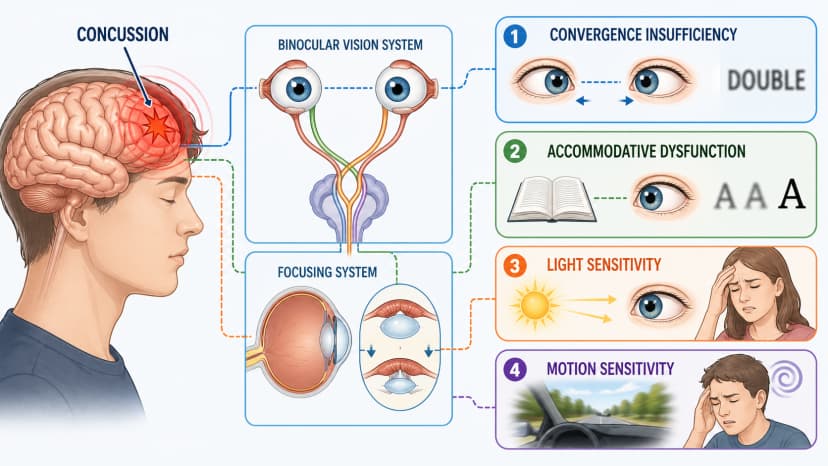
Post-traumatic vision syndrome refers to a constellation of visual symptoms that can occur after traumatic brain injury (TBI) or concussion. Even when the eyes and basic vision are normal, patients may experience significant visual symptoms because the brain's ability to process visual information has been disrupted.
Key Takeaways
- Visual symptoms after head injury-common but often overlooked
- Eyes may be normal-problem is in brain's visual processing
- Symptoms include: focusing problems, light sensitivity, reading difficulty
- Can significantly impact daily function
- Treatment available-vision therapy can help many patients
Understanding Post-Traumatic Vision Syndrome
Vision is more than just seeing clearly-the brain must coordinate eye movements, maintain focus, process visual information, and integrate vision with balance. Head injury can disrupt any of these functions without damaging the eyes themselves. This is why standard eye exams may be "normal" while patients still experience significant visual problems.
Symptoms
Common Visual Symptoms
Eye movement and coordination problems:
- Double vision
- Difficulty tracking moving objects
- Eyes feel like they don't work together
- Losing place while reading
Focusing problems:
- Blurred vision, especially near
- Difficulty shifting focus between distances
- Eye strain with close work
Visual sensitivity:
- Light sensitivity (photophobia)
- Visual overwhelm in busy environments
- Motion sensitivity
Reading difficulties:
- Words move or blur on page
- Losing place frequently
- Quick fatigue with reading
- Comprehension problems
Associated Symptoms
- Headache with visual tasks
- Dizziness and balance problems, including visual vertigo
- Nausea with visual activity
- Fatigue
- Difficulty concentrating
When Symptoms Occur
- May appear immediately after injury
- May develop days to weeks later
- Often persist after other concussion symptoms resolve
Underlying Problems
Convergence Insufficiency
- Difficulty turning eyes inward for near focus
- Common after TBI
- Causes double vision or strain at near
Accommodative Dysfunction
- Difficulty focusing at near distances
- Eyes don't adjust focus normally
- Causes blurred near vision
Oculomotor Dysfunction
- Poor control of eye movements
- Affects tracking, scanning, reading
- May cause oscillopsia
Visual Processing Problems
- Difficulty with visual-spatial tasks
- Trouble with visual memory
- Problems with visual attention
- Similar processing issues can occur with Long COVID vision problems
Diagnosis
Comprehensive Eye Examination
Beyond standard testing:
- Convergence and divergence testing
- Accommodative testing
- Eye movement (saccade and pursuit) evaluation
- Visual processing assessment
Symptoms Often Missed
Standard vision screening may miss these problems. A comprehensive examination by a provider familiar with TBI-related vision issues is recommended.
Related Evaluations
- Neurological assessment
- Vestibular evaluation (balance)
- Cognitive testing
- Occupational therapy assessment
Treatment
Vision Therapy
May help selected patients, especially with documented eye-teaming/focusing deficits
- Exercises to improve eye coordination
- Convergence training
- Accommodative exercises
- Oculomotor training
- Often requires specialized therapy
Glasses and Lenses
- Reading glasses (for accommodative problems)
- Prism glasses (for eye alignment or convergence problems)
- Tinted lenses (for light sensitivity-FL-41 often helpful)
- Blue-light filtering
Environmental Modifications
- Reduce screen time
- Adjust lighting
- Take frequent breaks
- Minimize visual clutter
- Use larger text
Lifestyle Modifications
- Adequate sleep
- Pacing of activities
- Gradual return to visually demanding tasks
- Stress management
Prognosis
Generally Favorable
- Most patients improve with treatment
- Evidence for vision therapy is strongest for specific deficits (such as convergence insufficiency), not all post-concussion visual symptoms
- Improvement may continue for months to years
- Some patients achieve full recovery
Factors Affecting Recovery
- Severity of initial injury
- Age
- Prior visual problems
- Participation in treatment
- Time since injury
Living with Post-Traumatic Vision Syndrome
Practical Tips
Reading:
- Use larger text
- Cover surrounding text
- Take frequent breaks
- Use audio alternatives when possible
Screen use:
- Reduce brightness
- Use dark mode
- Limit screen time
- Take regular breaks (20-20-20 rule)
Environment:
- Reduce clutter
- Control lighting
- Avoid busy visual environments when possible
Activities:
- Pace yourself
- Recognize warning signs of visual fatigue
- Rest when needed
Work and School
- May need accommodations
- Extended time for reading tasks
- Modified lighting
- Breaks as needed
- Audio alternatives for reading
Frequently Asked Questions
Why didn't my regular eye exam find anything wrong?
Standard eye exams focus on visual acuity (clarity) and eye health. Post-traumatic vision syndrome involves problems with eye coordination, focusing, and processing that require specialized testing to detect.
Will this get better on its own?
Some symptoms may improve spontaneously, but many patients have persistent symptoms that benefit from treatment. Vision therapy can significantly speed recovery and improve outcomes.
Is this permanent?
No-most patients improve with appropriate treatment, and many recover fully. Even those with persistent symptoms can usually be helped significantly.
Can I drive?
This depends on your specific symptoms. If you have double vision, significant visual field issues, or severe symptoms that impair visual processing, driving may not be safe until these improve. Discuss with your doctor.
Why is reading so hard if my vision is "normal"?
Reading requires precise eye movements, coordinated focusing, and sustained visual attention-all functions that can be disrupted after head injury. Your basic vision (acuity) may be fine, but the visual processing needed for reading is impaired.
References
Medical Disclaimer: This information is for educational purposes only and does not replace professional medical advice, diagnosis, or treatment. If you have concerns about visual symptoms after head injury, please consult a qualified healthcare provider.
Sources:
- Ciuffreda KJ, et al. Occurrence of oculomotor dysfunctions in acquired brain injury. Optom Vis Sci. 2007;84(2):155-167.
- Master CL, et al. Vision diagnoses are common after concussion in adolescents. Clin Pediatr. 2016;55(3):260-267.
- Neuro-Optometric Rehabilitation Association. Vision and TBI.
- Brain Injury Association of America. About Brain Injury.