

Carotid Ultrasound (Doppler)
An ultrasound test to evaluate blood flow in the neck arteries that supply the eyes and brain.
2 min read
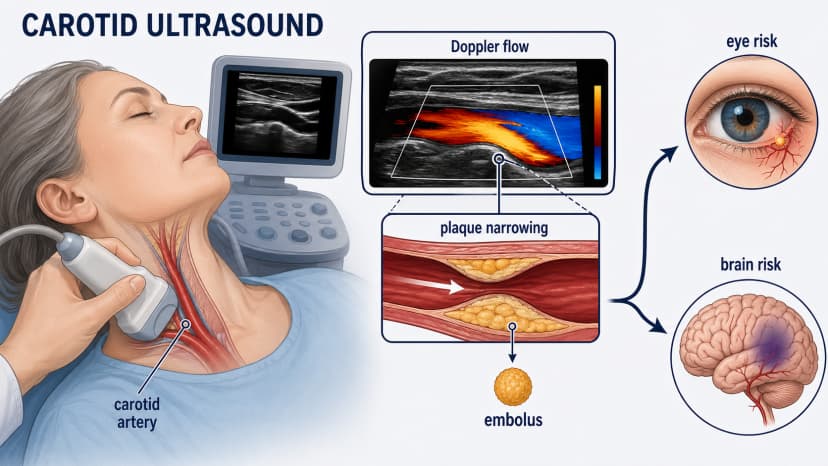
Carotid ultrasound uses sound waves to visualize the carotid arteries in the neck. It can detect narrowing (stenosis) or plaques that may affect blood flow to the eyes and brain.
Key Takeaways
- Non-invasive ultrasound of neck arteries
- Detects narrowing and plaques
- Important for transient vision loss
- No radiation or injection needed
- Takes about 30 minutes
Why It's Done
- Evaluate transient vision loss (amaurosis fugax)
- Assess for embolic source after retinal artery occlusion
- Screen for carotid disease
- Evaluate before certain surgeries
- Follow known carotid stenosis
What It Evaluates
Carotid Arteries
- Common carotid
- Internal carotid (supplies eye and brain)
- External carotid
- Bifurcation (where they divide)
What It Shows
- Degree of narrowing (stenosis percentage)
- Plaque presence and characteristics
- Blood flow velocity
- Direction of flow
What to Expect
Before the Test
- No special preparation
- Can eat and drink normally
- Take usual medications
During the Test
- Lie on back with neck extended
- Gel applied to neck
- Ultrasound probe moved along neck
- May hear "whooshing" (blood flow sounds)
- Completely painless
- Takes 20-30 minutes
After the Test
- Resume normal activities
- No recovery time needed
- Results available quickly
Results and Next Steps
Normal
- No significant narrowing
- Normal blood flow
Significant Stenosis
- May need further imaging (CTA, MRA)
- Consider medical management or intervention
- Depends on degree and symptoms
Importance in Eye Disease
Carotid disease can cause:
- Temporary vision loss in one eye
- Retinal artery occlusion
- Ocular ischemic syndrome
- Important to identify and treat
Medical Disclaimer: This information is for educational purposes only and does not replace professional medical advice.
Sources:
- MedlinePlus. Carotid Duplex Ultrasound.
- MedlinePlus. Carotid Artery Disease.
Was this article helpful?