

Microvascular Decompression
Brain surgery for selected hemifacial spasm patients, separating an irritating blood vessel from the facial nerve.
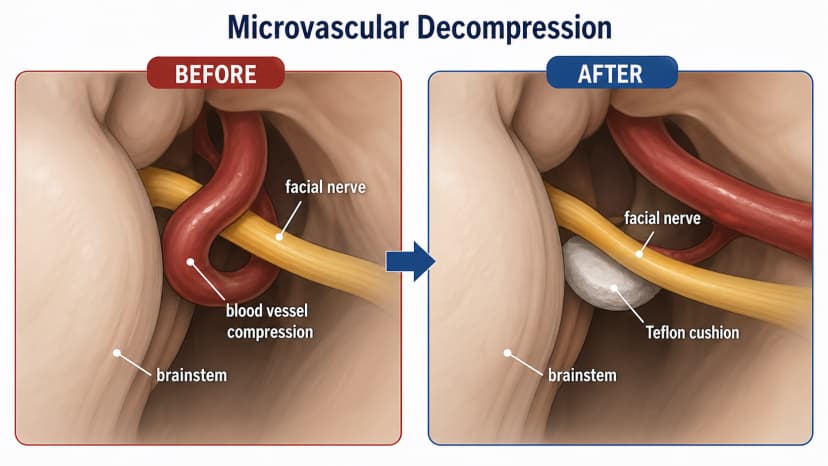
Microvascular decompression (MVD) is the surgical option for hemifacial spasm when symptoms and imaging suggest that a blood vessel is compressing the facial nerve near the brainstem. The operation places a small cushion between the vessel and the nerve. If the diagnosis and anatomy are appropriate, spasms can improve substantially and sometimes permanently. Because this is intracranial surgery, patient selection is strict.
Key Takeaways
- May provide long-lasting relief for carefully selected hemifacial spasm patients
- Performed under general anesthesia through a small opening behind the ear
- Places a cushion between vessel and nerve
- Often effective when imaging and symptoms fit, but usually considered after less invasive options
- Considered when repeat Botox is not enough, not tolerated, or not desired
How It Works
Hemifacial spasm often begins where the facial nerve exits the brainstem. A nearby artery can irritate the nerve with each heartbeat. During MVD, the surgeon moves the vessel away and places soft padding, commonly Teflon, so the nerve is no longer compressed.
Who Is a Candidate
- Clear diagnosis of hemifacial spasm
- Symptoms severe enough to justify neurosurgery
- Botox injections are not working well enough, are not tolerated, or are not wanted long-term
- General health is good enough for anesthesia and recovery
- MRI or MRA may show vascular contact or compression that supports surgical planning
The Procedure
Before Surgery
- MRI/MRA helps the neurosurgeon map the facial nerve and nearby vessels
- General health evaluation and anesthesia review
- Blood thinners may need adjustment, but only with the prescribing clinician involved
- Hearing evaluation may be performed because hearing risk, while uncommon, is real
During Surgery
- General anesthesia
- Small incision behind the ear
- Small craniotomy to access the nerve near the brainstem
- Identification of the compressing vessel
- Placement of a small cushion between vessel and nerve
- Often takes 2-3 hours
After Surgery
- Close monitoring at first, sometimes in an ICU setting
- Hospital stay commonly 2-5 days
- Fatigue, incision soreness, and temporary balance symptoms can happen early
- Recovery takes weeks; spasm relief may be immediate or delayed
Success Rates
Many series report spasm relief in the 80-90% range for well-selected patients. Some people improve right away; others notice gradual improvement over weeks or months. A small percentage relapse or have incomplete relief.
Risks
- Hearing loss, often quoted around 1-5% depending on series and case complexity
- Facial weakness, temporary or rarely permanent
- CSF leak
- Stroke, rare but serious
- Infection or bleeding
- Standard anesthesia risks
Compared to Botox
| MVD Surgery | Botox Injections |
|---|---|
| Potentially long-lasting relief | Ongoing treatment usually needed |
| One-time procedure | Every 3-4 months |
| Surgical risks | Lower procedural burden; temporary weakness, dry eye, ptosis, diplopia, and rare distant-spread effects can occur |
| Hospital stay | Office procedure |
Medical Disclaimer: This information is for educational purposes only and does not replace professional medical advice.
Sources:
- MedlinePlus. Trigeminal Neuralgia.
- American Academy of Ophthalmology EyeWiki. Hemifacial Spasm.