

Hemifacial Spasm
Involuntary twitching and spasms on one side of the face, usually caused by a blood vessel pressing on the facial nerve.
Hemifacial spasm (HFS) is a neuromuscular condition causing involuntary twitching, contractions, and spasms of the muscles on one side of the face. Unlike blepharospasm, it affects one side only and involves muscles beyond just the eyelids. It's most commonly caused by a blood vessel compressing the facial nerve.
Key Takeaways
- One side of face only-key distinguishing feature
- Usually caused by blood vessel pressing on facial nerve
- Starts around eye, may spread to lower face
- Usually benign after appropriate evaluation, but it can be bothersome
- Treatment options: botulinum toxin injections or surgery
Understanding Hemifacial Spasm
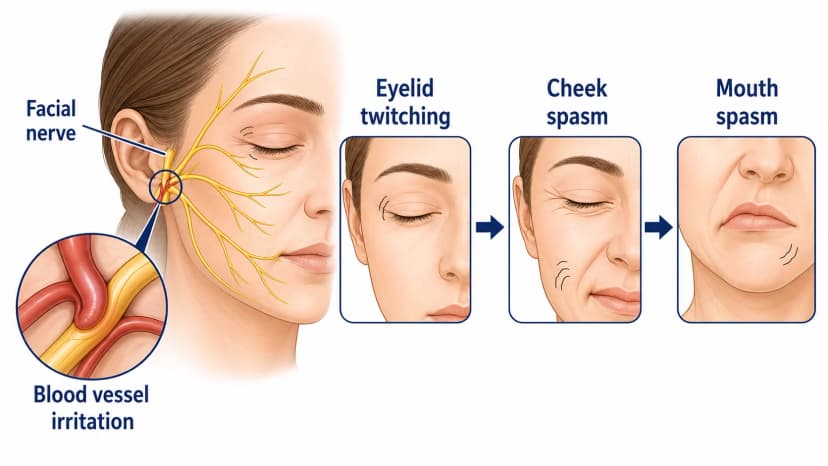
The facial nerve (seventh cranial nerve) controls the muscles of facial expression. When this nerve is irritated, usually by compression from a nearby blood vessel, the muscles it controls start firing involuntarily, causing the characteristic twitching and spasms.
Symptoms
Typical Progression
- Starts around the eye-twitching of eyelid
- Spreads downward-to cheek, mouth, jaw muscles
- May involve neck muscle (platysma)
- Always same side of face
Characteristics
- Irregular, involuntary muscle contractions
- Twitching, pulling, spasms
- May cause eye to squeeze shut (similar to ptosis in appearance)
- Mouth may pull to the side
- Present during sleep (unlike blepharospasm)
- Triggered by stress, fatigue
- May affect hearing (ear muscle involvement)
- Often causes light sensitivity from eye closure
Severity Range
- Mild: occasional twitching, minimally bothersome
- Moderate: frequent spasms affecting function
- Severe: near-constant contractions, significantly disabling
Causes
Primary (Most Common)
Vascular compression
- Blood vessel (usually artery) pressing on facial nerve
- Where nerve exits brainstem
- Causes abnormal nerve signals
- Anterior inferior cerebellar artery most common culprit
Secondary (Less Common)
- Tumor near facial nerve
- Bell's palsy sequela
- Brainstem lesions (stroke, MS)
- Arteriovenous malformation
- After skull base surgery
Diagnosis
Clinical Features
- Unilateral facial twitching/spasms
- Typical spread pattern (eye to lower face)
- No other neurological abnormalities
Differentiating From Other Conditions
| Condition | Key Features |
|---|---|
| Hemifacial spasm | One side, includes lower face, persists during sleep |
| Blepharospasm | Both eyes, eyelids only, resolves during sleep |
| Facial myokymia | Continuous undulating movement, not spasms |
| Eyelid myokymia | Brief twitching, one lid, benign, temporary |
| Tics | Suppressible, may have premonitory urge |
Imaging
MRI brain with special sequences
- FIESTA/CISS sequences show nerve-vessel relationship
- Rules out tumor or other structural cause
- May see vessel loop at nerve root entry zone
Treatment
Botulinum Toxin Injections
First-line treatment for most patients
- Injected into affected facial muscles
- Weakens muscles to reduce spasms
- 85-95% get significant improvement
- Lasts 3-4 months
- Need repeat injections
- Well tolerated, low risk
Side effects:
- Temporary facial weakness
- Droopy mouth corner
- Dry eye
- Bruising
Microvascular Decompression Surgery
Definitive treatment option
- Surgical separation of blood vessel from facial nerve
- Places cushion between vessel and nerve
- Potentially curative (no more injections needed)
- 85-90% success rate
Considerations:
- Brain surgery with general anesthesia
- Small risks (hearing loss, facial weakness, rare serious complications)
- Usually reserved for:
- Patients who want potential cure
- Botox failures or intolerance
- Younger patients with long expected lifespan
Oral Medications
- Generally not very effective
- Sometimes tried for mild cases
- Carbamazepine, baclofen, gabapentin
- May reduce frequency somewhat
Living with Hemifacial Spasm
Practical Tips
- Manage stress and fatigue
- Get adequate sleep
- Avoid excessive caffeine
- Wear sunglasses to reduce embarrassment
- Be open with others about the condition
Driving
- Driving safety depends on severity, frequency, eyelid closure, and clinician guidance
- Discuss driving with your doctor if spasms close the eye or distract you
Social Impact
- Can be embarrassing or socially uncomfortable
- Most people cope well with treatment
- Support groups available
Prognosis
With Treatment
- Most achieve good control with Botox
- Surgery can be curative
- Quality of life usually good
Without Treatment
- May worsen over time
- Rarely remits spontaneously
- Usually benign after secondary causes are excluded, but it can be bothersome
Natural History
- Usually remains one-sided; bilateral or changing symptoms should prompt reassessment
- Doesn't cause permanent facial weakness
- Usually benign after appropriate evaluation (but affects quality of life)
Frequently Asked Questions
Is hemifacial spasm dangerous?
Hemifacial spasm is usually benign after appropriate evaluation excludes secondary causes. However, it can significantly affect quality of life through embarrassment and functional impairment. The underlying cause is often vascular compression, but tumors, brainstem lesions, and other secondary causes need to be considered when symptoms or exam findings are atypical.
Will it spread to the other side of my face?
Hemifacial spasm usually remains one-sided. If you develop spasms on the other side or the pattern changes, that should prompt re-evaluation for another condition such as blepharospasm or a secondary cause.
Should I have surgery or Botox?
This is a personal decision weighing the desire for potentially long-lasting surgical relief against the lower procedural burden of ongoing injections. Botulinum toxin injections are effective for many patients but can still cause temporary weakness, dry eye, ptosis, or other side effects. Younger patients with severe symptoms often consider surgery.
Can hemifacial spasm go away on its own?
Rarely. Spontaneous remission occurs in less than 10% of cases. Most patients need ongoing treatment.
What's the difference between this and a facial tic?
Tics are partially voluntary-you feel an urge and can suppress them temporarily. Hemifacial spasm is completely involuntary and cannot be suppressed by willpower. Tics are also often associated with other movements or vocalizations.
How do I find a specialist for hemifacial spasm?
Hemifacial spasm is best managed by a neuro-ophthalmologist with experience in both botulinum toxin injections and evaluating for surgical candidacy. Hashemi Eye Care provides comprehensive hemifacial spasm management including Botox treatment and surgical referral coordination.
References
Medical Disclaimer: This information is for educational purposes only and does not replace professional medical advice, diagnosis, or treatment. If you have concerns about hemifacial spasm or any symptoms, please consult a qualified healthcare provider.
Sources:
- Tan EK, Jankovic J. Hemifacial spasm. UpToDate. 2024.
- Barker FG, et al. Microvascular decompression for hemifacial spasm. J Neurosurg. 1995;82(2):201-210.
- Wang A, Jankovic J. Hemifacial spasm: clinical findings and treatment. Muscle Nerve. 1998;21(12):1740-1747.
- American Academy of Ophthalmology EyeWiki. Hemifacial Spasm.
- StatPearls [Internet]. Hemifacial Spasm.