

Chemical Eye Burns
Eye injury from exposure to acids or alkalis requiring immediate irrigation. Learn emergency treatment and why alkali burns are more dangerous.
Chemical eye burns occur when the eye is exposed to acids, alkalis, or other caustic substances. This is a true ocular emergency-immediate irrigation can mean the difference between full recovery and permanent blindness. Alkali burns (from lye, oven cleaner, cement, etc.) are particularly dangerous because they continue to penetrate and damage the eye.
Key Takeaways
- Ocular emergency-irrigate immediately, before anything else
- Alkali burns are more dangerous than acid burns (deeper penetration)
- Immediate irrigation saves vision-use any clean water available
- Continue irrigating for at least 30 minutes (longer for alkali burns, until pH normalizes)
- Seek emergency care while irrigating or immediately after
- Long-term complications can occur even after apparent recovery
Emergency First Aid
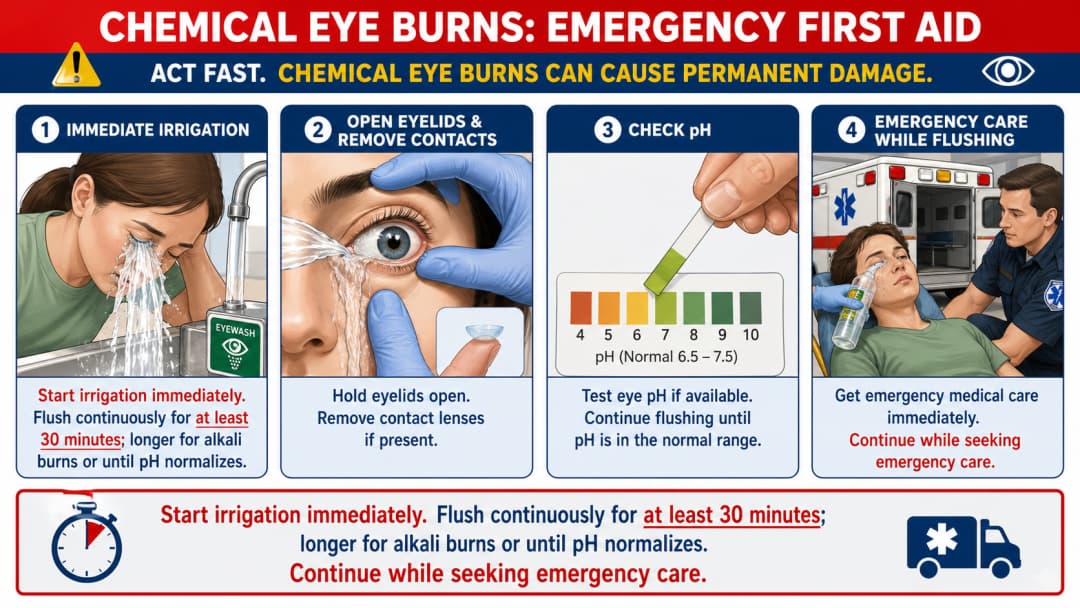
START IRRIGATION IMMEDIATELY
Do not wait. Do not try to find the "right" solution. Do not look up information first.
- Use any clean water (tap water, bottled water, saline)
- Flush the eye continuously for at least 30 minutes (longer for alkali, until pH normalizes)
- Hold the eyelids open (they'll want to close)
- Remove contact lenses if present (during irrigation)
- Call 911 or go to ER while irrigating or immediately after
Irrigation in the first seconds to minutes is the single most important factor in outcome.
How to Irrigate
- If available, use an eyewash station
- Otherwise, use a sink, shower, hose, or water bottle
- Position head with injured eye down (so chemical doesn't run into good eye)
- Pour water continuously over the open eye
- Have patient look in all directions while irrigating
- Continue for at least 30 minutes (longer for alkali burns)
- Remove any visible particulate matter if present
Types of Chemical Burns
Alkali Burns (More Dangerous)
Common Sources:
- Lye (drain cleaners)
- Ammonia (cleaning products)
- Lime and cement
- Oven cleaner
- Fireworks
- Industrial chemicals
Why They're Worse:
- Penetrate deeply into tissues (saponification)
- Continue damaging tissue even after surface exposure ends
- Can reach inside of eye (anterior chamber) rapidly
- Damage may appear less severe initially than it is
Acid Burns
Common Sources:
- Battery acid (sulfuric acid)
- Pool chemicals (muriatic acid)
- Vinegar (acetic acid)
- Rust removers
- Some cleaning products
Behavior:
- Tend to cause surface damage
- Proteins coagulate, creating a barrier
- Usually don't penetrate as deeply
- Still serious-high concentrations cause severe damage
Other Irritants
- Solvents
- Detergents
- Pepper spray
- Some cosmetics
These cause irritation but typically less severe than true acid/alkali burns.
Severity Classification
Grade I (Best Prognosis)
- No limbal ischemia (white area around cornea)
- No corneal haze (or very mild)
- Damage limited to conjunctiva
Grade II
- Some limbal ischemia (<1/3 of limbus)
- Corneal haze but iris visible
Grade III
- Significant limbal ischemia (1/3 to 1/2 of limbus)
- Total corneal haze (no iris details visible)
Grade IV (Worst Prognosis)
- Extensive limbal ischemia (>1/2 of limbus)
- Cornea opaque
- Severe damage to limbal stem cells
Symptoms
Immediate
- Severe pain (though severe burns may have less pain due to nerve damage)
- Tearing
- Redness
- Blurred vision
- Inability to open eyes (blepharospasm)
- Foreign body sensation
- Swelling of eyelids
Warning Signs of Severe Burn
- White, blanched appearance to eye surface
- Unable to see iris/pupil clearly
- Severe vision loss
- Lids swollen shut
Diagnosis
Emergency Room Evaluation
- History: What chemical? How long exposure? Irrigation done?
- Visual acuity check
- pH testing of eye (target: 7.0-7.4)
- Slit lamp examination
- Assessment of:
- Corneal clarity
- Limbal ischemia (blood vessel damage at cornea edge)
- Conjunctival damage
- Intraocular pressure (may be elevated)
- Anterior chamber reaction
Why pH Matters
- Normal eye pH: 7.0-7.4
- Must irrigate until pH normalizes
- Continue irrigation and recheck pH 5-10 minutes after stopping
- Particularly important for alkali burns (may need prolonged irrigation)
Treatment
Acute Phase (First 1-2 Weeks)
Continued Irrigation:
- In ER: liters of saline through a lens device
- Continue until pH normal and stable
Medications:
- Topical antibiotics (prevent infection)
- Cycloplegics (reduce pain from ciliary spasm)
- Artificial tears/lubricants (frequent)
- Vitamin C drops (may help healing)
- Possibly topical steroids (carefully-can impair healing)
- Oral pain medication
- Tetanus prophylaxis if not current
Remove Retained Material:
- Sweep fornices (pockets behind lids) for particles
- Especially important with cement or powder exposures
Pressure Management:
- IOP may be elevated
- Treat with pressure-lowering drops
Intermediate Phase
- Continue lubrication
- Treat/prevent complications
- May need amniotic membrane transplant for severe cases
- Scleral lens for surface protection
Long-Term Management
Depending on severity:
- Treatment of persistent epithelial defects
- Management of scarring
- Treatment of glaucoma if developed
- Possible corneal transplant
- Limbal stem cell transplant (for severe cases)
- Lid surgery if needed
Complications
Acute
- Corneal ulceration
- Infection
- Elevated intraocular pressure
- Severe inflammation
Chronic
- Corneal scarring (opacity)
- Limbal stem cell deficiency (surface doesn't heal properly)
- Symblepharon (lids stuck to eyeball)
- Dry eye (severe)
- Glaucoma
- Cataract
- Persistent epithelial defects (cornea won't heal)
- Chronic inflammation
- Blindness
Prognosis
Factors Affecting Outcome
- Type of chemical (alkali worse than acid)
- Duration of exposure
- Speed of irrigation (most important factor you can control)
- Amount of irrigation
- Severity grade at presentation
- Limbal involvement (affects healing)
Outcomes by Grade
| Grade | Prognosis |
|---|---|
| I | Usually excellent recovery |
| II | Good, may have some scarring |
| III | Fair, likely significant scarring |
| IV | Poor, often severe vision loss |
Prevention
At Home
- Store chemicals safely, out of reach of children
- Wear safety glasses when using caustic chemicals
- Read product labels
- Never mix cleaning chemicals
- Keep chemicals in original containers
At Work
- Use required personal protective equipment
- Know location of eyewash stations
- Follow safety protocols
- Ensure adequate ventilation
- Know emergency procedures
Eyewash Stations
- Should provide 15 minutes of continuous flow
- Should be within 10-second walk
- Must be maintained and tested regularly
- Know the location before an emergency
Frequently Asked Questions
Should I neutralize the chemical with an opposite pH?
No. Do not try to neutralize. The heat generated by neutralization reactions can cause additional damage. Copious irrigation with water or saline is the correct approach.
Is milk better than water for irrigation?
No. Water is fine and usually more accessible. The priority is immediate, copious irrigation-use whatever clean water source is available. Don't waste time looking for something "better."
How long should I really irrigate?
At least 20-30 minutes for most exposures. For alkali burns, longer may be needed. pH should be checked and irrigation continued until normal. At home, irrigate as long as possible while arranging transport to ER.
My eye feels better-can I stop irrigating?
No. Continue irrigating for the full recommended time. Pain relief doesn't mean the chemical is gone. Alkali burns in particular can feel better initially while still causing deep damage.
Will I be able to see again?
This depends on the severity of the burn. Mild burns often recover completely. Severe burns can cause permanent vision loss. Early, aggressive irrigation and proper treatment give the best chance of good outcome.
What if I don't know what chemical it was?
Irrigate anyway. The treatment is the same-immediate, copious irrigation. If you have the container, bring it to the ER (safely) so they know what you were exposed to.
References
Medical Disclaimer: This information is for educational purposes only and does not replace professional medical advice, diagnosis, or treatment. Chemical eye burns are emergencies-irrigate immediately and seek emergency care.
Sources:
- American Academy of Ophthalmology. Chemical Eye Burns.
- Dua HS, et al. Chemical eye injury: pathophysiology, assessment and management. Eye. 2020;34(11):2001-2019.
- Wagoner MD. Chemical injuries of the eye: current concepts in pathophysiology and therapy. Surv Ophthalmol. 1997;41(4):275-313.
- American Academy of Ophthalmology EyeWiki. Chemical Injury of the Conjunctiva and Cornea.