

Cortical Cataract
A type of age-related cataract with spoke-like opacities in the outer lens cortex, causing glare and light scatter. Learn about symptoms and treatment.
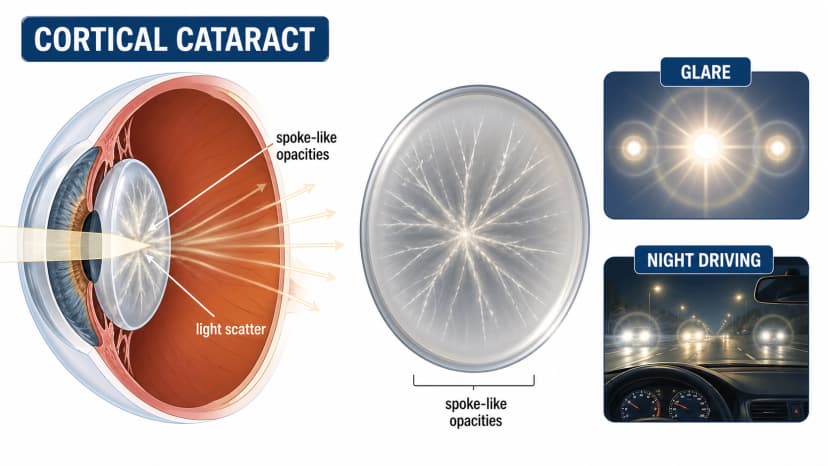
A cortical cataract develops in the outer layer (cortex) of the lens, starting at the edges and extending inward like spokes of a wheel. Unlike nuclear cataracts that primarily blur distance vision, cortical cataracts are notorious for causing glare and light scatter, particularly in bright conditions.
Key Takeaways
- Affects the outer cortex of the lens (around the edges)
- "Spoke-like" opacities extending toward center
- Main symptom: glare and light sensitivity
- Often associated with diabetes and UV exposure
- May coexist with nuclear and posterior subcapsular cataracts
- Treatment: cataract surgery when symptoms significant
What Is a Cortical Cataract?
How Cortical Cataracts Form
- Opacities begin at the lens periphery (edge)
- Extend inward like spokes on a wheel
- Scatter light rather than blocking it uniformly
- Can eventually reach the central visual axis
Symptoms
Hallmark: Glare and Light Scatter
Cortical cataracts are particularly known for causing glare.
The spoke-like opacities scatter light entering the eye, creating:
- Glare from oncoming headlights
- Difficulty in bright sunlight
- "Starbursts" around lights
- Hazy vision in bright conditions
Other Symptoms
- Reduced contrast sensitivity
- Difficulty distinguishing objects against background
- Monocular double vision (in some cases)
- Halos around lights
Causes and Risk Factors
Strong Associations
- Diabetes-strongly linked to cortical cataracts
- UV light exposure-protective sunglasses may reduce risk
- Age-most common cause
- Smoking
- Family history
Diagnosis
Slit lamp examination
- Classic "spoke-like" or wedge-shaped opacities
- Begin at lens equator (edge)
- Point toward center
- Best seen with retroillumination
Glare Testing
- Tests vision under bright light conditions
- Better reflects real-world visual difficulty
- Helpful when deciding on surgery
Treatment
Non-Surgical Management
For mild cortical cataracts:
- Polarized sunglasses for outdoor glare
- Wide-brimmed hats
- Anti-glare coatings on glasses
Cataract Surgery
Surgery is recommended when glare significantly impairs function. Cataract surgery removes the clouded lens and replaces it with a clear artificial lens with excellent results.
Frequently Asked Questions
Why is my glare so bad when my vision test is good?
Standard visual acuity is tested under ideal lighting. Cortical cataracts scatter light, causing significant glare that isn't captured by standard testing. Your real-world symptoms better reflect your impairment.
Does diabetes make cataracts worse?
Yes. Diabetes accelerates cataract formation, particularly cortical cataracts. Good blood sugar control may slow progression.
Can UV-blocking sunglasses prevent cataracts?
UV protection may reduce the risk of cortical cataracts. Sunglasses should block 99-100% of UV-A and UV-B rays.
References
Medical Disclaimer: This information is for educational purposes only and does not replace professional medical advice, diagnosis, or treatment. Discuss your cataract and treatment options with your eye care provider.
Sources:
- American Academy of Ophthalmology. Cataracts.
- Klein BE, et al. Incidence of age-related cataract over a 10-year interval: the Beaver Dam Eye Study. Ophthalmology. 2002;109(11):2052-2057.
- West SK, et al. Sunlight exposure and risk of lens opacities. JAMA. 1998;280(8):714-718.
- National Eye Institute. Cataracts.