

Nuclear Cataract
The most common type of age-related cataract, affecting the center of the lens. Learn about symptoms, including 'second sight,' and treatment.
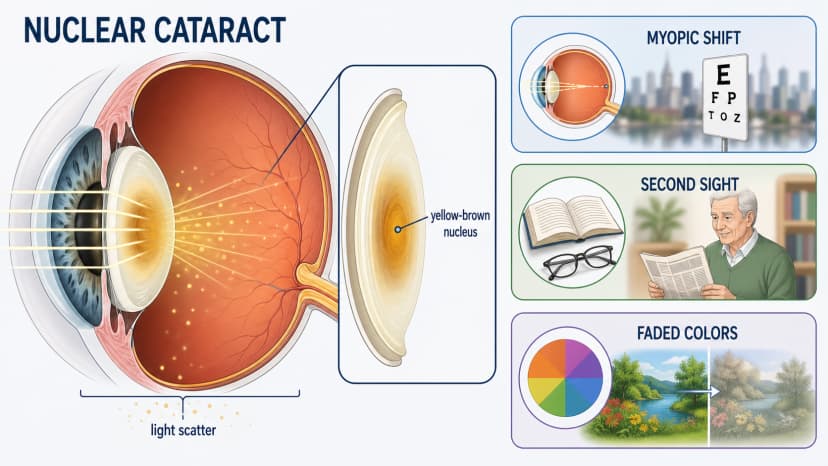
A nuclear cataract is the most common type of age-related cataract, developing in the central portion (nucleus) of the lens. It causes gradual yellowing and hardening of the lens center, leading to blurred distance vision, color perception changes, and sometimes a temporary improvement in near vision called "second sight." Nuclear cataracts progress slowly and eventually require surgical treatment.
Key Takeaways
- Most common type of age-related cataract
- Affects the center (nucleus) of the lens
- Causes yellowing of vision and distance blur
- "Second sight"-temporary improvement in near vision (due to myopic shift)
- Slowly progressive-over years
- Treatment: cataract surgery when vision significantly affected
What Is a Nuclear Cataract?
Lens Anatomy
The eye's lens has layers like an onion:
- Nucleus: central, oldest lens fibers
- Cortex: surrounding newer fibers
- Capsule: outer covering
Nuclear Cataract Development
As we age:
- The nucleus becomes denser and harder (nuclear sclerosis)
- Proteins in the nucleus clump and discolor
- The lens becomes increasingly yellow, then brown
- Light transmission decreases
- Vision gradually blurs
Symptoms
Early Symptoms
- Gradual blur of distance vision
- Yellowing of vision (often not noticed until cataract removed)
- Faded colors-colors appear less vibrant
- Difficulty with road signs at night
- Need brighter light for reading
The "Second Sight" Phenomenon
Some patients experience temporary improvement in reading vision.
As the nuclear cataract develops, it changes the lens's focusing power, making you more nearsighted (myopic shift). This can temporarily improve near vision-you may suddenly read without glasses that you previously needed. This "second sight" is temporary and doesn't mean the cataract is improving.
Late Symptoms
- Significant distance blur
- Difficulty driving, especially at night
- Brown-tinged vision (brunescent cataract)
- Difficulty distinguishing blue and purple colors
- Double vision in one eye (rare)
- Reading requires very bright light
Progression
Timeline
Nuclear cataracts typically progress slowly over years:
- Early: Mild density, minimal visual impact
- Moderate: Noticeable blur, often needs surgery considered
- Advanced (Brunescent): Dense, brown; surgery more challenging
What Affects Progression
- Age: Primary factor
- UV exposure: May accelerate
- Smoking: Increases risk and progression
- Diabetes: May accelerate
- Steroid use: Can worsen
Diagnosis
Eye Examination
Visual acuity testing:
- Measures how cataract affects vision
- Distance vision often more affected than near
Slit lamp examination:
- Direct visualization of lens
- Grading of nuclear density
- Assessment of color (yellow vs. brown)
Refraction:
- May show increasing nearsightedness (myopic shift)
- New glasses may temporarily help
Impact on Daily Life
Activities Affected
- Driving: Especially at night; glare from oncoming headlights
- Reading street signs: Distance blur
- Color perception: Difficulty distinguishing blues/purples
- Watching TV: Blurred at distance
- Recognizing faces at a distance
When Surgery Is Considered
Surgery is recommended when the cataract:
- Significantly impairs daily activities
- Makes driving unsafe
- Affects quality of life
- Prevents management of other eye conditions
- Patient desires improvement
There's no "right" time-decision is based on your symptoms and needs.
Treatment
Non-Surgical Management
For early cataracts:
- Stronger glasses or updated prescription
- Better lighting for tasks
- Anti-glare coatings on glasses
- Magnification for reading
- Avoiding night driving if problematic
Cataract Surgery
Cataract surgery is the only definitive treatment.
The clouded lens is removed and replaced with a clear artificial intraocular lens (IOL). Surgery is highly successful with low risk.
Special Considerations for Dense Nuclear Cataracts
Very dense (brunescent) nuclear cataracts:
- Surgery may be more challenging
- Longer ultrasound time needed
- Slightly higher risk
- Still very successful in experienced hands
After Cataract Surgery
Visual Recovery
- Vision often improved within days
- Full healing takes several weeks
- Colors appear much brighter
- Distance vision typically excellent
- May still need reading glasses
Frequently Asked Questions
Can a nuclear cataract be reversed?
No. There is no medication, drop, or therapy that reverses cataract formation. Surgery is the only treatment to remove the clouded lens.
How do I know when I need surgery?
Surgery is recommended when the cataract significantly affects your quality of life or ability to perform important activities. There's no specific visual acuity that requires surgery-it's based on your symptoms and needs.
Why did my near vision suddenly improve?
This "second sight" occurs because the cataract changes your lens's focusing power, making you temporarily more nearsighted. It's not a sign of improvement-the cataract is actually progressing.
References
Medical Disclaimer: This information is for educational purposes only and does not replace professional medical advice, diagnosis, or treatment. Discuss your cataract and treatment options with your eye care provider.
Sources: