

Diabetic Macular Edema (DME)
Fluid accumulation in the macula from diabetes, causing blurred central vision. Learn about symptoms, diagnosis, and highly effective treatments.
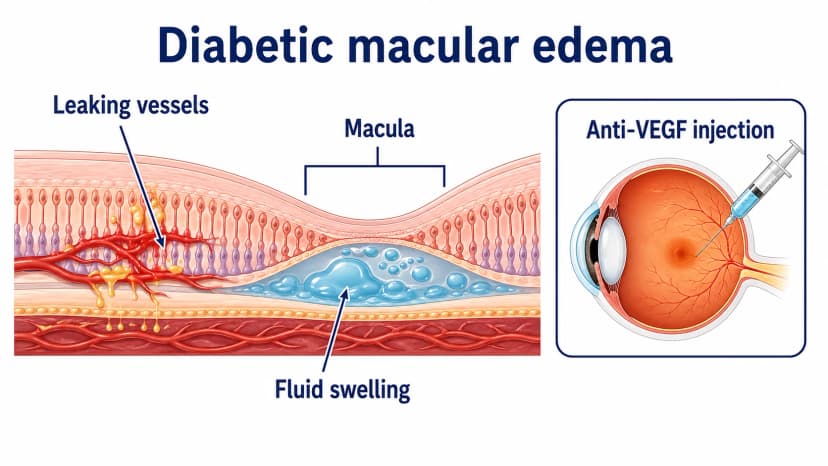
Diabetic macular edema (DME) is the accumulation of fluid in the macula (the central part of the retina responsible for sharp, detailed vision) due to leaking blood vessels damaged by diabetes. It's the most common cause of vision loss in people with diabetic retinopathy and can occur at any stage of the disease. The good news: DME is highly treatable with modern therapies.
Key Takeaways
- Fluid accumulates in the macula from leaking blood vessels
- Most common cause of vision loss in diabetic retinopathy
- Can occur at any stage-even with mild diabetic retinopathy
- Causes blurred central vision
- Highly treatable-anti-VEGF injections are very effective
- Early treatment = better outcomes
What Is the Macula?
Why It Matters
The macula is:
- The central 5-6 mm of the retina
- Contains the fovea (center of sharpest vision)
- Responsible for:
- Reading
- Recognizing faces
- Driving
- Fine detail work
- Color perception
When the macula is swollen with fluid, these functions are impaired.
How DME Develops
The Mechanism
- Diabetes damages blood vessel walls
- Vessels become leaky (breakdown of blood-retinal barrier)
- Fluid and proteins leak into the retina
- Fluid accumulates in the macula
- The macula swells
- Retinal cells don't function properly
- Vision becomes blurred
Why DME Causes Vision Loss
- Fluid separates the retinal layers
- Photoreceptors (light-sensing cells) are displaced
- Normal retinal architecture is disrupted
- If prolonged, lasting photoreceptor damage can occur
Symptoms
Early DME
- May have no symptoms
- Detected only on OCT imaging
- Vision may be normal
Symptomatic DME
- Blurred central vision
- Difficulty reading (small print)
- Difficulty recognizing faces
- Colors appear washed out
- Distorted vision (straight lines appear wavy)
- Fluctuating vision (worse when blood sugar is high)
What You Might Notice
- Need more light to read
- Can't see fine details
- Central blur that glasses don't correct
- "Spot" in central vision
Types of DME
Center-Involving DME
- Fluid directly affects the fovea (center of macula)
- More significant impact on vision
- Treatment typically recommended
Non-Center-Involving DME
- Fluid near but not at the fovea
- May have better vision
- May be observed or treated depending on severity
Clinically Significant Macular Edema (CSME)
A clinical definition (before OCT was available):
- Thickening within 500 microns of fovea
- Hard exudates within 500 microns of fovea with adjacent thickening
- Thickening > 1 disc area within 1 disc diameter of fovea
Now largely replaced by OCT-based assessment.
Diagnosis
Optical Coherence Tomography (OCT)
OCT is essential for DME diagnosis and management:
- Non-invasive imaging
- Cross-sectional view of retina
- Shows fluid within retinal layers
- Measures retinal thickness
- Guides treatment decisions
- Monitors treatment response
Dilated Fundus Exam
- Visual inspection of macula
- May see thickening, hard exudates
- Less sensitive than OCT
Fluorescein Angiography
- Shows leaking blood vessels
- Shows extent of ischemia
- Not always needed but helpful in some cases
Visual Acuity Testing
- Measures impact on vision
- Important for treatment decisions
- Monitors treatment response
Treatment
Anti-VEGF Injections (First-Line)
Anti-VEGF therapy has revolutionized DME treatment:
- Aflibercept (Eylea)
- Ranibizumab (Lucentis)
- Bevacizumab (Avastin) (off-label but widely used)
- Faricimab (Vabysmo) and longer-interval anti-VEGF options for selected patients
These block VEGF, reducing vessel leakage and swelling.
How They Work:
- Injected into the vitreous cavity
- Block VEGF (a growth factor causing leakage)
- Reduce macular edema
- Improve vision in many patients
Treatment Schedule:
- Monthly initially (typically 4-6 injections)
- Then extended based on response
- Many patients need ongoing treatment
- Some can stop after achieving stability
Effectiveness:
- Roughly one-third to two-fifths of patients gain 3 or more lines of vision in major trials, depending on baseline vision, agent, and adherence
- Most patients maintain or improve vision
- Better outcomes with earlier treatment
Steroid Treatments
Options:
- Dexamethasone implant (Ozurdex)-lasts ~3 months
- Fluocinolone implant (Iluvien)-lasts up to 3 years
- Triamcinolone injection
When Used:
- Patients who don't respond to anti-VEGF
- Pseudophakic patients (already had cataract surgery)
- When less frequent injections desired
Side Effects:
- Cataract progression (high risk)
- Elevated eye pressure (needs monitoring)
- Infection (rare)
Laser Photocoagulation
Focal/Grid Laser:
- Applied to leaking vessels/areas
- Was standard before anti-VEGF era
- Still used in some cases
- May be combined with injections
- Less effective than anti-VEGF at improving vision
Systemic Control
Always important regardless of eye treatment:
- Blood sugar control (A1C goal <7% for most)
- Blood pressure control
- Lipid management
- These affect treatment response and progression
If you're unsure whether your eye problems are from diabetes, blood pressure, or both, the answer is often that both contribute and both need to be managed.
Treatment Outcomes
What to Expect
With Treatment:
- Majority maintain or improve vision
- Improvement often seen within weeks
- May need years of treatment
- Better outcomes with earlier treatment
Without Treatment:
- Progressive vision loss likely
- Chronic edema causes permanent damage
- Risk of significant visual disability
Factors Affecting Response
- Baseline vision (better starting vision = better outcome)
- Duration of DME (chronic DME responds less well)
- Systemic control (blood sugar, blood pressure)
- Adherence to treatment schedule
- Presence of ischemia
Living with DME
Treatment Commitment
- Expect multiple visits and injections
- Treatment is ongoing for many
- Missing appointments affects outcomes
- Plan for the time commitment
Maximizing Outcomes
- Keep all appointments
- Get injections on schedule
- Control blood sugar
- Control blood pressure
- Take all prescribed medications
- Report vision changes
Coping Strategies
- Use adequate lighting for reading
- Use magnification if helpful
- Large-print materials
- Audiobooks as alternative
- Low vision aids if needed
Frequently Asked Questions
How many injections will I need?
This varies greatly. Initially, you'll likely need monthly injections. After the macula stabilizes, intervals can often be extended. Some patients need treatment for years; others achieve lasting stability. Your doctor will adjust based on your response.
Do the injections hurt?
Most patients tolerate injections well. Numbing drops and antiseptic are used. You may feel pressure but usually not significant pain. Any discomfort is brief. The benefit of preserving vision outweighs the temporary discomfort.
Will my vision get better?
Many patients experience significant improvement in vision. In major trials, roughly one-third to two-fifths gained 3 or more lines on the eye chart, while many others stabilized without further loss. The sooner treatment starts and the more consistently it is maintained, the better the outcomes.
What if I don't get treated?
Without treatment, DME typically progresses. Vision gradually worsens. Chronic swelling causes permanent retinal damage. Eventually, significant visual disability occurs. This is preventable with treatment.
Can DME come back after it's gone?
Yes. DME can recur even after successful treatment. This is why ongoing monitoring is important. Recurrence can often be retreated successfully if caught early.
Does controlling my blood sugar help?
Absolutely. Good blood sugar control:
- May reduce severity of DME
- Improves response to treatment
- Reduces need for as many injections
- Prevents progression of diabetic retinopathy
- Protects your other eye
Can I drive with DME?
This depends on your vision level. Many people with DME can still drive, especially if vision is preserved with treatment. You'll be evaluated to ensure you meet legal requirements. Protecting your vision with treatment helps maintain independence.
References
Medical Disclaimer: This information is for educational purposes only and does not replace professional medical advice, diagnosis, or treatment. If you have diabetes, maintain regular eye exams and consult healthcare providers about DME.
Sources:
- American Academy of Ophthalmology. Diabetic Macular Edema.
- Diabetic Retinopathy Clinical Research Network. Aflibercept, bevacizumab, or ranibizumab for diabetic macular edema. N Engl J Med. 2015;372(13):1193-1203.
- Schmidt-Erfurth U, et al. Guidelines for the management of diabetic macular edema by the European Society of Retina Specialists (EURETINA). Ophthalmologica. 2017;237(4):185-222.
- National Eye Institute. Macular Edema.