

Anti-VEGF Injections (Intravitreal Injections)
Retina injections that quiet leaky blood vessels in wet AMD, diabetic eye disease, vein occlusions, and related conditions.
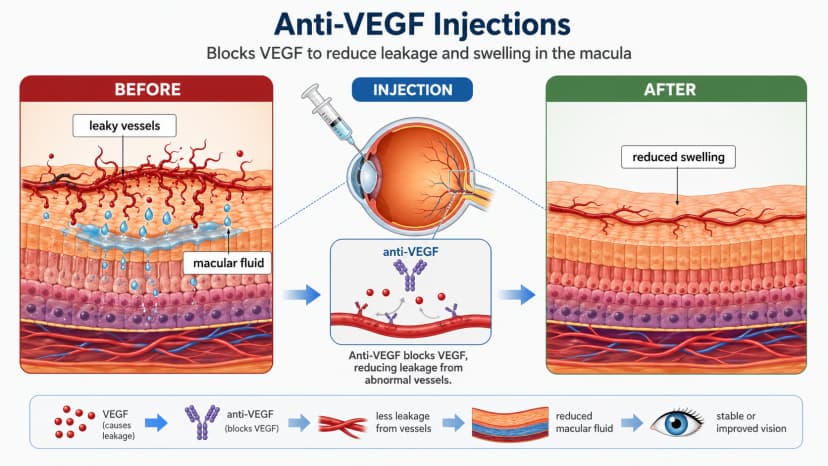
Anti-VEGF injections are a major treatment in modern retina care. These medications are placed inside the eye, where they block vascular endothelial growth factor - VEGF, the signal that tells fragile abnormal vessels to grow and leak. For wet AMD, diabetic macular edema, retinal vein occlusions, and several other retina problems, the treatment can stabilize vision and sometimes improve it. Repeat treatment is commonly needed.
Key Takeaways
- Core treatment for wet AMD, diabetic macular edema, and vein-occlusion swelling
- Injected directly into the eye during a brief office procedure
- The eye is numbed first; most people feel pressure more than pain
- Ongoing treatment is common, often over years
- Can preserve vision and sometimes improve it, especially when started early
- Serious complications are rare but include infection, retinal tear or detachment, and pressure spikes
How Anti-VEGF Works
VEGF is a protein that signals new blood vessels to grow. In the retina, too much VEGF can turn into trouble:
- Growth of fragile, leaky blood vessels
- Fluid leakage into the retina (edema)
- Bleeding in the eye
- Scarring and vision loss
Anti-VEGF medications block that signal. Less leakage means fluid can reabsorb and the retina may flatten back toward normal.
Conditions Treated
Wet AMD (Age-Related Macular Degeneration)
- First-line treatment
- Often stabilizes vision and can improve it
- Requires ongoing monitoring and repeat injections
- More than 90% of patients stabilize or improve in major treatment-era studies
Diabetic Macular Edema (DME)
- Reduces retinal swelling
- Improves vision
- Often combined with diabetes management
Diabetic Retinopathy
- Treats swelling and abnormal vessel growth
- May reduce need for laser treatment
- Used for proliferative diabetic retinopathy
Retinal Vein Occlusions
- Central retinal vein occlusion (CRVO)
- Branch retinal vein occlusion (BRVO)
- Reduces macular edema
Other Conditions
- Myopic choroidal neovascularization
- Central serous retinopathy complicated by choroidal neovascularization
- Retinopathy of prematurity
- Neovascular glaucoma (adjunctive)
Available Medications
Ranibizumab (Lucentis)
- FDA-approved for multiple conditions
- Given monthly or less frequently
- Specifically designed for eye use
Aflibercept (Eylea)
- Targets VEGF and related proteins
- Often given every 8 weeks after loading doses
- Widely used
Bevacizumab (Avastin)
- Originally a cancer drug
- Used off-label for eye conditions
- Significantly less expensive
- Comparable to approved anti-VEGF drugs in some major trials and indications, but used off-label in the eye and not identical for every condition
Brolucizumab (Beovu)
- Newer agent
- May allow longer intervals between injections
- Some concerns about inflammation risk
Faricimab (Vabysmo)
- Targets both VEGF and Ang-2
- May allow longer treatment intervals
- FDA-approved for wet AMD and DME
The Injection Procedure
Anti-VEGF medications are delivered via intravitreal injection - a quick, in-office procedure where medication is injected directly into the eye. See our intravitreal injection guide for full details on what to expect, preparation, aftercare, treatment schedules, and risks.
Systemic Considerations
Anti-VEGF medications can enter the bloodstream in small amounts. Large studies have generally shown low systemic risk, but patients with recent stroke, heart attack, severe cardiovascular disease, or major clotting history should tell the retina specialist so the risks and benefits can be reviewed carefully.
Long-Term Expectations
Duration of Treatment
- Most patients need ongoing treatment for years
- Some can eventually extend intervals or stop with careful monitoring
- Stopping too soon can allow fluid or bleeding to return, sometimes quietly at first
Treatment Outcomes
For Wet AMD:
- About 90% stabilize or improve
- About 30-40% gain significant vision
- Best outcomes with early treatment
For Diabetic Eye Disease:
- Significant improvement in many patients
- Also requires blood sugar control
- May need laser treatment in addition
Frequently Asked Questions
How long do the effects last?
The medication remains active for weeks, often around 4-8 weeks depending on the drug and the eye's response. Some newer agents can last longer in selected patients, but follow-up imaging and examination determine the interval.
Will I need injections forever?
Many patients need ongoing treatment, though the interval may lengthen over time. Some patients eventually stop with close monitoring. Others have recurrent fluid or bleeding when the interval becomes too long.
Does insurance cover these injections?
Generally yes, including Medicare. Some medications are more expensive than others. Your doctor's office can discuss costs and coverage options.
What about the injection procedure itself?
See our intravitreal injection page for detailed information about the procedure, what to expect, pain management, aftercare, and treatment schedules.
References
Medical Disclaimer: This information is for educational purposes only and does not replace professional medical advice, diagnosis, or treatment. If you have questions about anti-VEGF treatment, please consult your retina specialist.
Sources:
- American Society of Retina Specialists. Intravitreal Injections.
- American Society of Retina Specialists. Intravitreal Injections and Anti-VEGF Treatment.
- CATT Research Group. Ranibizumab and bevacizumab for neovascular age-related macular degeneration. N Engl J Med. 2011;364(20):1897-1908.
- National Eye Institute. Age-Related Macular Degeneration Treatment.