

Duane Retraction Syndrome
A congenital eye movement disorder where the eye cannot turn outward fully and retracts into the socket when turning inward.
Duane retraction syndrome is a congenital condition affecting eye movement. It occurs because of abnormal wiring during fetal development-the nerve that should control the muscle turning the eye outward doesn't develop properly, and another nerve partially takes over. The result is limited outward eye movement and eye retraction when looking inward.
Key Takeaways
- Present from birth-caused by abnormal nerve development
- Limited outward movement of affected eye
- Eye retracts into socket when looking inward
- Often little or no double vision-brain adapts
- Usually stable-doesn't progress
- May need treatment for cosmesis or abnormal head position
Understanding Duane Syndrome
During normal development, the sixth cranial nerve controls the muscle that turns the eye outward (lateral rectus). In Duane syndrome, this nerve doesn't develop properly. Instead, a branch from the third nerve (which normally controls other eye muscles) connects to the lateral rectus. This abnormal wiring causes the characteristic features of the syndrome.
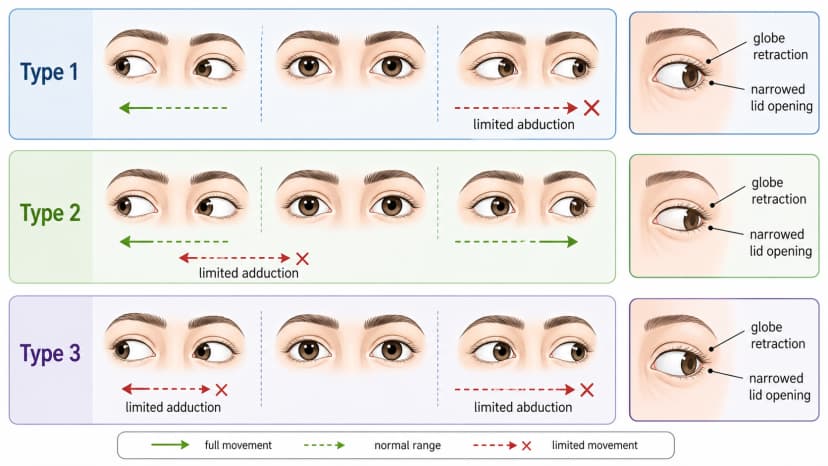
Types
Type I (Most Common-70-80%)
- Limited abduction (can't turn eye outward)
- Normal or near-normal adduction (turning inward)
- Eye retracts when looking inward
Type II (Less Common-~7%)
- Limited adduction (can't turn eye inward)
- Normal or near-normal abduction
Type III (Less Common-~15%)
- Limited movement in both directions
- Eye retracts when looking inward or straight
Symptoms
Eye Movement
- Cannot turn affected eye fully outward (Type I)
- Eye pulls back into socket when turning inward
- Eyelid opening narrows when looking inward
- May have abnormal up or down movements
Vision and Alignment
- Often no double vision-brain adapted since birth
- Eyes may appear aligned when looking straight ahead
- Misalignment visible when looking to the side
Compensatory Head Position
- Head turn toward affected side
- Maintains eye alignment and avoids diplopia
- May be the main concern for treatment
Associated Conditions
Some patients have additional findings:
- Hearing abnormalities
- Skeletal abnormalities
- Other eye or systemic conditions
Diagnosis
Clinical Examination
- Characteristic pattern of eye movement limitation
- Eye retraction observed
- Eyelid narrowing during adduction
- Usually apparent in infancy or childhood
Imaging
- MRI brain can show absent sixth nerve
- Usually not necessary for diagnosis if clinical features typical
Rule Out Other Causes
- Sixth nerve palsy (acquired)-different history
- Other forms of strabismus
- Thyroid eye disease
Treatment
Observation
Many patients need no treatment:
- Aligned in primary position
- No significant head turn
- No diplopia
- Good binocular vision
Indications for Surgery
- Significant abnormal head position
- Significant misalignment in primary gaze
- Diplopia (uncommon)
- Cosmetic concerns
Surgical Options
- Strabismus surgery to improve alignment
- May involve muscles in both eyes
- Goals: reduce head turn, improve cosmesis, maintain alignment
Glasses/Prisms
- Rarely needed
- May help if any residual diplopia
Living with Duane Syndrome
Practical Considerations
- Most people adapt well
- Head turn becomes natural
- Vision usually excellent
- Most activities unaffected
Sports and Activities
- Usually no limitations
- May need slight head turn for activities requiring side gaze
- Sports participation generally fine
Driving
- Usually no issues
- Head turn compensates for limited eye movement
- Check with doctor if concerned
Prognosis
Excellent
- Condition is stable-doesn't worsen with age
- Not progressive
- Vision typically normal
- Most people have minimal impact on daily life
Post-Surgery
- Surgery can improve head position and alignment
- Cannot restore normal eye movement
- Generally good outcomes
Frequently Asked Questions
Can Duane syndrome be cured?
There's no cure-the abnormal nerve wiring can't be changed. However, most people with Duane syndrome function normally with minimal impact. Surgery can improve alignment and head position but doesn't restore normal eye movement.
Will my child need surgery?
Not necessarily. Many children with Duane syndrome don't need surgery if their eyes are aligned when looking straight ahead and they don't have a significant head turn. Surgery is considered when there's a noticeable head position, misalignment, or cosmetic concern.
Is Duane syndrome inherited?
Most cases are sporadic (not inherited), though some families show autosomal dominant inheritance. If you have Duane syndrome, your children may have a slightly increased risk, but most cases occur without family history.
Why doesn't my child have double vision?
Because Duane syndrome is present from birth, the brain develops with this visual input and adapts. Children don't experience double vision because their brains have always processed the eyes' slightly different positions as normal.
Will this get worse with age?
No. Duane syndrome is stable and doesn't progress. The eye movement pattern remains the same throughout life.
References
Medical Disclaimer: This information is for educational purposes only and does not replace professional medical advice, diagnosis, or treatment. If you have concerns about eye movement or any symptoms, please consult a qualified healthcare provider.
Sources:
- Engle EC. Duane syndrome. GeneReviews. 2024.
- DeRespinis PA, et al. Duane's retraction syndrome. Surv Ophthalmol. 1993;38(3):257-288.
- American Association for Pediatric Ophthalmology and Strabismus. Duane Syndrome.
- American Academy of Ophthalmology EyeWiki. Duane Retraction Syndrome.