
MRI Brain and Orbits
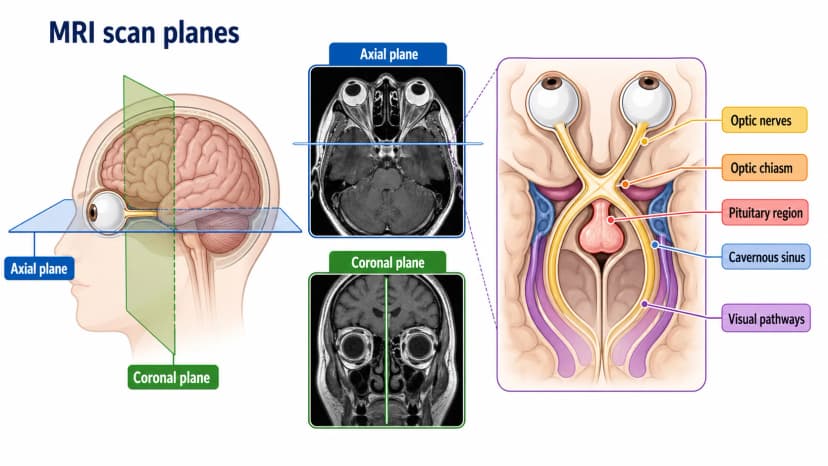
Magnetic resonance imaging of the brain and eye sockets to evaluate the visual pathways, optic nerves, and surrounding structures.
MRI (magnetic resonance imaging) uses powerful magnets and radio waves to create detailed images of the brain, optic nerves, and eye sockets (orbits). Unlike CT scans, MRI involves no radiation. It is the preferred imaging test for most neuro-ophthalmic conditions because it shows soft tissues - nerves, brain, and muscles - with exceptional detail.
Key Takeaways
- Best imaging for optic nerves and brain - shows soft tissue detail that CT cannot
- No radiation exposure - uses magnets and radio waves
- Contrast dye (gadolinium) often added to detect inflammation or tumors
- Takes 30-60 minutes - you must lie still inside the scanner
- Sedation is available if you are claustrophobic
- Results are read by a radiologist and shared with your doctor, usually within 1-3 days
How MRI Works
MRI creates images using a strong magnetic field and radio wave pulses - no X-rays are involved. The magnets cause hydrogen atoms in your body to align briefly, and the radio waves capture signals that a computer converts into detailed pictures. Different tissues (brain, nerve, fluid, fat) produce different signals, which is why MRI can distinguish structures that look similar on a CT scan.
Why It's Ordered
Your doctor may order an MRI of the brain and orbits to:
- Evaluate optic neuritis and look for signs of multiple sclerosis
- Rule out tumors pressing on the visual pathway (pituitary tumor, meningioma, compressive optic neuropathy)
- Assess for stroke affecting vision
- Evaluate unexplained vision loss or visual field deficits
- Check for thyroid eye disease - muscle enlargement and orbital changes
- Investigate causes of cranial nerve palsies (including fourth and sixth nerve)
- Look for venous sinus thrombosis in patients with papilledema or IIH
- Evaluate NMO or MOGAD lesions
MRI With and Without Contrast
Without Contrast
A standard MRI without contrast shows brain and orbital anatomy well. It can detect strokes, structural abnormalities, and some tumors.
With Contrast (Gadolinium)
Gadolinium is a contrast dye injected through an IV during the scan. It highlights areas of inflammation, active disease, or tumor. Your doctor will typically order contrast when looking for:
- Active optic neuritis - the optic nerve "enhances" (lights up) on contrast images
- Tumors - enhancement shows the tumor's blood supply and extent
- Active MS lesions vs. older, inactive ones
- Infection or inflammation in the brain or orbits
Before Receiving Contrast
- A blood test (creatinine, eGFR) is typically done to check kidney function, since gadolinium is cleared by the kidneys.
- Tell your doctor and the imaging team if you have kidney disease, dialysis, pregnancy, prior contrast reaction, severe asthma, or any implanted medical device.
- Severely impaired kidney function (eGFR < 30 mL/min/1.73 m²) increases the risk of nephrogenic systemic fibrosis (NSF), a rare but serious scarring disorder of skin and internal organs. The American College of Radiology divides gadolinium agents into Group I (highest NSF risk - generally avoided in advanced kidney disease), Group II (lowest risk - preferred), and Group III. Modern Group II agents - including gadobutrol, gadoteridol, gadoterate, gadobenate, gadopiclenol, and gadoxetate - are preferred when contrast is needed in patients with kidney disease, and the test is often deferred or done without contrast unless absolutely necessary.
- Gadolinium can cross the placenta. In pregnancy, gadolinium is avoided unless the benefit clearly outweighs the risk - non-contrast MRI is preferred when possible.
What to Expect
Before the MRI
- Remove all metal: jewelry, watches, hearing aids, hair clips, belts with metal buckles
- Tell staff about every implanted device - pacemakers and ICDs, cochlear implants, neurostimulators, deep-brain stimulators, programmable shunts, drug pumps, aneurysm clips, metallic foreign bodies in the eye (especially from metal-grinding work), or any retained shrapnel. Modern devices are typically labeled MRI-conditional (safe under specific conditions) or MRI-unsafe. Bring the device manufacturer's ID card if you have one. Programmable shunts often need to be re-interrogated and reset after MRI by a neurosurgery team.
- Wear comfortable clothing without metal - you may be asked to change into a gown
- An IV line will be placed if contrast is ordered
- A family member or friend can usually wait in the waiting room but cannot enter the scanner room
During the MRI
- You lie still on a padded table that slides into a tube-shaped scanner
- The machine makes loud clicking, banging, and buzzing sounds - you will be given ear protection (earplugs or headphones)
- You can communicate with the technologist through an intercom at any time
- A squeeze ball or call button lets you signal the technologist if you need a break
- The scan takes 30-60 minutes depending on what sequences are ordered
- If contrast is given, you may feel a brief cool sensation in your arm during injection
- You must stay as still as possible - movement blurs the images
After the MRI
- You can resume all normal activities immediately
- If you received contrast, drink extra fluids to help flush it from your system
- The images are interpreted by a radiologist, and results are typically available within 1-3 business days
- Your referring doctor will discuss the findings with you
Special Sequences
For Optic Nerve
- Fat-suppressed images highlight the optic nerve against surrounding orbital fat
- These sequences show inflammation and contrast enhancement
For MS
- FLAIR sequences detect white matter lesions in the brain
- Gadolinium enhancement distinguishes active from old lesions
MRA/MRV
- MR angiography (MRA) images blood vessels - used to evaluate for aneurysm or vascular malformations
- MR venography (MRV) checks the venous sinuses for clots, often ordered in IIH
Ordering Details That Matter
"MRI brain and orbits" is not one single universal protocol. The wording of the order matters because different symptoms require different coverage:
- Optic neuritis or compressive optic neuropathy - MRI brain and orbits with and without contrast, with fat-suppressed orbital sequences
- Papilledema or suspected IIH - MRI brain/orbits plus MRV to look for venous sinus thrombosis or stenosis
- Pupil-involving third nerve palsy - vascular imaging such as CTA or MRA is usually needed to evaluate for aneurysm; a routine outpatient MRI is not enough
- Suspected stroke - the emergency department may start with CT/CTA or urgent MRI depending on timing, local protocol, and treatment eligibility
If symptoms are sudden or worsening, the priority is getting to the right emergency setting. The MRI protocol can be adjusted once the emergency team has examined you.
If You're Claustrophobic
Many patients feel anxious about the enclosed scanner. Here are practical options:
- Tell the staff beforehand - they are experienced in helping anxious patients
- Sedation can be arranged (oral medication taken before the scan, or IV sedation)
- Open MRI is available at some imaging centers - the scanner is wider and less enclosed, though image quality may differ
- Bring music or a podcast - many centers allow you to listen through MRI-compatible headphones
- Close your eyes before entering the scanner and keep them closed
- Breathing exercises - slow, steady breaths help reduce anxiety
For comprehensive preparation tips, managing claustrophobia, and understanding your results, see our guide: Understanding Your MRI - A Patient's Complete Guide.
When MRI Is Ordered Urgently
Not all MRIs are routine. Some situations call for urgent or same-day imaging:
- Sudden vision loss with suspected optic neuritis or stroke
- New double vision with a third nerve palsy and pupil involvement - MRA or CTA may be done urgently to check for aneurysm
- Severe headache with papilledema - to rule out a brain mass or venous sinus thrombosis
- Progressive neurological symptoms - weakness, numbness, or vision changes worsening over hours to days
Call 911 if vision loss, visual field loss, or double vision starts suddenly with facial droop, arm weakness, speech trouble, severe sudden headache, confusion, fainting, or trouble walking. Also seek emergency department care the same day for a new droopy eyelid with double vision and a larger pupil, or for severe headache with papilledema. These situations should not wait for a routine outpatient MRI appointment.
If your doctor orders an urgent MRI, it does not necessarily mean something dangerous has been found - it means they want to rule out time-sensitive conditions quickly.
MRI vs CT
| Feature | MRI | CT Scan |
|---|---|---|
| Time | 30-60 minutes | 5-10 minutes |
| Best for | Soft tissue, nerves, brain detail | Bone, acute bleeding |
| Radiation | None | Small dose (X-rays) |
| Contrast type | Gadolinium (IV) | Iodinated contrast (IV) |
| Claustrophobia | Enclosed tube - can be challenging | Open ring - usually well tolerated |
| Metal implants | Some implants unsafe in MRI | Generally OK with most implants |
| Availability | Usually scheduled in advance | Widely available, often same-day |
Understanding Your Results
MRI reports can contain unfamiliar terms. Here are some common ones:
- Enhancement - an area that "lights up" after contrast, indicating increased blood flow from inflammation, tumor, or active disease
- Lesion - any area that looks different from normal tissue; it does not automatically mean cancer. In neuro-ophthalmology, lesions are often from inflammation (like MS plaques) or small-vessel disease
- White matter changes - bright spots on FLAIR images that can indicate MS, small-vessel disease, migraines, or simply age-related changes
- Optic nerve thickening or enhancement - may indicate optic neuritis or another inflammatory process
- Mass effect - a structure (tumor, swelling) pushing on nearby brain tissue
Your doctor will explain what the findings mean for your specific situation. A single MRI finding rarely tells the whole story - it is interpreted alongside your symptoms, exam, and other tests.
Frequently Asked Questions
Is MRI safe with dental fillings or braces?
Most modern dental fillings, crowns, and braces are MRI-safe. Older fillings may cause minor image distortion but are generally not dangerous. Always inform the technologist about any dental work so they can adjust if needed.
What if I'm pregnant?
MRI without contrast is generally considered safe during pregnancy when medically necessary - it does not use radiation. Gadolinium contrast is typically avoided during pregnancy unless the benefit clearly outweighs the risk. Your doctor and radiologist will make this decision together.
Can I listen to music during the scan?
Many imaging centers offer MRI-compatible headphones so you can listen to music or a podcast. Ask when you schedule your appointment. Even without music, earplugs are always provided because the machine is loud.
How soon will I get my results?
Most MRI results are available within 1-3 business days. Urgent scans ordered from the emergency department are often read within hours. Your referring doctor will review the results and contact you to discuss the findings.
Why does my doctor want contrast?
Contrast (gadolinium) helps distinguish active inflammation or tumor from normal tissue. For example, in optic neuritis, the inflamed optic nerve enhances on contrast images. Without contrast, some conditions can be missed.
What if I can't lie still for that long?
If you have difficulty staying still due to pain, anxiety, or a medical condition, talk to your doctor beforehand. Options include sedation, shorter scan protocols, or breaking the scan into segments. Movement degrades image quality, so it is important to stay as still as possible during each sequence.
Is gadolinium contrast safe?
Gadolinium is safe for most people, and serious allergic reactions are uncommon. Two precautions are important:
- Severe kidney disease (eGFR <30) raises the risk of nephrogenic systemic fibrosis (NSF), a rare but serious scarring disorder. Modern Group II agents are preferred in this group, and contrast is sometimes deferred entirely.
- Pregnancy - gadolinium is generally avoided unless absolutely necessary because it crosses the placenta.
A blood test to check kidney function is usually done before contrast is given.
Medical Disclaimer: This information is for educational purposes only and does not replace professional medical advice.
Sources:
- Radiological Society of North America. Brain MRI.
- Radiological Society of North America / American College of Radiology. Orbits, Vision, and Visual Loss.
- MedlinePlus. MRI Scans.
- American College of Radiology. ACR Manual on Contrast Media.