

Sixth Cranial Nerve Palsy (Abducens Nerve Palsy)
Weakness of the sixth cranial nerve causing inability to move the eye outward and horizontal double vision. Often microvascular but can indicate serious conditions.
Sixth cranial nerve palsy affects the abducens nerve, which controls the lateral rectus muscle-the muscle that moves the eye outward. When this nerve is damaged, the affected eye can't look toward the side, causing horizontal double vision that's worse when looking in that direction.
Key Takeaways
- Causes horizontal double vision worse when looking toward the affected side
- Eye can't move outward (abduct)
- Most common acquired isolated nerve palsy
- Often microvascular in adults with diabetes/hypertension
- In children or with other symptoms, may indicate tumor or increased intracranial pressure
- Usually recovers if microvascular
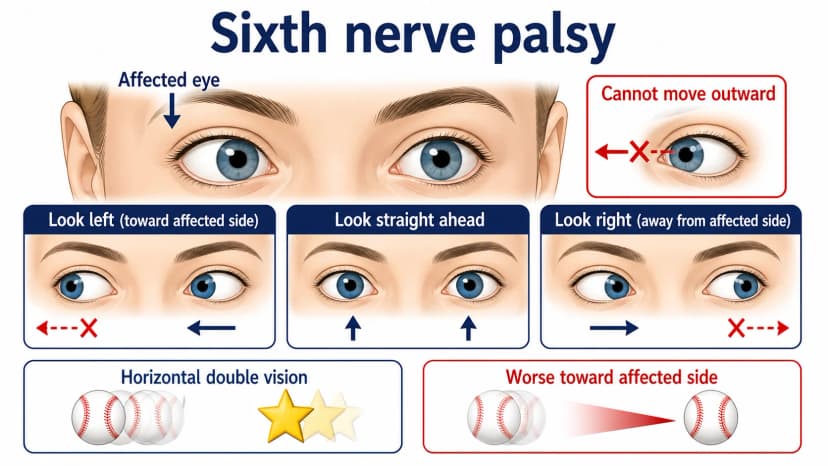
What the Sixth Nerve Controls
The sixth cranial nerve (abducens nerve) controls only one muscle: the lateral rectus. This muscle:
- Moves the eye outward (away from the nose)
- Works with the medial rectus of the other eye for coordinated gaze
Symptoms
Visual Symptoms
- Horizontal double vision-images side by side
- Worse looking toward affected side
- Better looking toward the opposite side
- Better at near (convergence helps)
- May turn head toward affected side to compensate
Eye Position
- Eye may appear turned inward (esotropia) in primary gaze
- Can't fully move eye outward
- Movement inward is normal
Causes
Microvascular (Most Common in Adults)
- Associated with diabetes, hypertension, hyperlipidemia
- Typical patient: older adult with vascular risk factors
- Usually isolated (no other neurological signs)
- Spontaneous recovery in 2-3 months
Elevated Intracranial Pressure
The sixth nerve has a long course through the skull and is sensitive to pressure changes:
- Idiopathic intracranial hypertension (IIH)-especially young overweight women
- Tumors-any mass causing increased pressure
- Hydrocephalus
- Intracranial hypotension-low CSF pressure from spinal fluid leaks
- May have papilledema and headaches
This is a "false localizing sign"-the sixth nerve palsy doesn't mean the problem is near the sixth nerve.
In Children
Requires careful evaluation:
- Tumors (especially brainstem)
- Increased intracranial pressure
- Post-infectious inflammation
- Congenital conditions like Duane syndrome
- Never assume microvascular in children
Other Causes
- Trauma
- Inflammation (sarcoidosis, multiple sclerosis)
- Tumors along nerve pathway
- Infection
- Cavernous sinus disease (often with other cranial nerve palsies)
- Giant cell arteritis in elderly
Evaluation
Key Questions
- Age of patient
- Vascular risk factors (diabetes, hypertension)
- Associated symptoms (headache, other neurological signs)
- Trauma history
- Speed of onset
Examination
- Eye movement assessment
- Look for papilledema
- Other cranial nerves
- Complete neurological exam
When Imaging Is Needed
Imaging is strongly favored for:
- Children
- Young adults without vascular risk factors
- Associated signs/symptoms (papilledema, headache, other nerve palsies)
- Bilateral sixth nerve palsy
- No improvement by 3 months
- Progressive worsening
May be observed:
- Classic microvascular presentation (older adult with diabetes/hypertension, isolated palsy)
- Still needs close follow-up
Tests
- MRI brain (with attention to brainstem and skull base)
- Blood tests (glucose, HbA1c, ESR/CRP in elderly)
- Lumbar puncture if elevated pressure suspected
Treatment
For Microvascular Sixth Nerve Palsy
- Observation-usually recovers in 2-3 months
- Control risk factors-optimize diabetes, blood pressure
- Symptomatic treatment for double vision:
- Patching one eye
- Fresnel prism (temporary stick-on prism)
For Underlying Cause
- Treat tumor, hydrocephalus, IIH, or other identified cause
- May need neurosurgery, medication, or shunting
If Persistent (6+ Months)
- Prism glasses for small deviations
- Strabismus surgery:
- Medial rectus recession
- Lateral rectus resection
- May need adjustable sutures
- Botulinum toxin injection to medial rectus sometimes used
Prognosis
Microvascular
- 80-90% recover spontaneously
- Most improvement within 3 months
- May have mild residual deviation
- Recurrence possible
Other Causes
- Depends on underlying condition
- Traumatic may be permanent
- Post-tumor treatment variable
Frequently Asked Questions
Why is my double vision worse when I look to one side?
The sixth nerve moves the eye outward. When you look toward the affected side, you're asking that weak muscle to work hardest. The eye can't keep up with the other eye, causing maximum separation and worse double vision.
Can I just close one eye?
Yes, patching or closing one eye can suppress binocular double vision temporarily. Alternate which eye you patch to avoid constantly relying on one eye. Fresnel prisms are another temporary option.
Do I need an MRI?
It depends on your age, risk factors, and clinical presentation. Classic microvascular presentations in older adults with diabetes may be observed. Children, young adults, or anyone with atypical features needs imaging.
How long until I recover?
Microvascular sixth nerve palsies typically begin improving within weeks and are mostly recovered by 3 months. If not improving by then, your doctor will want to do additional testing.
Will this happen again?
There's about a 25% chance of having another cranial nerve palsy if you have ongoing vascular risk factors like diabetes. Controlling these conditions reduces recurrence risk.
Can I drive?
Double vision makes driving unsafe and often illegal. Once the double vision resolves (naturally or with prism), you can discuss returning to driving with your doctor.
References
Medical Disclaimer: This information is for educational purposes only and does not replace professional medical advice, diagnosis, or treatment. If you have concerns about sixth nerve palsy or any symptoms, please consult a qualified healthcare provider.
Sources:
- Patel SV, et al. Incidence, associations, and evaluation of sixth nerve palsy using a population-based method. Ophthalmology. 2004;111(2):369-375.
- North American Neuro-Ophthalmology Society. Microvascular Cranial Nerve Palsy.
- Elder C, et al. Isolated abducens nerve palsy: update on evaluation and diagnosis. Curr Neurol Neurosci Rep. 2016;16(8):69.
- American Academy of Ophthalmology EyeWiki. Abducens Nerve Palsy.