
Fourth Cranial Nerve Palsy (Trochlear Nerve Palsy)
Weakness of the fourth cranial nerve causing vertical double vision and compensatory head tilt. Often caused by trauma or present from birth.
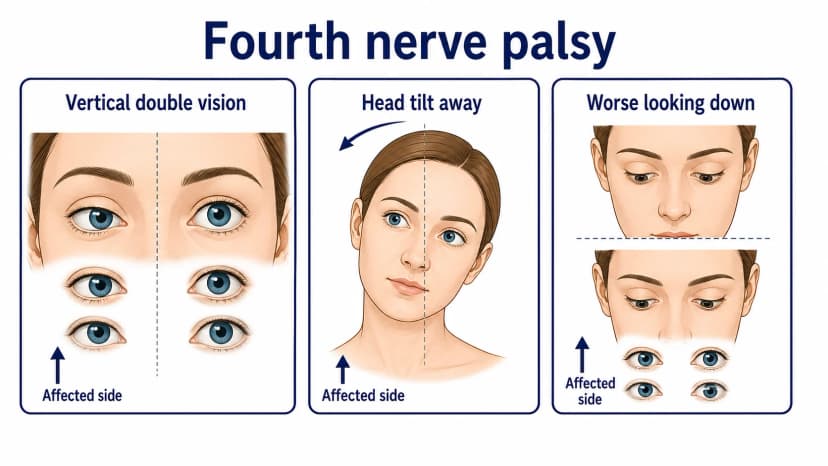
Fourth cranial nerve palsy affects the trochlear nerve, which controls the superior oblique muscle. This muscle helps rotate and depress the eye. When the fourth nerve is damaged, the eye drifts upward, causing vertical double vision and often a characteristic head tilt.
Key Takeaways
- Causes vertical double vision with images tilted or one above the other
- Characteristic head tilt away from affected side to compensate
- Most common causes: trauma, microvascular (diabetes/hypertension), congenital
- Old photos may show longstanding head tilt suggesting congenital origin
- Usually recovers if microvascular; may need prism or surgery if persistent
What the Fourth Nerve Controls
The fourth cranial nerve (trochlear nerve) controls only one muscle: the superior oblique. This muscle:
- Rotates the eye inward (intorsion)
- Depresses the eye when looking inward
- Helps looking down and in (like reading)
Symptoms
Visual Symptoms
- Vertical double vision-one image above the other
- Tilted images-one image appears rotated
- Worse when looking down and toward the nose (reading, going down stairs)
- Worse when tilting head toward affected side
Compensatory Head Posture
- Head tilts away from the affected side
- Chin tucks down
- Face turns toward the opposite side
- These positions align the eyes and reduce double vision
- May cause neck pain from chronic posturing
Reading Difficulties
- Looking down and inward maximally uses the superior oblique
- This is the position for reading
- Patients often have trouble reading or looking at a tablet/phone
Causes
Congenital (Present from Birth)
- Often decompensates in adulthood
- Look at old photos-head tilt present for years
- May have large "fusional reserve" that fails with age, illness, or fatigue
- Accounts for many "spontaneous" adult presentations
Trauma
- Most common acquired cause
- Head injury, even minor, can damage the nerve
- Bilateral fourth nerve palsy often traumatic
Microvascular (Ischemic)
- Similar to other microvascular cranial nerve palsies
- Associated with diabetes, hypertension
- Usually recovers in 2-3 months
Other Causes
- Tumors
- Demyelination (multiple sclerosis)
- Inflammation
- Viral infections (rare cases such as HFMD causing fourth nerve palsy)
- Rarely: aneurysm, stroke
Diagnosis
Clinical Tests
Parks-Bielschowsky three-step test:
- Which eye is higher?
- Does deviation increase looking left or right?
- Does deviation increase tilting head left or right?
Head tilt test:
- Tilting head toward affected side worsens vertical deviation
- Key diagnostic maneuver
Looking for Cause
- Old photographs-check for longstanding head tilt (congenital)
- History of trauma-even remote head injury
- Vascular risk factors-diabetes, hypertension
Imaging
- MRI brain often performed
- Rules out structural causes
- May be observed without imaging in classic microvascular presentation
Treatment
Observation
For microvascular fourth nerve palsy:
- Usually improves spontaneously
- Recovery typically within 2-3 months
- Monitor vascular risk factors
Prism Glasses
- Small prisms can align images
- Useful for stable, small deviations
- May be temporary or permanent solution
- Incorporated into glasses
Patching
- Cover one eye to eliminate double vision
- Temporary measure
- Alternate eyes to avoid favoring one
Strabismus Surgery
Indications:
- Stable deviation for at least 6 months
- Deviation too large for prism
- Significant impact on quality of life
Options:
- Weaken the inferior oblique muscle
- Tuck/strengthen the superior oblique
- May need surgery on other muscles
For Decompensated Congenital
- Prism often effective
- Surgery if prism inadequate
- Usually good results
Prognosis
Microvascular
- Most recover within 2-3 months
- May have some residual deviation
- Recurrence possible
Traumatic
- Variable recovery
- May be permanent
- Often amenable to surgery
Congenital/Decompensated
- Won't spontaneously resolve
- But usually responds well to treatment
- Prism or surgery usually effective
Living with Fourth Nerve Palsy
Adaptations
- Use head tilt position when needed
- Consider neck support/exercises for posture-related pain
- Good lighting for reading
- Larger text can help reduce strain
When to Worry
- If deviation is getting worse
- New symptoms develop
- Not improving as expected
- Severe or persistent neck pain
Frequently Asked Questions
Why does my head always tilt?
You're naturally compensating to align your eyes and avoid double vision. This is actually a sign that your brain is working to help you see single. However, it can cause neck strain over time.
Could I have had this my whole life?
Possibly. Congenital fourth nerve palsy is common and may only become symptomatic in adulthood when the compensating mechanisms weaken. Looking at old photos for head tilt can help determine this.
Will my double vision go away?
If microvascular, it usually improves significantly within 2-3 months. Congenital or traumatic cases may be more persistent but are usually treatable with prism or surgery.
Why is going down stairs so difficult?
Looking down and in-the position for seeing stairs-maximally uses the superior oblique muscle, which is what's weak in fourth nerve palsy. This is a common complaint.
Is surgery effective?
Yes, strabismus surgery for fourth nerve palsy has good success rates. It's typically performed once the deviation has been stable for several months.
References
Medical Disclaimer: This information is for educational purposes only and does not replace professional medical advice, diagnosis, or treatment. If you have concerns about fourth nerve palsy or any symptoms, please consult a qualified healthcare provider.
Sources:
- Tamhankar MA, et al. Clinical profile, etiology and outcome of isolated fourth nerve palsy. J Neuroophthalmol. 2013;33(4):372-375.
- North American Neuro-Ophthalmology Society. Microvascular Cranial Nerve Palsy.
- American Association for Pediatric Ophthalmology and Strabismus. Superior Oblique Palsy.