

Strabismus Surgery
Eye muscle surgery to improve eye alignment, treat double vision, or support binocular vision when non-surgical options are insufficient.
Strabismus surgery adjusts the muscles that control eye position to improve alignment. It is used when prism glasses are insufficient or impractical, and when the eye deviation is stable enough for surgical planning. The procedure is commonly performed in both children and adults, with technique chosen according to the measured pattern of misalignment.
Key Takeaways
- Adjusts eye muscle position to improve alignment
- Treats double vision (diplopia), visible eye turns, or both
- Outpatient surgery with same-day discharge
- Multiple techniques are available, including adjustable sutures in selected adults
- Success rate ~80-90% for achieving satisfactory alignment
- May require more than one surgery in some cases
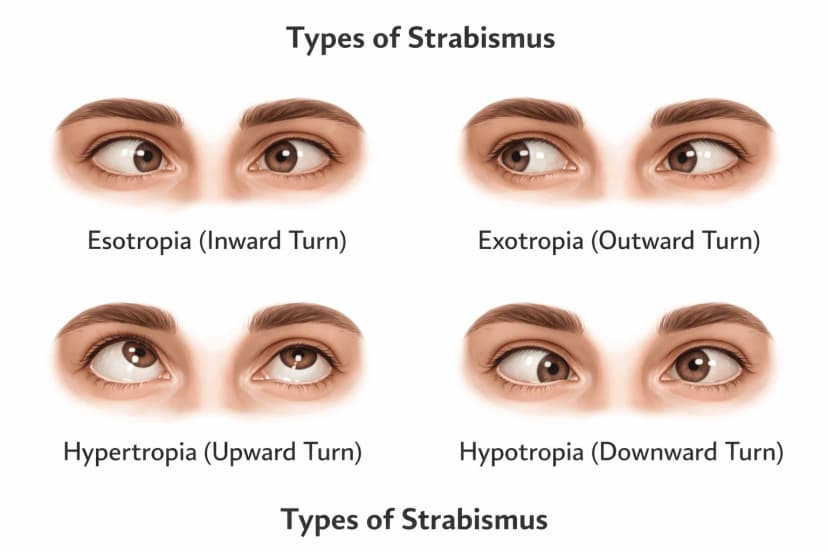
How Strabismus Surgery Works
Mechanism
The eye is moved by six extraocular muscles, each controlled by a different nerve:
- Medial rectus: Turns eye inward (cranial nerve III)
- Lateral rectus: Turns eye outward (cranial nerve VI)
- Superior rectus: Turns eye up (cranial nerve III)
- Inferior rectus: Turns eye down (cranial nerve III)
- Superior oblique: Turns eye down and inward (cranial nerve IV)
- Inferior oblique: Turns eye up and outward (cranial nerve III)
Surgery changes how strongly the muscles pull by:
- Weakening overacting muscles (recession, myectomy)
- Strengthening underacting muscles (resection, plication)
- Repositioning muscles (transposition procedures)
When Surgery Is Considered
Indications
Double vision from:
- Sixth nerve palsy (stable for 6+ months)
- Fourth nerve palsy (stable)
- Third nerve palsy (stable, selected cases)
- Thyroid eye disease (stable phase)
- Post-traumatic strabismus
Childhood strabismus:
- Esotropia (eyes turn in)
- Exotropia (eyes turn out)
- To restore binocular vision and prevent amblyopia
Adult strabismus:
- Long-standing misalignment
- Nystagmus (Kestenbaum procedure to move null point)
- Functional and cosmetic concerns
Prerequisites
- Stable deviation: Not actively changing (typically wait 6+ months after cranial nerve palsy onset)
- Prisms not adequate: Too large for glasses, or cosmetically unacceptable
- Significant functional impact: Affecting daily activities, work, driving
- Or cosmetic concern: Even without double vision
When Surgery Is NOT Recommended
- Actively changing deviation (still recovering)
- Unstable myasthenia gravis (medical treatment first)
- Very recent onset (wait to see if spontaneous recovery occurs)
- Deviation well-controlled with prisms that patient tolerates
Types of Procedures
Recession
Weakening procedure-moves muscle insertion backward
- Most common technique
- Muscle detached from eye and reattached farther back
- Reduces the muscle's pulling effect
- Amount of recession (in mm) depends on deviation size
- Predictable outcomes
Resection
Strengthening procedure-shortens the muscle
- A portion of muscle is removed
- Remaining muscle reattached at original insertion
- Increases muscle's pulling power
- Often combined with recession of the antagonist muscle
Plication
Alternative strengthening procedure
- Muscle folded rather than cut
- May be reversible early after surgery
- Less commonly used
Adjustable Sutures
Allows post-operative fine-tuning
- Muscle attached with special sutures
- Can be tightened or loosened hours after surgery
- Patient must be cooperative (usually adults)
- Done under local anesthesia with sedation
- Improves outcomes, especially for complex cases
- Particularly useful for:
- Thyroid eye disease
- Reoperations
- Restrictive strabismus
- Complex deviations
Transposition Procedures
For complete muscle paralysis
- Muscles moved to new locations
- Helps when one muscle completely non-functional
- Examples: Knapp procedure, Hummelsheim procedure
- Used for complete sixth nerve palsy or third nerve palsy
Patient Selection
Evaluation Before Surgery
- Complete neuro-ophthalmic examination
- Measurements at multiple visits to confirm stability
- Prism and cover testing at distance and near
- Assessment in multiple gaze positions
- Forced duction testing (to check for restrictions)
- MRI if underlying cause unclear
Best Candidates
- Stable deviation for at least 6 months
- Clear surgical goal (eliminate diplopia, improve alignment)
- Realistic expectations
- Able to comply with post-operative care
- Underlying condition addressed (thyroid controlled, etc.)
What to Expect
Before Surgery
Pre-operative:
- Stop blood thinners if medically safe (discuss with prescribing doctor)
- Arrange transportation (no driving day of surgery)
- Nothing to eat or drink after midnight
- Continue eye drops and essential medications
Day of surgery:
- Arrive at surgical center as directed
- Pre-operative assessment and consent
- Anesthesia discussion
- Mark surgical site
During Surgery
Anesthesia:
- General anesthesia-most common, especially for children
- Local with sedation-for adjustable suture techniques
- Topical with sedation-selected cases
The procedure:
- Surgery performed on the white part of the eye (sclera)
- No incision through the cornea or into the eye
- Conjunctiva (clear membrane) opened to access muscles
- Muscles repositioned as planned
- Sutures close the conjunctiva
- Duration: 30-60 minutes per eye
After Surgery
Immediately:
- Recovery room monitoring
- Same-day discharge typical
- Eye may be patched briefly
- Mild pain, managed with acetaminophen or ibuprofen
First days:
- Red, sore eyes (normal, resolves over 1-2 weeks)
- Swelling of eyelids
- Some discharge
- Antibiotic and steroid drops as prescribed
- Avoid swimming, heavy lifting, dusty environments
First weeks:
- Gradually improving comfort
- Redness fading
- No driving until cleared by surgeon
- Return to work typically 1-2 weeks (office work sooner)
- Avoid contact sports for 2-4 weeks
Final alignment:
- Initial alignment may be over- or under-corrected while healing progresses
- Final position typically stable at 6-8 weeks
- Adjustable sutures adjusted in first 24-48 hours if needed
Adjustable Suture Adjustment
If you have adjustable sutures:
- Return same day or next morning (depending on protocol)
- Topical anesthetic applied
- Surgeon tests alignment
- Sutures tightened or loosened as needed
- Brief discomfort during adjustment
- Significantly improves outcomes in appropriate patients
Risks and Complications
Common (Not Dangerous)
- Redness-normal, resolves over weeks
- Soreness-controlled with over-the-counter pain relievers
- Swelling-temporary
- Over- or under-correction-may need additional surgery
Less Common
- Infection-rare, treated with antibiotics
- Scarring-can affect eye movement
- Persistent or new double vision-usually temporary, may need prisms
- Bleeding-usually minor, resolves
- Conjunctival cyst-may need treatment
Rare
- Scleral perforation-uncommon, can be repaired
- Retinal detachment-very rare
- Vision loss-extremely rare
- Anesthesia complications-standard risks apply
Outcomes and Success Rates
Defining Success
- Functional success: Elimination of diplopia in primary gaze
- Cosmetic success: Acceptable alignment to patient
- Single operation success rate: ~80-90%
Factors Affecting Outcomes
Better outcomes:
- Simple horizontal deviations
- Consistent measurements pre-operatively
- Adjustable sutures when appropriate
- First surgery (not reoperation)
More challenging:
- Restrictive strabismus (thyroid eye disease)
- Multiple previous surgeries
- Complex patterns (vertical, torsional)
- Variable deviations
Need for Additional Surgery
- 20-30% may need additional surgery
- Sometimes planned in stages
- Reoperations generally still successful
- Each surgery may be slightly less predictable than the last
Comparison to Non-Surgical Treatments
| Treatment | Advantages | Disadvantages |
|---|---|---|
| Prism glasses | Non-invasive, reversible | Limited to smaller deviations, cosmetic concerns |
| Botox injection | Office procedure, temporary | Wears off, less predictable |
| Surgery | Permanent correction possible, can address large deviations | Surgical risks, recovery time |
When Prisms Are Preferred
- Small, stable deviations
- Elderly or poor surgical candidates
- Patient preference
- Temporary deviations expected to resolve
When Botox May Be Used
- Temporary correction
- Diagnostic (to predict surgical outcome)
- Patients who cannot undergo surgery
- Acute sixth nerve palsy (controversial)
Living After Strabismus Surgery
Recovery Timeline
| Time | What to Expect |
|---|---|
| Day 1 | Sore, red, swollen eyes |
| Week 1 | Improving comfort, still red |
| Week 2 | Can usually return to work/school |
| Week 4 | Redness mostly resolved |
| Week 6-8 | Final alignment achieved |
| Month 3+ | Fully healed |
Long-Term
- Most patients satisfied with outcomes
- Alignment usually stable long-term
- Some drift may occur over years
- Regular follow-up with ophthalmologist
Frequently Asked Questions
Will I be awake during surgery?
Most adults have the option of being asleep (general anesthesia) or having local anesthesia with sedation. Children typically have general anesthesia.
Is strabismus surgery painful?
You'll have anesthesia during surgery, so you won't feel pain. Afterward, eyes are sore for several days but this is manageable with over-the-counter pain relievers.
How long does recovery take?
Most people return to normal activities within 1-2 weeks. Full healing and final alignment usually take 6-8 weeks. Heavy physical activity and swimming are restricted for several weeks.
Will I need glasses after surgery?
Surgery corrects alignment but doesn't change your need for glasses. If you wore glasses before, you'll likely still need them. However, you may no longer need prisms.
What if the surgery doesn't work?
If alignment isn't satisfactory, additional surgery can be performed. Each case is evaluated individually. Most patients achieve satisfactory alignment eventually.
Can strabismus surgery be reversed?
Surgery is generally considered permanent. However, if over-corrected, additional surgery can be done to improve alignment.
How many times can strabismus surgery be performed?
There's no absolute limit, but each surgery becomes technically more challenging due to scarring. Most patients achieve good results within 1-2 surgeries.
Will my insurance cover strabismus surgery?
Strabismus surgery is generally covered by insurance when performed for functional reasons (diplopia, abnormal head position). Coverage for purely cosmetic concerns varies.
References
Medical Disclaimer: This information is for educational purposes only and does not replace professional medical advice, diagnosis, or treatment.
Sources:
- American Association for Pediatric Ophthalmology and Strabismus. Strabismus Surgery.
- Rowe FJ, et al. Interventions for convergence insufficiency. Cochrane Database Syst Rev. 2020;CD006768.
- Mills MD, et al. Strabismus surgery for adults: a report by the AAO. Ophthalmology. 2004;111(6):1255-1262.
- American Association for Pediatric Ophthalmology and Strabismus. Strabismus Surgery.
- Hatt SR, et al. Adjustable versus non-adjustable sutures for strabismus. Cochrane Database Syst Rev. 2019;CD004240.