

Internuclear Ophthalmoplegia (INO)
A brainstem disorder causing impaired horizontal eye movement coordination. Often caused by multiple sclerosis in young adults or stroke in older patients.
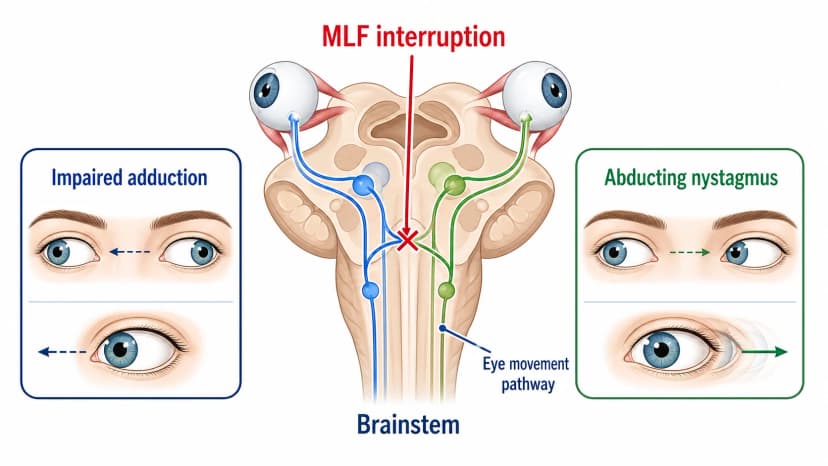
Internuclear ophthalmoplegia (INO) is an eye movement disorder caused by damage to the medial longitudinal fasciculus (MLF), a pathway in the brainstem that coordinates horizontal eye movements. The result is difficulty with looking toward one side: one eye doesn't turn inward properly while the other eye shows jerky movements (nystagmus).
Key Takeaways
- Brainstem lesion affecting eye movement coordination
- In young adults: usually multiple sclerosis
- In older adults: usually stroke
- Causes double vision with horizontal gaze
- Treatment depends on underlying cause
Understanding INO
When you look to one side, your brain coordinates both eyes: one eye turns outward (abduction) while the other turns inward (adduction). This coordination requires signals to travel through the MLF. When the MLF is damaged, the message to turn one eye inward is interrupted, while the outward-turning eye overshoots and develops nystagmus.
Symptoms
Primary Symptoms
Double vision
- Horizontal diplopia when looking to one side
- May be subtle or pronounced
- May have trouble with smooth pursuit movements
Eye movement findings:
- Weak adduction (eye doesn't turn inward fully)
- Nystagmus in the abducting (outward-turning) eye
- Convergence may be preserved
Other Possible Symptoms
- Oscillopsia (bouncing vision)
- Difficulty reading
- Balance problems (if other brainstem areas involved)
- Other neurological symptoms depending on cause
Bilateral INO
When both MLFs are damaged (both sides):
- Called "wall-eyed bilateral INO" (WEBINO)
- Both eyes have trouble turning inward
- Often appears as if eyes are drifting outward
- Strongly suggests multiple sclerosis
Causes
In Young Adults
Multiple Sclerosis (most common)
- May be first sign of MS
- Often bilateral
- May recover with treatment
In Older Adults
Stroke (most common)
- Usually unilateral
- May have other brainstem symptoms
- Less likely to fully recover
Other Causes
- Brainstem tumors
- Infection
- Trauma
- Rarely, other conditions
Diagnosis
Clinical Examination
- Eye movement assessment
- Looking for characteristic pattern:
- Impaired adduction on affected side
- Nystagmus of abducting eye
- Test convergence (often preserved)
Imaging
- Essential for diagnosis
- Shows lesion in MLF
- Helps identify cause (MS plaques vs stroke vs tumor)
Additional Testing
If MS suspected:
- MRI with specific MS protocol
- Lumbar puncture for oligoclonal bands
- Visual evoked potentials
If stroke suspected:
- Vascular imaging (MRA or CTA)
- Stroke risk factor assessment
- Cardiac evaluation
Treatment
Treat Underlying Cause
For MS:
- Acute attacks: high-dose IV corticosteroids
- Disease-modifying therapy to prevent future attacks
- See MS and Vision
For stroke:
- Standard stroke management
- Antiplatelet or anticoagulation
- Risk factor modification
- Rehabilitation
Symptom Management
- Prisms for persistent double vision (limited effectiveness)
- Eye patching as needed
- Time-many cases improve
Prognosis
In MS
- Often improves significantly with treatment
- May fully recover
- Can recur with future MS attacks
In Stroke
- Recovery variable
- Some improvement common
- May have permanent residual
Factors Affecting Outcome
- Underlying cause
- Size and location of lesion
- Age
- Overall neurological function
Frequently Asked Questions
Does INO mean I have MS?
Not necessarily. In young adults, MS is the most common cause, but not the only one. In older adults, stroke is more common. The MRI and other tests help determine the cause. If MS is suspected, further evaluation is needed to make the diagnosis.
Will my double vision go away?
In many cases, especially with MS-related INO, there can be significant improvement. Stroke-related INO may also improve, though sometimes more slowly and incompletely. Your doctor can give you a better idea based on your specific situation.
What is the medial longitudinal fasciculus?
The MLF is a bundle of nerve fibers in the brainstem that carries signals coordinating horizontal eye movements. It connects the nerve controlling the muscle that turns the eye outward with the nerve controlling the muscle that turns the other eye inward, allowing coordinated movement.
Is this the same as a cranial nerve palsy?
No. In cranial nerve palsy, the nerve to an eye muscle is damaged. In INO, the nerves are intact, but the pathway coordinating their function is damaged. The pattern of eye movement abnormality is different.
References
Medical Disclaimer: This information is for educational purposes only and does not replace professional medical advice, diagnosis, or treatment. If you have concerns about eye movement problems or any symptoms, please consult a qualified healthcare provider.
Sources:
- Frohman EM, et al. The medial longitudinal fasciculus in ocular motor physiology. Neurology. 2008;70(17):e57-67.
- Chen L, et al. Internuclear ophthalmoplegia: causes and long-term outcomes. Arch Neurol. 2008;65(10):1326-1328.
- American Academy of Ophthalmology. Internuclear Ophthalmoplegia.
- StatPearls [Internet]. Internuclear Ophthalmoplegia.