

Multiple Sclerosis Vision Complications
Multiple sclerosis frequently affects vision through optic neuritis, eye movement problems, and other visual disturbances. Learn about MS-related vision issues.
Multiple sclerosis (MS) commonly affects the visual system. Optic neuritis is often the first symptom of MS, and eye movement disorders are common as the disease progresses. Understanding these visual complications helps patients recognize symptoms and seek appropriate care.
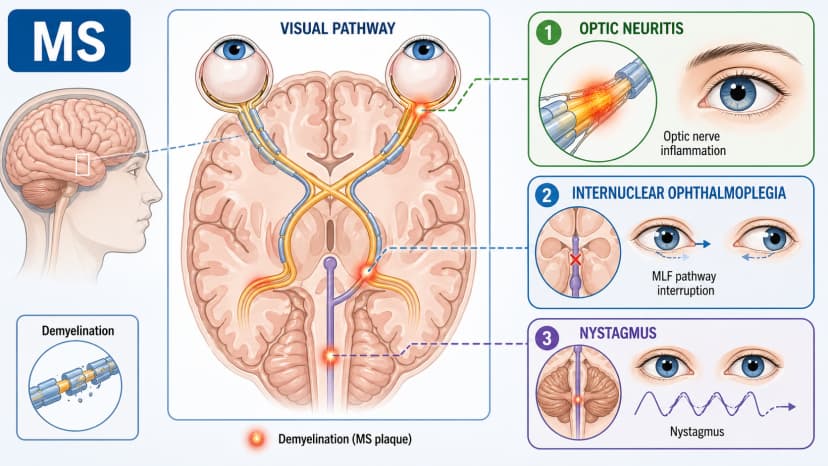
Key Takeaways
- Optic neuritis is often the first sign of MS and occurs in 50% of patients
- Internuclear ophthalmoplegia (INO) is very suggestive of MS in young adults
- Visual symptoms in MS usually improve but may leave some residual deficit
- Heat and fatigue worsen symptoms (Uhthoff phenomenon)
- Disease-modifying therapies reduce risk of new visual attacks
How MS Affects Vision
MS damages the myelin coating of nerves (demyelination). When this affects the visual pathways, various symptoms can result:
Optic Neuritis
The most common visual complication:
- Pain with eye movement
- Vision loss over hours to days
- Color desaturation-colors appear washed out
- Usually one eye at a time
- Often first MS symptom
Recovery: Most people recover good vision, but subtle deficits may persist.
See Optic Neuritis for detailed information.
Internuclear Ophthalmoplegia (INO)
Damage to connections between eye movement centers:
- One eye can't move inward when looking to the side
- Other eye has nystagmus (jerking movements)
- May cause double vision or oscillopsia
- Bilateral INO in young adult is highly suggestive of MS
Other Eye Movement Disorders
- Nystagmus-involuntary eye movements
- Sixth nerve palsy-can't look outward
- Skew deviation-vertical misalignment
- Gaze palsies-difficulty looking in certain directions
Visual Field Defects
From demyelination in visual pathways beyond the optic nerve:
- Chiasmal or retrochiasmal lesions
- Hemianopia (loss of half visual field)
- Various patterns depending on lesion location
Uhthoff Phenomenon
Worsening of visual symptoms with:
- Heat (hot weather, exercise, hot shower)
- Fever
- Fatigue
- Stress
Vision returns to baseline when temperature normalizes or after rest. This doesn't mean MS is worsening-it's a transient effect.
Diagnosis
Eye Examination Findings
- Reduced visual acuity (during acute optic neuritis)
- RAPD (relative afferent pupillary defect)
- Color vision loss
- Optic disc pallor (after optic neuritis)
- Abnormal eye movements
Testing
Visual evoked potentials (VEP)
- Shows delayed nerve conduction
- Can detect prior optic neuritis even if vision recovered
- Useful for MS diagnosis
Optical coherence tomography (OCT)
- Measures retinal nerve fiber layer thickness
- Thinning indicates optic nerve damage
- Can track disease over time
- Shows demyelinating lesions
- Essential for MS diagnosis - see understanding your MRI results for what to expect
- Monitors disease activity
- Documents visual field defects
- Tracks changes over time
Treatment
Acute Optic Neuritis
- IV methylprednisolone speeds recovery
- Corticosteroids are the standard treatment for MS visual relapses
- Doesn't change final visual outcome
- Consider starting MS disease-modifying therapy
Disease-Modifying Therapy
Reduces risk of future relapses including visual attacks:
- Multiple medication options available
- Work with neurologist to select appropriate therapy
- Earlier treatment generally better
Symptomatic Treatment
For nystagmus:
- Gabapentin or memantine may help
- Often difficult to treat
For double vision:
- Prisms
- Patching
- Often improves spontaneously
Rehabilitation
- Low vision services if significant visual loss
- Occupational therapy for adaptations
- Visual rehabilitation programs
Living with MS Visual Problems
Managing Uhthoff Phenomenon
- Avoid overheating
- Use cooling vests in hot weather
- Take cool showers
- Rest when fatigued
- Use air conditioning
Daily Adaptations
- Good lighting
- Larger fonts on devices
- Audio books if reading difficult
- Contrast enhancement
- Rest breaks during visual tasks
Driving
- Visual requirements vary by location
- May need formal driving evaluation
- Report visual changes to doctor
Monitoring
- Regular neuro-ophthalmology visits
- Periodic OCT to track nerve layer
- Report new visual symptoms promptly
When to Seek Care
Contact your neurologist or neuro-ophthalmologist if you experience:
- New vision loss or blurring
- New double vision
- Pain with eye movement
- Visual symptoms lasting more than 24 hours
- Worsening of known visual problems
New visual symptoms may indicate an MS relapse requiring treatment.
Prognosis
For Individual Attacks
- Most visual recovery occurs within months
- Many people recover good functional vision
- Some residual deficit is common (color vision, contrast)
Long-Term
- Disease-modifying therapy reduces relapse frequency
- Cumulative damage possible with repeated attacks
- Most people maintain functional vision
- Regular monitoring important
Frequently Asked Questions
Will I go blind from MS?
Complete blindness from MS is rare. While optic neuritis can cause significant vision loss, most people recover functional vision. The key is early treatment and disease modification to reduce attacks.
Why does my vision get worse when I'm hot?
This is Uhthoff phenomenon. Heat slows nerve conduction in demyelinated nerves. It's temporary and doesn't mean your MS is worsening. Cool down and your vision will return to baseline.
Should I start MS treatment if I've only had optic neuritis?
If MRI shows brain lesions suggesting MS risk, early treatment is often recommended. Our optic neuritis and MS risk guide walks through what this means for you. Discuss with your neurologist-early treatment may prevent or delay MS and future attacks.
Can MS affect vision in both eyes at once?
Usually MS causes optic neuritis in one eye at a time. Simultaneous bilateral involvement is more concerning for NMO/NMOSD and should prompt antibody testing.
How often should I get my eyes checked?
Regular neuro-ophthalmology follow-up depends on your situation. Generally, periodic monitoring with OCT and clinical exam is recommended, with more frequent visits if having active symptoms.
References
Medical Disclaimer: This information is for educational purposes only and does not replace professional medical advice, diagnosis, or treatment. If you have concerns about MS or visual symptoms, please consult a qualified healthcare provider.
Sources:
- Balcer LJ, et al. Vision and vision-related outcome measures in multiple sclerosis. Brain. 2015;138(Pt 1):11-27.
- National Multiple Sclerosis Society. Vision Problems.
- Thompson AJ, et al. Diagnosis of multiple sclerosis: 2017 revisions of the McDonald criteria. Lancet Neurol. 2018;17(2):162-173.
- MedlinePlus. Multiple Sclerosis.