

Intracranial Hypotension
Low pressure inside the skull from cerebrospinal fluid leak, causing positional headaches and sometimes visual symptoms.
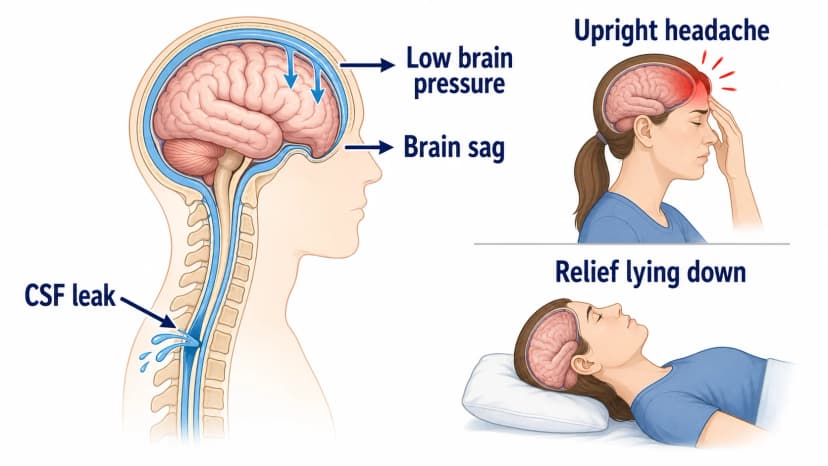
Intracranial hypotension occurs when cerebrospinal fluid (CSF) leaks from the spinal canal, causing low pressure inside the skull. The hallmark symptom is headache that worsens when upright and improves when lying down.
Key Takeaways
- Positional headache is the key feature-worse upright, better lying flat
- Caused by CSF leak-often spontaneous or after lumbar puncture
- Visual symptoms can include double vision
- Usually treatable-with conservative measures or blood patch
- Important to diagnose correctly-often initially misdiagnosed
Understanding Intracranial Hypotension
The brain floats in cerebrospinal fluid (CSF), which cushions it from the skull. When CSF leaks out (usually from the spine), the pressure inside the head drops. Without adequate cushioning, the brain sags downward when upright, pulling on pain-sensitive structures and cranial nerves.
Symptoms
Headache
Classic positional pattern:
- Severe when upright (sitting or standing)
- Improves significantly when lying flat
- Worse as the day progresses
- Better in morning after sleeping
Character:
- Often described as severe, throbbing
- May involve entire head or back of head
- Can be debilitating
Visual Symptoms
- Double vision-from sixth nerve palsy
- Blurred vision
- Visual field changes
- Rarely, vision loss
Other Symptoms
- Neck pain and stiffness
- Nausea
- Hearing changes (muffled, tinnitus)
- Dizziness
- Cognitive symptoms ("brain fog")
- Arm or facial numbness or tingling
Causes
Spontaneous CSF Leak
- Occurs without obvious cause
- Often in connective tissue disorders (Ehlers-Danlos, Marfan)
- Tear in spinal dura (covering of spinal cord)
Post-Procedural
- After lumbar puncture (spinal tap)
- After spinal anesthesia
- After spinal surgery
Traumatic
- After spine trauma
- After certain injuries
Diagnosis
Clinical Assessment
- Characteristic positional headache pattern
- Onset timing (spontaneous vs post-procedure)
- Associated symptoms
Imaging
- Brain sagging
- Pachymeningeal enhancement (dura lights up with contrast)
- Subdural fluid collections
- Pituitary enlargement
MRI spine
- May show site of CSF leak
- Epidural fluid collections
CT myelography
- Gold standard for locating leak
- Dye injected into spinal fluid, CT scan shows leak site
Lumbar Puncture
- Low opening pressure supports diagnosis, but normal pressure does not rule it out
- Must be done lying down (can briefly worsen symptoms)
Treatment
Conservative Management
First-line approach:
- Bed rest (lying flat)
- Hydration
- Caffeine
- Time (some leaks seal spontaneously)
Epidural Blood Patch
Highly effective treatment
- Patient's own blood injected into epidural space
- Blood clots and seals the leak
- Often provides rapid relief
- May need to be repeated
Targeted Treatment
If leak site identified:
- Fibrin glue injection
- Surgical repair (rarely needed)
For Sixth Nerve Palsy
- Usually resolves when CSF pressure normalizes
- Prism glasses for temporary double vision relief
Prognosis
With Treatment
- Most patients recover completely
- Blood patch effective in 70-90%
- May need multiple patches
- Symptoms can recur
Complications if Untreated
- Chronic headache
- Subdural hematoma
- Persistent double vision
- Rarely, severe complications
Frequently Asked Questions
How long does recovery take?
With successful blood patch, many patients feel better within hours to days. Complete recovery may take weeks. Some need multiple blood patches. Conservative treatment alone may take weeks to months.
Can I prevent post-lumbar puncture headache?
Lying flat immediately after lumbar puncture was traditionally recommended but hasn't been proven to prevent headaches. Using smaller needles and atraumatic needle tips reduces risk. Stay well-hydrated.
Will my double vision go away?
Yes, in most cases. The sixth nerve palsy from intracranial hypotension typically resolves once the CSF pressure normalizes. This may take weeks to months. Temporary prism glasses can help in the meantime.
Can intracranial hypotension come back?
Yes, especially in people with spontaneous leaks due to connective tissue disorders. Some patients have recurrent episodes requiring repeated treatment.
References
Medical Disclaimer: This information is for educational purposes only and does not replace professional medical advice, diagnosis, or treatment. If you have concerns about headache or any symptoms, please consult a qualified healthcare provider.
Sources:
- Schievink WI. Spontaneous spinal cerebrospinal fluid leaks. Headache. 2008;48(8):1166-1172.
- Mokri B. Spontaneous intracranial hypotension. Curr Neurol Neurosci Rep. 2001;1(2):109-117.
- Kranz PG, et al. CSF leaks: epidural blood patches. Lancet Neurol. 2017;16(3):237-252.
- American Academy of Ophthalmology EyeWiki. Spontaneous Intracranial Hypotension.
- Spinal CSF Leak Foundation. About Spinal CSF Leaks.