

Non-Proliferative Diabetic Retinopathy (NPDR)
The early stage of diabetic eye disease with retinal changes but no abnormal blood vessel growth. Learn about stages, monitoring, and prevention of progression.
Non-proliferative diabetic retinopathy (NPDR) is the early stage of diabetic retinopathy, where diabetes damages the small blood vessels in the retina but abnormal new blood vessels have not yet grown. Most diabetics with retinopathy are in this stage. While vision may be normal, NPDR can progress to the more severe proliferative stage and can cause vision loss through macular edema. Because high blood pressure causes similar retinal changes, some patients wonder whether their findings are from diabetes or blood pressure - often, both contribute.
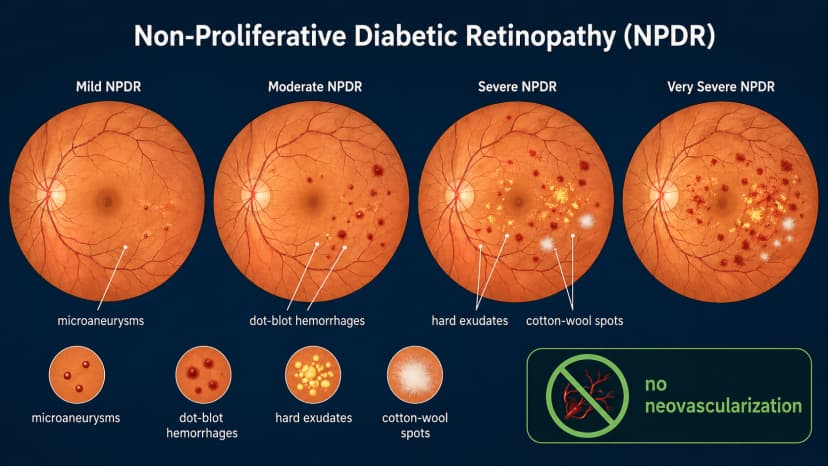
Key Takeaways
- Early stage of diabetic retinopathy
- No abnormal new blood vessel growth (that's "proliferative")
- Often no symptoms-detected only by eye exam
- Three severity levels: mild, moderate, severe
- Severe NPDR has high risk of progressing to proliferative stage
- Treatment focuses on systemic control and treating macular edema if present
What Happens in NPDR
Blood Vessel Changes
High blood sugar damages retinal blood vessels:
- Vessel walls weaken
- Microaneurysms form (tiny bulges in vessel walls)
- Vessels leak fluid and blood
- Vessel closure occurs (capillary dropout)
- The retina becomes ischemic (oxygen-starved) in areas
What the Doctor Sees
Microaneurysms:
- Tiny red dots (earliest sign)
- Weak spots in vessel walls
Hemorrhages:
- Dot hemorrhages (small, round)
- Blot hemorrhages (larger, deeper)
- Flame hemorrhages (superficial, flame-shaped)
Hard Exudates:
- Yellow, waxy deposits
- From leaked lipids
- Often in rings around leaking areas
Cotton Wool Spots:
- White, fluffy areas
- Areas of retinal nerve fiber layer infarction
- Sign of ischemia
Venous Changes:
- Venous beading (varies in caliber)
- Venous loops
Intraretinal Microvascular Abnormalities (IRMA):
- Abnormal vessels within the retina
- Shunt vessels
- Sign of severe NPDR
Stages of NPDR
Mild NPDR
- At least one microaneurysm
- Earliest detectable stage
- Low risk of progression in short term
- Annual monitoring typically sufficient
Moderate NPDR
- More than just microaneurysms
- Hemorrhages, hard exudates in more than one quadrant
- Not meeting criteria for severe
- Monitoring every 6-9 months typically
Severe NPDR
Severe NPDR has high risk of progressing to proliferative diabetic retinopathy.
The "4-2-1 rule" defines severe NPDR (any of the following):
- Hemorrhages in 4 quadrants
- Venous beading in 2 or more quadrants
- IRMA in 1 or more quadrants
Without treatment, ~50% progress to PDR within one year.
Very Severe NPDR
- Two or more features of severe NPDR
- Very high risk of progression
- Consider treatment to prevent PDR
Symptoms
Often None
Many patients with NPDR have no symptoms.
Vision may be completely normal, especially in mild and moderate stages. This is why screening eye exams are so important-you can't rely on symptoms to detect NPDR.
When Symptoms Occur
Symptoms usually indicate macular involvement:
- Blurred vision
- Difficulty reading
- Colors appear washed out
- Fluctuating vision (varies with blood sugar)
Diabetic Macular Edema (DME)
The Main Cause of Vision Loss in NPDR
Diabetic macular edema can occur at any stage of NPDR:
- Leaking blood vessels cause fluid to accumulate in the macula
- Macula is responsible for central, detailed vision
- Causes blurred and distorted central vision
- Treatable with injections
DME Can Occur With:
- Mild NPDR
- Moderate NPDR
- Severe NPDR
- Proliferative diabetic retinopathy
Diagnosis
Dilated Eye Exam
Essential for detection:
- Pupil dilation allows view of entire retina
- Direct visualization of retinal changes
- Staging of NPDR severity
Optical Coherence Tomography (OCT)
- Cross-sectional retinal images
- Detects macular edema (fluid in macula)
- Essential for management
- Non-invasive
Fluorescein Angiography
- Dye study showing blood vessel leakage and closure
- Helps determine extent of disease
- Guides treatment decisions
- Used selectively (not for all patients)
OCT Angiography
- Non-invasive vessel imaging
- Shows areas of non-perfusion
- Increasingly used for monitoring
Treatment
For NPDR Without Macular Edema
Primary Treatment: Systemic Control
No eye treatment is typically needed for NPDR without macular edema. Focus on:
- Blood sugar control-most important factor
- Blood pressure control-reduces progression risk
- Cholesterol management
- Smoking cessation
- Regular monitoring
For NPDR With Macular Edema
If macular edema is present, it should be treated regardless of NPDR severity:
- Aflibercept (Eylea)
- Ranibizumab (Lucentis)
- Bevacizumab (Avastin, off-label)
- Very effective at reducing edema and improving vision
Steroid Options:
- Dexamethasone implant (Ozurdex)
- For patients who don't respond to anti-VEGF
- Risk of cataract, elevated eye pressure
Laser Photocoagulation:
- Focal/grid laser to leaking areas
- Less commonly used now
- May be adjunct to injections
For Severe NPDR
Options to Prevent Progression to PDR:
- Close monitoring (every 2-4 months)
- Consider anti-VEGF injections (can prevent progression)
- Consider panretinal photocoagulation if high-risk features
- Decision individualized based on:
- Reliability of follow-up
- Presence of high-risk features
- Patient factors
Monitoring Schedule
| NPDR Stage | Typical Follow-Up |
|---|---|
| Mild | 12 months |
| Moderate | 6-9 months |
| Severe | 3-4 months |
| With macular edema | Monthly initially during treatment |
Schedules are individualized based on patient factors
Prognosis
Progression Rates (Without Systemic Improvement)
- Mild NPDR: 5% progress to PDR in 1 year
- Moderate NPDR: 12-27% progress to PDR in 1 year
- Severe NPDR: ~50% progress to PDR in 1 year
With Good Systemic Control
- Progression can be significantly slowed
- Some features may improve
- Macular edema responds well to treatment
Key Factors in Prognosis
- Blood sugar control (HbA1c)
- Blood pressure control
- Duration of diabetes
- Baseline severity
- Adherence to follow-up
Prevention of Progression
What You Can Do
Blood Sugar Control:
- Target HbA1c <7% for most patients
- Work with your diabetes team
- Monitor blood sugar regularly
- Take medications as prescribed
Blood Pressure Control:
- Target <130/80 typically
- Take medications as prescribed
- Reduce salt intake
- Exercise as recommended
Other Measures:
- Don't smoke
- Control cholesterol
- Maintain healthy weight
- Regular exercise
The Evidence
Studies show:
- Intensive blood sugar control reduces progression by 50-70%
- Blood pressure control reduces progression by ~30%
- Combining both provides even greater protection
Frequently Asked Questions
If I have no symptoms, why do I need treatment or monitoring?
NPDR often has no symptoms, but it can progress to sight-threatening disease. Regular monitoring catches problems early when they're most treatable. Macular edema can develop at any time and responds best to early treatment.
Will my diabetic retinopathy get worse?
This depends largely on your blood sugar and blood pressure control. With good systemic control, progression can be significantly slowed or even stopped. Without it, progression is likely over time.
Do I need eye injections?
Not necessarily. Injections are only needed if you have macular edema causing vision problems. NPDR without macular edema is managed with systemic control and monitoring.
Can diabetic retinopathy improve?
Some features like mild macular edema can improve with better blood sugar control. More established changes usually don't reverse completely, but progression can be stopped.
How often do I need eye exams?
This depends on the severity of your NPDR. Mild disease may be monitored annually, while severe NPDR needs exams every few months. Your eye doctor will advise on your specific schedule.
Is NPDR serious?
While NPDR is the early stage and often doesn't affect vision, it indicates your diabetes is affecting your eyes. It can progress to vision-threatening disease, which is why monitoring and systemic control are important.
References
Medical Disclaimer: This information is for educational purposes only and does not replace professional medical advice, diagnosis, or treatment. If you have diabetes, maintain regular eye exams as recommended by your healthcare providers.
Sources:
- American Academy of Ophthalmology. Diabetic Retinopathy.
- Early Treatment Diabetic Retinopathy Study Research Group. Grading diabetic retinopathy from stereoscopic color fundus photographs. Ophthalmology. 1991;98(5 Suppl):786-806.
- Diabetes Control and Complications Trial Research Group. The effect of intensive treatment of diabetes on the development and progression of long-term complications. N Engl J Med. 1993;329(14):977-986.
- National Eye Institute. Diabetic Retinopathy.