
Nystagmus
Involuntary rhythmic eye movements that may cause oscillopsia or reduced visual acuity depending on the type.
Nystagmus is involuntary, rhythmic oscillation of the eyes. These repetitive eye movements can be present from birth (congenital/infantile) or develop later in life (acquired). The pattern, direction, and characteristics of nystagmus provide important clues about its underlying cause and guide appropriate evaluation and treatment.
Key Takeaways
- Congenital nystagmus typically does not cause oscillopsia (bouncing vision) because the brain adapts
- Acquired nystagmus usually causes oscillopsia and often indicates a neurological problem requiring evaluation
- The pattern of nystagmus (direction, waveform, null point) helps identify the cause
- Some types indicate serious conditions requiring urgent workup (downbeat nystagmus, see-saw nystagmus)
- Treatment depends on the type and underlying cause-ranges from observation to medications to surgery
Understanding Nystagmus
What Causes Eye Oscillation?
Normal eye position is maintained by a complex system involving:
- The vestibular system (inner ear balance organs)
- The cerebellum (coordinates movement)
- Brainstem gaze centers
- Eye muscles and their nerves
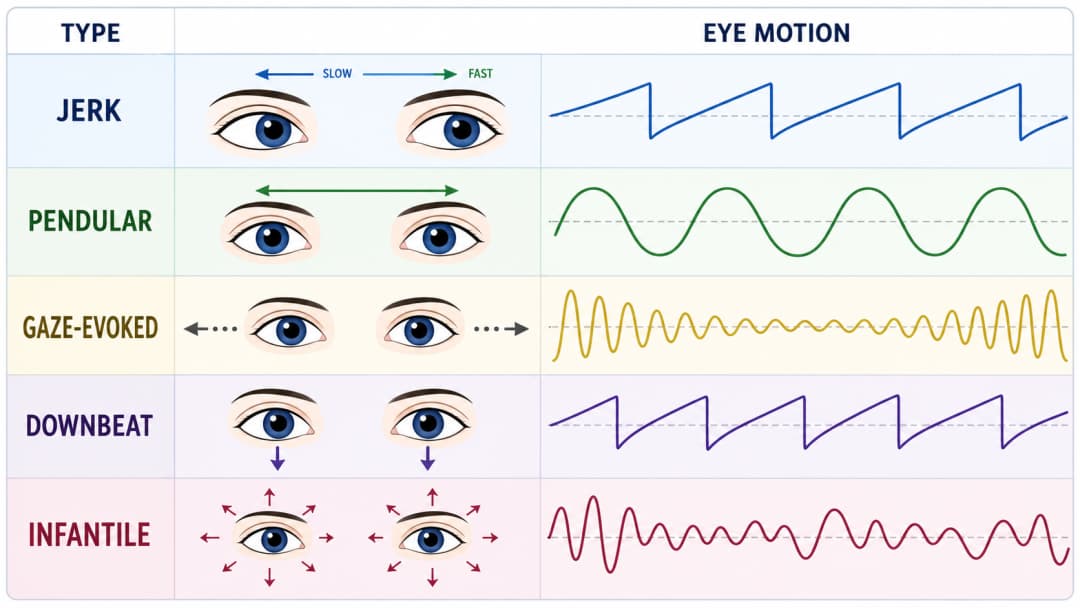
Nystagmus occurs when this system is disrupted, causing the eyes to drift slowly in one direction, then quickly correct back (jerk nystagmus) or oscillate equally in both directions (pendular nystagmus).
Waveforms
Jerk nystagmus: Slow drift in one direction, fast corrective movement in the opposite direction. Named by the direction of the fast phase.
Pendular nystagmus: Equal speed oscillation in both directions, like a pendulum.
Types of Nystagmus
By Age of Onset
Congenital/Infantile Nystagmus
- Present from infancy (noticed in first months of life)
- Usually horizontal, even in vertical gaze
- Often has a null point-a gaze direction where nystagmus is minimal
- Dampens with convergence (looking at near objects)
- Patient typically does NOT perceive oscillopsia
- May adopt a head turn or tilt to use null point
- Associated with decreased visual acuity
- May be isolated or associated with:
- Albinism
- Congenital cataracts
- Optic nerve hypoplasia
- Retinal disorders (achromatopsia, rod-cone dystrophy)
Acquired Nystagmus
- Develops later in life
- Usually causes oscillopsia (bouncing or shimmering vision)
- Often indicates a neurological problem
- Requires evaluation to determine cause
- Direction and pattern help localize the lesion
By Direction
Downbeat Nystagmus
Fast phase beats downward
Downbeat nystagmus is often associated with lesions at the craniocervical junction (where skull meets spine) and requires MRI imaging. Autoimmune causes such as anti-GAD antibody syndrome should also be considered.
Common causes:
- Chiari malformation (brain tissue extends into spinal canal)
- Cerebellar degeneration
- Multiple sclerosis
- Stroke
- Medications (lithium, anticonvulsants)
- Magnesium deficiency
Upbeat Nystagmus
Fast phase beats upward
Associated with:
- Brainstem lesions (medulla or pons)
- Cerebellar vermis lesions
- Wernicke encephalopathy (thiamine deficiency)
- Drug toxicity
Horizontal Nystagmus
Fast phase beats left or right
Most common direction; causes include:
- Infantile nystagmus
- Vestibular dysfunction
- Brainstem/cerebellar lesions
- Drug effects (alcohol, sedatives, anticonvulsants)
Torsional (Rotary) Nystagmus
Eyes rotate around the visual axis
Often indicates:
- Vestibular lesions
- Brainstem lesions
- Often combined with other directions
Special Types
Periodic Alternating Nystagmus (PAN)
- Horizontal nystagmus that reverses direction every 90-120 seconds
- Associated with craniocervical junction abnormalities, cerebellar disease
- May respond to baclofen treatment
See-Saw Nystagmus
- One eye rises and intorts while other falls and extorts, then reverses
- Often associated with parasellar lesions (near pituitary)
- Requires neuroimaging
Vestibular Nystagmus
- Follows peripheral vestibular system damage
- Mixed horizontal-torsional
- Associated with vertigo, nausea
- Suppressed by visual fixation
- Usually temporary (acute vestibular neuritis)
Gaze-Evoked Nystagmus
- Occurs only when looking in certain directions
- Normal in extreme lateral gaze
- Pathological if persistent or asymmetric
- Caused by medications, cerebellar disease, brainstem lesions
Symptoms
In Infantile Nystagmus
- Reduced visual acuity (usually mild to moderate)
- Head turn or tilt (to use null point)
- No oscillopsia (world doesn't appear to shake)
- Nystagmus may worsen with anxiety, fatigue
In Acquired Nystagmus
- Oscillopsia-world appears to bounce, shimmer, or jiggle
- Blurred vision
- Difficulty reading
- Dizziness or imbalance (especially with vestibular causes)
- Nausea
- Difficulty with movement or walking
Diagnosis
Clinical Examination
- Observation of nystagmus characteristics:
- Direction (horizontal, vertical, torsional, mixed)
- Waveform (jerk vs pendular)
- Effect of gaze direction
- Effect of fixation (does it dampen when patient focuses on a target?)
- Presence of null point
- Effect of convergence
Key Tests
- MRI brain and brainstem-essential for acquired nystagmus to rule out structural lesions
- Craniocervical junction MRI-specifically for downbeat nystagmus
- Visual field testing-if optic nerve or chiasmal lesion suspected
- OCT-to evaluate retina and optic nerve
- Vestibular testing (ENG/VNG)-if vestibular cause suspected
- Blood tests-B12, thiamine, magnesium, drug levels
When to Image
Urgent MRI indicated for:
- Any acquired nystagmus (especially in adults)
- Downbeat or upbeat nystagmus
- See-saw nystagmus
- Nystagmus with other neurological symptoms
- Nystagmus that doesn't fit typical infantile pattern
Treatment
Treatment depends on the type and underlying cause of nystagmus.
For Infantile Nystagmus
Observation-many patients function well without treatment
Optical correction
- Correct any refractive error (glasses/contacts)
- Contact lenses may dampen nystagmus more than glasses
Prisms
- Can shift null point to straight ahead
- Reduces need for head turn
Surgery
- Kestenbaum procedure-moves null point to primary position
- Tenotomy procedures-may reduce nystagmus intensity
- Generally reserved for significant head turns or marked visual impact
Medications
- Gabapentin or memantine-may reduce intensity in some patients
- Effectiveness variable
For Acquired Nystagmus
Treat the underlying cause
- Remove offending medication
- Address nutritional deficiency (thiamine, B12, magnesium)
- Treat structural lesion if possible
Medications (may help reduce oscillopsia)
- Gabapentin-often first-line
- Memantine-NMDA receptor antagonist
- Baclofen-especially for periodic alternating nystagmus
- Clonazepam-may help some types
- 4-aminopyridine-for downbeat nystagmus
Optical aids
- Base-out prisms can induce convergence (dampens some nystagmus)
- Contact lenses provide more stable retinal image
For Vestibular Nystagmus
- Usually self-limited (resolves as vestibular system compensates)
- Vestibular rehabilitation therapy
- Medications for acute symptoms (antiemetics, vestibular suppressants)
Prognosis
Infantile Nystagmus
- Lifelong condition, but stable
- Vision typically 20/40 to 20/200 range
- Many patients function well, especially with null point
- Does not usually progress
- May improve slightly with age
Acquired Nystagmus
- Depends entirely on underlying cause
- Some causes reversible (drug toxicity, nutritional deficiency)
- Others may persist or worsen (degenerative conditions)
- Oscillopsia often improves with treatment
Living with Nystagmus
Practical Tips
- Use your null point-it's okay to turn your head to see better
- Good lighting helps compensate for reduced acuity
- Large print and magnification for reading
- Sit close to screens and boards (classroom, work)
- Take breaks-visual fatigue is common
Driving
- Many people with infantile nystagmus can drive if visual acuity meets legal requirements
- Acquired nystagmus with oscillopsia may preclude driving
- Check your local regulations and discuss with your doctor
At Work/School
- Inform teachers/employers about your vision needs
- Request accommodations (preferred seating, extra time, large print)
- Use assistive technology if helpful
Frequently Asked Questions
Is nystagmus dangerous?
Nystagmus itself is not dangerous, but acquired nystagmus can be a sign of a serious underlying condition that needs diagnosis and treatment. Infantile nystagmus is not dangerous but affects vision.
Will my child's nystagmus get worse?
Infantile nystagmus typically remains stable throughout life. It may even improve slightly as the child develops. It does not usually progress.
Can nystagmus be cured?
Infantile nystagmus cannot be cured, but treatments can improve the condition. Some causes of acquired nystagmus are reversible (like drug toxicity or vitamin deficiency). Treatment focuses on underlying causes and symptom management.
Why does stress make my nystagmus worse?
Nystagmus often increases with stress, anxiety, fatigue, and illness. This is normal and usually temporary. The nystagmus should return to baseline when the trigger resolves.
Can I wear contact lenses with nystagmus?
Yes, and contact lenses may actually help! Because they move with your eyes, they can provide a more stable retinal image than glasses. They may also slightly dampen nystagmus through proprioceptive feedback.
Should my baby have an MRI?
For typical infantile nystagmus with no other concerning features, MRI may not be necessary. However, if there are atypical features or the nystagmus doesn't fit the classic infantile pattern, imaging may be recommended.
Where can I get my nystagmus evaluated?
Acquired nystagmus requires careful neuro-ophthalmological evaluation to determine the underlying cause. The pattern, direction, and waveform of the nystagmus guide both diagnosis and treatment. If you've been told your nystagmus is "just something you have" without a thorough workup, consider evaluation by a neuro-ophthalmologist. Hashemi Eye Care specializes in the evaluation and management of nystagmus and other eye movement disorders.
References
Medical Disclaimer: This information is for educational purposes only and does not replace professional medical advice, diagnosis, or treatment.
Sources:
- Leigh RJ, Zee DS. The Neurology of Eye Movements. 5th ed. Oxford University Press; 2015.
- American Academy of Ophthalmology. Nystagmus.
- Thurtell MJ, Leigh RJ. Treatment of nystagmus. Curr Treat Options Neurol. 2012;14(1):60-72.
- MedlinePlus. Nystagmus.
- Sarvananthan N, et al. The prevalence of nystagmus: the Leicestershire nystagmus survey. Invest Ophthalmol Vis Sci. 2009;50(11):5201-5206.