

Bitemporal Hemianopia
Loss of peripheral vision on both sides (temporal fields), typically caused by compression of the optic chiasm from a pituitary tumor or other midline lesion.
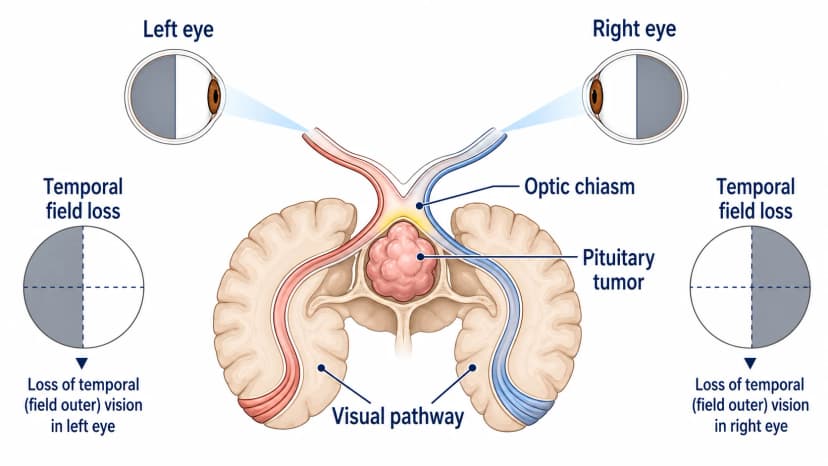
Bitemporal hemianopia is a specific pattern of vision loss affecting the outer (temporal) visual fields of both eyes. It occurs when the optic chiasm-where the optic nerves cross-is compressed, typically by a pituitary tumor or other lesion at the base of the brain.
Key Takeaways
- Both outer (temporal) fields affected
- Indicates optic chiasm compression
- Classic finding with pituitary tumors
- Central vision often preserved initially
- Requires brain imaging to find cause
Understanding the Anatomy
At the optic chiasm, nerve fibers from the inner (nasal) half of each retina cross to the opposite side. These fibers carry information from the temporal (outer) visual fields.
When the chiasm is compressed from below (as with a pituitary tumor), these crossing fibers are damaged first, causing loss of both temporal visual fields.
What Patients Experience
- "Tunnel vision" or narrowed peripheral vision
- Bumping into things on the sides
- Difficulty seeing cars approaching from the side while driving
- May not notice the problem until significant
- Often discovered on routine visual field testing
Common Causes
Pituitary Adenoma
- Most common cause
- Tumor grows upward from pituitary gland
- Compresses chiasm from below
- See Pituitary Tumor
Other Causes
- Craniopharyngioma-benign tumor near pituitary
- Meningioma-tumor of the meninges
- Aneurysm-of nearby blood vessels
- Empty sella syndrome
- Chiasmal glioma-tumor of the optic chiasm
Diagnosis
Visual Field Testing
- Visual field test shows characteristic pattern
- Defects respect the vertical midline
- May be asymmetric between the two eyes
- "Junction scotoma" if optic nerve also affected
Brain Imaging
- MRI brain with contrast
- Shows the lesion compressing the chiasm
- Helps identify the specific cause
- May need MRI of pituitary with specialized protocol
Endocrine Testing
If pituitary tumor suspected:
- Prolactin level
- Growth hormone/IGF-1
- Thyroid function
- Cortisol levels
- Other pituitary hormones
Treatment
Treatment depends on the underlying cause:
Pituitary Adenoma
- Dopamine agonists for prolactinomas
- Transsphenoidal surgery for other types
- Radiation therapy in some cases
- See Pituitary Tumor
Other Lesions
- Surgery for accessible tumors
- Radiation for some lesions
- Monitoring for slow-growing tumors
Visual Prognosis
- Early treatment often leads to improvement
- Vision may recover significantly if compression relieved
- Recovery depends on:
- Duration of compression
- Severity of damage
- Speed of treatment
- Some permanent loss may remain
Living with Bitemporal Hemianopia
Driving Considerations
- May not be safe to drive
- Check with your state's requirements
- Some patients can drive with adaptations
Daily Adaptations
- Turn head more to scan periphery
- Be extra careful crossing streets
- Use mirrors strategically at home
- Good lighting important
Important: Bitemporal hemianopia indicates a lesion at the optic chiasm and requires prompt brain imaging to identify the cause. Most causes are treatable.
Frequently Asked Questions
Why does a pituitary problem affect side vision?
The pituitary gland sits below the optic chiasm, where crossing visual fibers carry information from the outer fields of both eyes. Upward pressure on those crossing fibers classically causes temporal field loss.
Can bitemporal hemianopia improve after treatment?
Often it can, especially when compression is found and treated before long-standing optic nerve damage develops. Recovery depends on how severe and prolonged the compression was.
Is this the same as glaucoma tunnel vision?
No. Both can narrow peripheral vision, but the pattern is different. Bitemporal hemianopia respects the vertical midline and points to the chiasm; glaucoma usually follows optic nerve fiber bundle patterns.
Medical Disclaimer: This information is for educational purposes only and does not replace professional medical advice, diagnosis, or treatment.
Sources:
- American Academy of Ophthalmology. Pituitary Adenoma. EyeWiki.
- Melmed S. Pituitary-tumor endocrinopathies. N Engl J Med. 2020;382(10):937-950.