

Homonymous Hemianopia
Loss of vision on the same side (left or right) in both eyes, caused by damage to the brain's visual pathways, often from stroke.
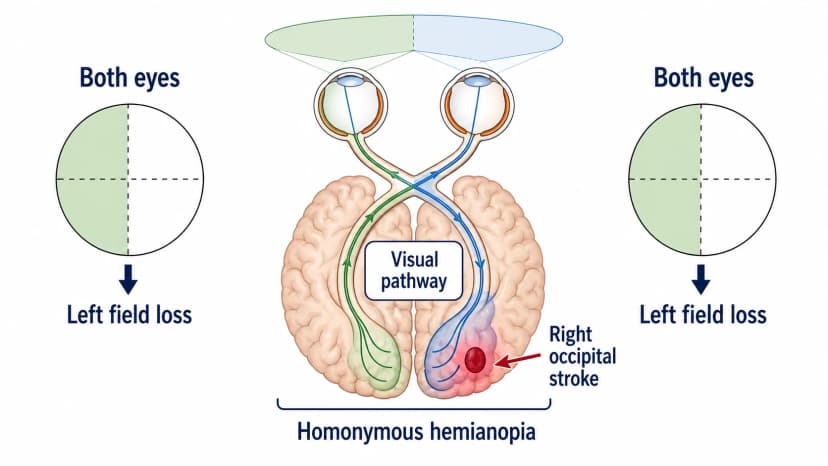
Homonymous hemianopia is loss of half the visual field on the same side in both eyes. For example, a right homonymous hemianopia means the right half of vision is lost in both the left and right eyes. This indicates damage to the brain (not the eyes) and is most commonly caused by stroke.
Key Takeaways
- Same side affected in both eyes (left or right)
- Indicates brain damage, not eye problem
- Stroke is the most common cause
- Lesion is on the opposite side of the visual field loss
- Affects daily activities including reading and driving
Understanding the Pattern
Due to how the visual pathways are organized:
- Information from the left visual field goes to the right brain
- Information from the right visual field goes to the left brain
So damage to the right side of the brain causes left homonymous hemianopia, and vice versa.
What Patients Experience
- Missing half of the visual world
- Bumping into objects on the affected side
- Difficulty reading (especially left hemianopia)
- Getting lost in familiar places
- May not initially realize vision is abnormal
- "Where did that car/person come from?"
Causes
Stroke (Most Common)
- Posterior cerebral artery stroke-most common
- Middle cerebral artery stroke
- See Stroke and Vision
Other Causes
- Brain tumor
- Traumatic brain injury
- Brain surgery complications
- Multiple sclerosis (less common)
- Hemorrhage
- Infection or abscess
Associated Features
The specific features can help localize where in the brain the damage occurred:
Complete vs. Incomplete
- Complete: Entire half field missing
- Incomplete: Partial involvement (quadrantanopia)
Macular Sparing
- Central vision preserved
- More common with occipital lobe lesions
- May allow some reading ability
Congruence
- Congruent: Defects nearly identical in both eyes (occipital lobe)
- Incongruent: Defects differ between eyes (more anterior lesions)
Diagnosis
Visual Field Testing
- Visual field test documents the pattern
- Shows defect respecting vertical midline
- Quantifies severity
Brain Imaging
- MRI brain to identify the lesion
- CT scan if MRI not immediately available
- MRA or CTA if vascular cause suspected
Stroke Workup
If stroke is the cause:
- Cardiac evaluation
- Carotid imaging
- Blood tests for risk factors
Treatment
Acute Stroke
- Emergency stroke treatment if within time window
- tPA (clot-busting medication) if eligible
- Thrombectomy for large vessel occlusion
Rehabilitation
- Visual rehabilitation-compensatory strategies
- Scanning training-learning to look toward blind side
- Prism therapy-controversial but may help some
- Occupational therapy-adapting daily activities
Treat Underlying Cause
- Stroke prevention measures
- Tumor treatment if applicable
- Address other causes appropriately
Visual Prognosis
- Some spontaneous recovery possible (especially first 3-6 months)
- Complete recovery uncommon
- Learning to compensate is key
- Rehabilitation can improve function even without recovery
Living with Homonymous Hemianopia
Reading Difficulties
Particularly challenging with left hemianopia:
- Difficulty finding the start of lines
- Use a ruler or line guide
- Some patients benefit from reading vertically
- Large print may help
Driving
- Most jurisdictions have visual field requirements
- Usually cannot drive with complete hemianopia
- Some may qualify with incomplete defects
- Check local regulations
Safety Strategies
- Turn head actively toward blind side
- Arrange furniture to minimize obstacles
- Good lighting throughout home
- Walk with affected side toward wall
- Use a cane if needed
Technology Aids
- Text-to-speech software
- Large monitors positioned appropriately
- Apps that can help with reading
Related Conditions
- Quadrantanopia-one quarter affected
- Stroke and Vision
Frequently Asked Questions
Why is vision lost on the same side in both eyes?
After the optic chiasm, the brain carries left-world vision on the right side and right-world vision on the left side. A right-sided brain injury therefore causes left-sided field loss in both eyes.
Can I just turn my head to compensate?
Active scanning helps, but it takes training and practice. Occupational therapy, visual rehabilitation, reading strategies, and environmental changes can make compensation more reliable.
Is new homonymous hemianopia a stroke symptom?
Yes. Sudden same-side field loss can be a stroke symptom. Call 911 immediately, especially if it occurs with any BE-FAST warning sign: balance trouble, new eye or vision symptoms, face droop, arm weakness, speech trouble, confusion, trouble walking, or sudden severe headache.
Medical Disclaimer: This information is for educational purposes only and does not replace professional medical advice, diagnosis, or treatment.
Sources:
- Goodwin D. Homonymous Hemianopia. StatPearls/NCBI.