

Stroke-Related Vision Loss
Vision loss or visual symptoms caused by stroke affecting the visual pathways in the brain. Includes visual field defects, double vision, and visual processing problems.
Stroke can affect vision in many ways, depending on where in the brain the stroke occurs. The visual pathways extend from the eyes through the brainstem and into the occipital lobes at the back of the brain. Damage anywhere along these pathways can cause visual symptoms ranging from visual field defects to complete blindness.
Key Takeaways
- Stroke can cause sudden vision loss or visual changes
- Location of stroke determines the type of visual deficit
- Homonymous hemianopia is a common pattern (loss of half the visual field in both eyes)
- May also cause double vision if brainstem affected
- Rehabilitation possible-brain can partially compensate
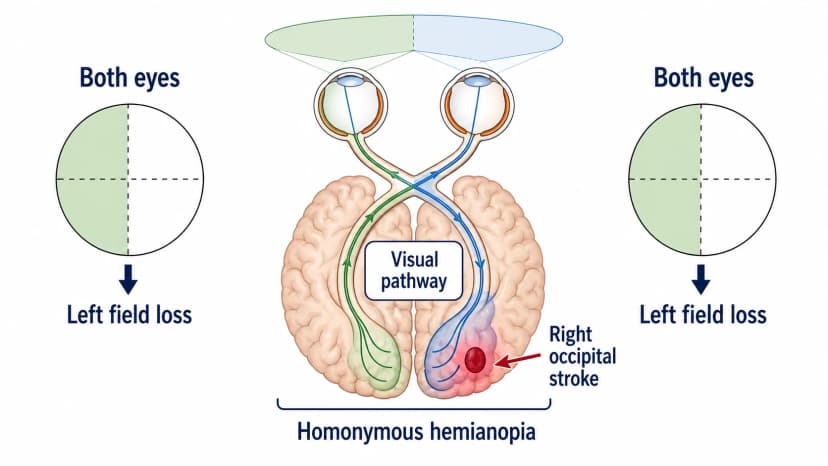
How Stroke Affects Vision
The visual system involves:
- Optic nerves carrying signals from the eyes
- Optic chiasm where fibers partially cross
- Optic tracts and radiations carrying signals through the brain
- Occipital cortex where vision is processed
Stroke can affect any of these areas, producing different patterns of vision loss.
Types of Vision Loss
Homonymous Hemianopia
Most common visual deficit from stroke
- Loss of same half of visual field in both eyes
- Right-sided stroke → left visual field loss (and vice versa)
- Often not noticed initially-patient turns head to compensate
- May affect reading (can't see words on one side)
Quadrantanopia
- Loss of one quarter of visual field
- Upper or lower, right or left
- Caused by partial involvement of visual pathways
Cortical Blindness
- Complete vision loss from bilateral occipital stroke
- Eyes and optic nerves intact
- May have preserved light perception
- Can occur with preserved pupil reactions
Other Visual Symptoms
Hemineglect
- Not true blindness-patient ignores one side of space
- May not eat food on one side of plate
- Common with right parietal stroke
Visual Agnosia
- Cannot recognize objects despite seeing them
- May not recognize faces (prosopagnosia)
Double vision
- From brainstem stroke affecting eye movement nerves
- Sixth nerve palsy, third nerve palsy
- Internuclear ophthalmoplegia
Symptoms
Warning Signs
Sudden vision loss or visual changes can be a sign of stroke. Call 911 immediately if you experience:
- Sudden vision loss in one or both eyes
- Sudden visual field cut
- Sudden double vision
- Especially if accompanied by BE-FAST symptoms: balance trouble, face droop, arm weakness, speech difficulty, numbness, confusion, or trouble walking
What Patients Experience
- "I can't see on one side"
- "I keep bumping into things"
- "I can't see to read"
- "I see double"
- May not be aware of visual field loss
Diagnosis
Clinical Examination
- Visual field testing-confrontation and formal
- Eye movement assessment
- Pupil examination
- Full neurological examination
Imaging
- Shows stroke location and extent
- Diffusion-weighted imaging for acute stroke
- Identifies affected visual pathway structures
- Often done first in emergency
- Rules out hemorrhage
- Less sensitive for ischemic stroke
Vascular Evaluation
- Carotid imaging
- Cardiac evaluation
- Blood tests for stroke risk factors
Treatment
Acute Stroke Treatment
- Time-critical-"time is brain"
- Thrombolysis (clot-busting medication) if eligible
- Thrombectomy (mechanical clot removal) in some cases
- Supportive care and monitoring
Secondary Prevention
- Aspirin or other antiplatelets
- Anticoagulation if indicated (atrial fibrillation)
- Statin therapy
- Blood pressure management
- Diabetes control
- Smoking cessation
Visual Rehabilitation
Compensatory strategies
- Scanning training (learning to look into blind field)
- Reading strategies
- Environmental modifications
- Some evidence for visual field expansion training
- Prism glasses for hemianopia (selected cases)
Occupational therapy
- Daily living adaptations
- Safety modifications
Living with Visual Field Loss
Practical Tips
- Turn head to scan into blind field
- Use finger as guide when reading
- Be aware of hazards on affected side
- Good lighting important
- Organize environment
Driving
- Usually not allowed with hemianopia
- Laws vary by location
- May be possible if visual field recovers
- Discuss with doctor
Reading
- Often significantly affected
- May lose place, miss beginnings/ends of lines
- Reading guides and markers help
- Larger print may help
Prognosis
Recovery
- Some visual field recovery possible, especially first months
- Most improvement occurs within 6 months
- Spontaneous recovery occurs in 10-30%
- Brain compensates through scanning strategies
Factors Affecting Recovery
- Size and location of stroke
- Age
- Rehabilitation participation
- Overall health
Frequently Asked Questions
Will my vision come back?
Some recovery is possible, especially in the first few months. Many people experience partial improvement. Even without visual field recovery, you can learn scanning strategies to compensate.
Why didn't I notice my visual field loss at first?
The brain is good at "filling in" missing information, and people naturally turn their heads to compensate. Visual field loss is often discovered during formal testing or when it affects activities like reading or driving.
Can I drive with hemianopia?
In most places, homonymous hemianopia disqualifies you from driving because you cannot see hazards on one side. Some locations allow driving if the visual field loss is small or if compensatory strategies are demonstrated.
Is this the same as losing vision in one eye?
No. Hemianopia affects the same half of the visual field in both eyes because of how the brain's visual pathways are organized. Losing vision in one eye is different-that would be from a problem with the eye itself or its optic nerve.
References
Medical Disclaimer: This information is for educational purposes only and does not replace professional medical advice, diagnosis, or treatment. If you have concerns about stroke or vision changes, please consult a qualified healthcare provider immediately.
Sources:
- Rowe FJ, et al. Visual impairment following stroke. Cochrane Database Syst Rev. 2019.
- Zhang X, et al. Natural history of homonymous hemianopia. Neurology. 2006;66(6):901-905.
- American Stroke Association. Stroke and Vision.
- MedlinePlus. Stroke.