

Visual Hallucinations
Seeing things that aren't there-from simple shapes and lights to complex scenes-can have many causes. Learn when visual hallucinations require medical attention.
Visual hallucinations can mean a flash, a shape, a person in the room, a patterned scene, or a moving image that is not actually there. The term is often associated with psychiatric illness, but visual hallucinations are not automatically psychiatric. Eye disease, vision loss, migraine, seizures, medications, delirium, and brain disorders can all be involved.
Key Takeaways
- Visual hallucinations are not automatically a mental health diagnosis
- Charles Bonnet syndrome is a vision-loss phenomenon, not psychosis
- Simple flashes and complex scenes point to different systems
- New hallucinations deserve evaluation, especially with confusion, headache, fever, neurological symptoms, or vision loss
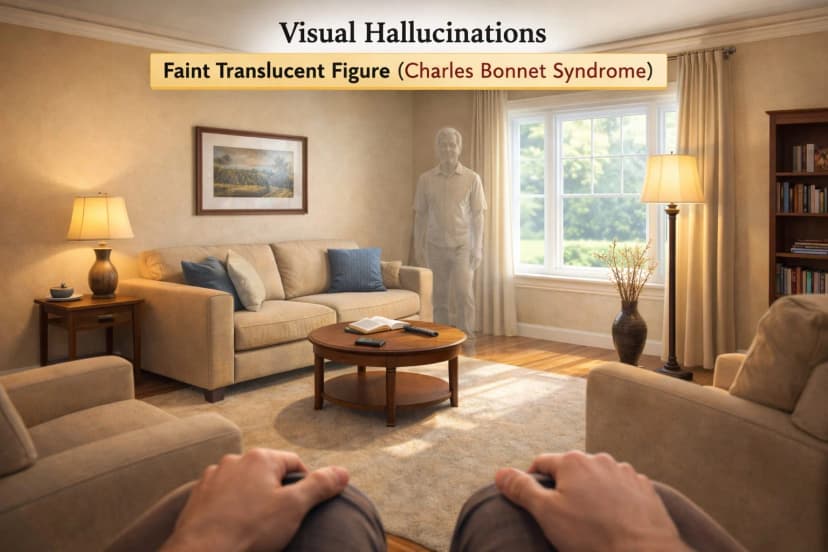
Types of Visual Hallucinations
Simple (Unformed) Hallucinations
- Photopsias-flashes of light
- Phosphenes-spots or patterns
- Colors or shapes-geometric patterns
- Zigzag lines-often migraine-related
These often point toward the eye, retina, migraine, or early visual pathway.
Complex (Formed) Hallucinations
- People-strangers, relatives (living or deceased)
- Animals-insects, pets, wildlife
- Objects-furniture, buildings
- Scenes-landscapes, events
- May be in color or black and white
- May move or be stationary
These more often involve higher visual processing or Charles Bonnet syndrome.
Common Causes
Eye and Visual Pathway Causes
Charles Bonnet Syndrome
- Visual hallucinations in people with significant vision loss
- Brain "fills in" missing visual input
- Hallucinations are recognized as not real
- No psychiatric illness
- Most common cause of complex visual hallucinations in elderly with vision loss
Retinal conditions
- Retinal detachment-flashes, floaters
- Macular degeneration-distortions, hallucinations
- Retinal tears-photopsias
Optic nerve conditions
- Optic neuritis-may cause phosphenes
- Optic nerve tumors-visual phenomena
Neurological Causes
Migraine
- Visual aura-zigzag lines, scintillating scotoma
- Usually precedes headache
- Lasts 20-60 minutes typically
Seizures
- Occipital lobe seizures-simple visual hallucinations
- Temporal lobe seizures-complex hallucinations
- Often brief, stereotyped
Stroke or brain lesions
- Peduncular hallucinosis-vivid hallucinations from brainstem stroke
- Occipital lobe lesions-simple or complex hallucinations
Dementia
- Lewy body dementia-frequently causes visual hallucinations
- Alzheimer's disease-less common but can occur
- Parkinson's disease dementia
- Persistent visual "static"
- May include palinopsia (afterimages)
Medical and Medication Causes
Delirium
- Acute confusion with hallucinations
- Caused by infection, medication, metabolic disturbance
Medications
- Anticholinergics
- Parkinson's disease medications
- Opioids
- Many others
Substance use
- Alcohol withdrawal (delirium tremens)
- Drug intoxication or withdrawal
- Hallucinogens
Psychiatric Causes
- Schizophrenia (usually auditory, but can be visual)
- Brief psychotic disorder
- Severe depression with psychotic features
Distinguishing Features
| Feature | Charles Bonnet | Migraine Aura | Seizure | Psychiatric |
|---|---|---|---|---|
| Duration | Minutes to hours | 20-60 min | Seconds to minutes | Variable |
| Awareness it's not real | Yes | Yes | Sometimes | Often no |
| Associated symptoms | Vision loss | Headache | May have other seizure signs | Other psychotic symptoms |
| Content | Complex, detailed | Geometric, moving | Simple or complex | Variable |
| Timing | Random | Before headache | Stereotyped | Varies |
When to Seek Care
Seek emergency care if visual hallucinations occur with:
- Confusion or altered consciousness
- Fever
- Severe headache
- Weakness, numbness, or speech problems
- Recent head injury
- New onset in someone without prior history
- Threatening or commanding content
- Suicidal or violent thoughts
Schedule evaluation for:
- Any new visual hallucinations
- Change in character of existing hallucinations
- Hallucinations causing distress or functional problems
- Associated vision loss
What You'll Be Asked in Clinic
Expect practical, specific questions:
About the hallucinations:
- What do you see? Describe in detail.
- How long do they last?
- How often do they occur?
- Do you know they aren't real?
- Are they distressing?
- Do you see them with eyes open, closed, or both?
- Any triggers?
About your health:
- Do you have vision loss? From what?
- Any history of migraines?
- Any history of seizures?
- Memory problems or cognitive changes?
- Any psychiatric history?
- What medications are you taking?
- Alcohol or drug use?
How Visual Hallucinations Are Diagnosed
Eye Examination
- Complete dilated exam
- Visual acuity and visual field testing
- OCT imaging
Neurological Examination
- Mental status testing
- Cranial nerve examination
- General neurological exam
Additional Testing
- MRI brain-looking for tumors, stroke, lesions
- EEG-if seizures suspected
- Blood tests-checking metabolic causes, vitamin levels
- Cognitive testing-if dementia suspected
Treatment Options
Treatment depends on the cause, because "seeing things" is a symptom, not one diagnosis:
For Charles Bonnet Syndrome
- Reassurance-knowing the cause isn't psychiatric is often helpful
- Optimizing remaining vision-better lighting, magnification
- Treating eye conditions-if possible
- Coping strategies-looking away, blinking, lighting changes
- Medications-rarely needed; low-dose antipsychotics sometimes help
For Migraine
- Migraine treatment and prevention
- Avoiding triggers
- See migraine-specific treatments
For Seizures
- Antiseizure medications
- Treating underlying cause if identified
For Medication-Induced
- Adjusting or stopping causative medication
- Adding protective medication if needed
For Dementia-Related
- Treating underlying dementia
- Low-dose antipsychotics if needed (carefully, due to risks)
- Non-pharmacological approaches-lighting, reassurance
For Psychiatric Causes
- Antipsychotic medications
- Comprehensive psychiatric care
Living with Visual Hallucinations
Coping Strategies for Charles Bonnet Syndrome
- Remind yourself it's not real-reality testing
- Good lighting-can reduce hallucinations
- Eye movements-looking away, blinking
- Social interaction-engaging with others
- Reduce fatigue-hallucinations may worsen when tired
- Join support groups-others understand
When to Worry
- Hallucinations becoming more frequent or distressing
- New types of hallucinations
- Hallucinations with other neurological symptoms
- Difficulty distinguishing hallucinations from reality
Frequently Asked Questions
Do visual hallucinations mean I'm going crazy?
Not necessarily. Many people with visual hallucinations do not have a psychiatric illness. Charles Bonnet syndrome, for example, happens in people with vision loss and is not a mental health condition.
Why do I see things that aren't there when I have poor vision?
When the brain receives less visual input due to vision loss, it can generate its own images-a phenomenon called "release hallucinations." This is Charles Bonnet syndrome and is surprisingly common in people with significant vision loss.
Are my hallucinations dangerous?
The images themselves usually are not dangerous, but they can be startling, distracting, or distressing. The reason to evaluate them is the possible underlying cause: delirium, medication effect, seizure, migraine, eye disease, or a brain problem.
Will my hallucinations go away?
It depends on the cause. Charles Bonnet syndrome hallucinations often decrease over time as the brain adapts. Medication-induced hallucinations stop when the medication is adjusted. Some causes require ongoing management.
Should I tell people about my hallucinations?
It's important to tell your doctor. Whether to tell others is a personal choice. Many people with Charles Bonnet syndrome find it helpful to explain to family members so they understand the condition.
References
Medical Disclaimer: This information is for educational purposes only and does not replace professional medical advice, diagnosis, or treatment. If you have concerns about visual hallucinations or any symptoms, please consult a qualified healthcare provider.
Sources:
- Rovner BW. Charles Bonnet syndrome. UpToDate. 2024.
- StatPearls. Charles Bonnet Syndrome. NCBI Bookshelf.
- Macular Society. Charles Bonnet Syndrome.