

Optic Nerve Sheath Fenestration
Eye-socket surgery that opens the optic nerve sheath to protect vision when papilledema from high pressure is threatening sight.
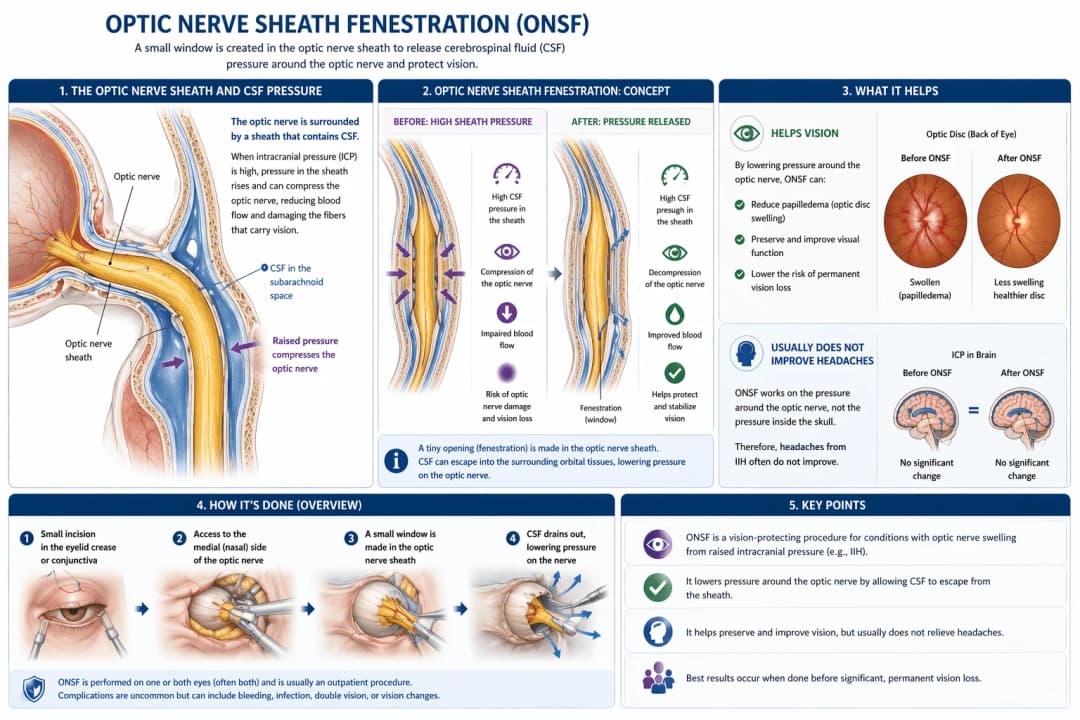
Optic nerve sheath fenestration (ONSF) is a targeted vision-saving surgery. The surgeon makes small windows in the covering around the optic nerve so cerebrospinal fluid can escape locally and stop squeezing the nerve. It is most often discussed in IIH with dangerous papilledema, where the eye problem is urgent even if the broader pressure problem still needs management.
Key Takeaways
- Protects vision in severe papilledema, especially from IIH
- Reduces pressure around the optic nerve, not the entire brain
- Used when vision is threatened or worsening despite medical treatment
- Usually does not fix headaches, which is frustrating but important to know
- May be chosen instead of, before, or alongside shunting, depending on the case
When It's Done
- Rapid or severe vision loss from papilledema
- Worsening visual fields despite medication
- Vision-threatening IIH when time is tight
- Sometimes one eye is treated first, sometimes both, depending on risk and surgeon preference
How It Works
The optic nerve is wrapped in a sheath that contains CSF. When intracranial pressure is high, that pressure travels along the sheath and crowds the nerve head. Fenestration creates a local pressure-release route near the optic nerve. It is a targeted eye-orbit procedure rather than a global treatment for intracranial pressure.
The Procedure
Before Surgery
- Complete eye examination
- Visual field testing and optic nerve imaging for baseline
- Coordination with neurology or neurosurgery when IIH is part of the picture
- Discussion of what the surgery can and cannot do, especially for headaches
During Surgery
- General anesthesia or local anesthesia with sedation, depending on approach and patient factors
- Incision through the conjunctiva or eyelid area
- Careful access to the optic nerve sheath inside the orbit
- Small openings made in the sheath
- Usually takes 1-2 hours
After Surgery
- Eye may be patched initially
- Antibiotic drops or ointment are used
- Avoid straining, heavy lifting, and eye rubbing early on
- Many cases are outpatient, though severe IIH may require inpatient care for the larger treatment plan
Outcomes
What It Helps
The main goal is to stabilize vision and prevent further optic nerve damage. Some patients improve, especially if treatment happens before permanent nerve injury sets in.
What It Doesn't Help
Headaches usually do not improve much because ONSF does not lower overall intracranial pressure. Papilledema in the other eye may improve in some patients, oddly enough, but it is not guaranteed.
Risks
- Double vision, temporary or rarely permanent
- Vision loss, rare but serious
- Pupil abnormality
- Bleeding around the eye
- Infection
- Scarring or need for additional pressure-lowering treatment later
Compared to Shunting
ONSF treats the optic nerve locally and is chosen when vision is the urgent problem. A shunt treats the CSF pressure system more globally and may help headaches more, though shunts carry their own revision burden. Some patients need both approaches.
Frequently Asked Questions
Does optic nerve sheath fenestration cure IIH?
No. It is mainly a vision-protection procedure. The underlying pressure disorder still needs coordinated care with neuro-ophthalmology, neurology, weight-management support when relevant, and sometimes neurosurgery.
Why might only one eye be operated on?
Some surgeons treat the worse eye first because papilledema can improve in both eyes after one-sided fenestration. Others treat both eyes when vision is threatened bilaterally. The choice depends on severity, timing, and surgeon preference.
How soon is vision monitored after surgery?
Follow-up is usually close at first, with visual field testing, optic nerve exam, and often OCT. The exact schedule depends on how threatened the vision was before surgery.
Medical Disclaimer: This information is for educational purposes only and does not replace professional medical advice.
Sources:
- StatPearls. Optic Nerve Decompression. NCBI Bookshelf.
- MedlinePlus. Idiopathic Intracranial Hypertension.
- Mollan SP, et al. Idiopathic intracranial hypertension: consensus guidelines on management. J Neurol Neurosurg Psychiatry. 2018;89(10):1088-1100.