

Orbital Decompression Surgery
Surgery that makes more room in the eye socket, mainly for thyroid eye disease with bulging, exposure, or optic nerve compression.
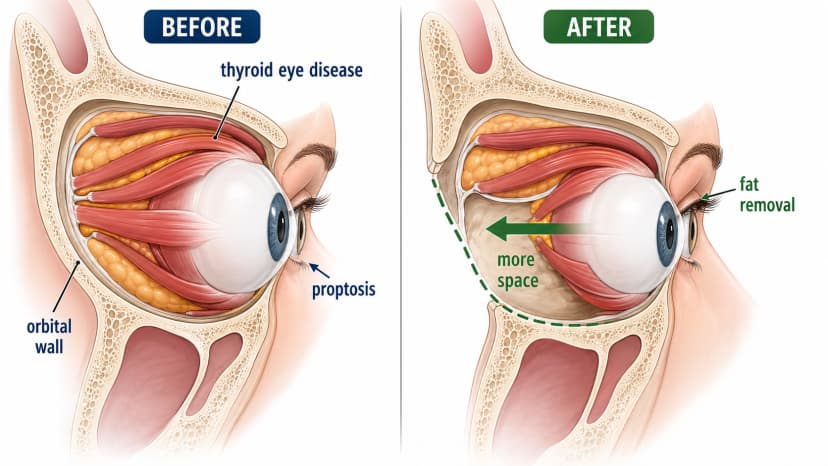
Orbital decompression surgery makes extra space inside the bony eye socket. In thyroid eye disease, swollen muscles and fat can crowd the orbit, pushing the eye forward (proptosis) or, in severe cases, compressing the optic nerve. Decompression allows crowded orbital tissue to shift into newly created space.
Key Takeaways
- Creates more space in the orbit by removing bone, fat, or both
- Treats serious thyroid eye disease complications
- Can relieve optic nerve compression when vision is at risk
- Reduces bulging and exposure symptoms in selected patients
- Often part of a staged plan, with eye-muscle or eyelid surgery later
Why It's Done
Urgent (Vision-Threatening)
- Optic nerve compression from thyroid eye disease
- Vision loss or color-vision change despite steroids or other urgent treatment
- Severe exposure where the cornea is at risk
- The point is prevention: keep temporary pressure from becoming permanent vision loss
Elective
- Reduction of proptosis after the active inflammatory phase has quieted
- Exposure keratopathy from poor eyelid closure
- Eye pressure, discomfort, or appearance concerns that meaningfully affect quality of life
Types of Decompression
Bone Removal (Wall Decompression)
Portions of the orbital wall are removed so swollen tissue can expand into neighboring sinus or temporal spaces. The medial wall, floor, and lateral wall may be used in different combinations. Removing more walls usually provides more decompression but can increase the risk of double vision.
Fat Removal
Orbital fat can be removed alone or with bone decompression. Fat removal may be enough for milder proptosis and can sometimes carry less double-vision risk than large bony decompressions.
What to Expect
Before Surgery
- Thyroid levels should be controlled
- Elective surgery is usually delayed until the disease is stable or inactive
- CT scan helps plan which walls or fat compartments to address
- Stop smoking; it worsens thyroid eye disease and healing. No way to soften that one.
Surgery
- General anesthesia
- Often 1-3 hours depending on approach and number of walls treated
- May be done through eyelid incisions, conjunctival incisions, endoscopic sinus routes, or a combination
After Surgery
- Swelling, bruising, congestion, and pressure are expected
- Some patients stay in the hospital, especially urgent or multi-wall cases
- Ice packs and head elevation help early
- Recovery is measured in weeks, with final settling over months
Possible Complications
- New or worsened double vision, one of the big practical risks
- Numbness of the cheek, upper lip, or teeth
- Sinus issues, infection, or bleeding
- CSF leak, rare
- Under- or over-correction of eye position
- Later strabismus surgery or eyelid surgery may be needed
Staged Approach
Thyroid eye disease surgery is often done in sequence:
- Decompression (if needed)
- Strabismus surgery (if needed)
- Eyelid surgery
Medical Disclaimer: This information is for educational purposes only and does not replace professional medical advice.
Sources:
- American Academy of Ophthalmology EyeWiki. Thyroid Eye Disease.
- American Academy of Ophthalmology. Graves' Disease.