Thyroid Eye Disease (Graves' Orbitopathy)
An autoimmune condition affecting the eyes in patients with thyroid problems, causing bulging eyes, double vision, and rarely vision-threatening complications.
Thyroid eye disease (TED), also called Graves' orbitopathy or thyroid-associated orbitopathy, is an autoimmune inflammatory condition affecting the eyes. It usually occurs in people with Graves' disease (hyperthyroidism) but can occur with other thyroid conditions or even normal thyroid function.
Key Takeaways
- Usually associated with Graves' disease (hyperthyroidism) but can occur with normal thyroid
- Symptoms: bulging eyes, eyelid retraction, double vision, dry eye
- Has active and stable phases-treatment depends on which phase
- Smoking significantly worsens the disease-quitting is essential
- New treatment (teprotumumab) is now available for active disease
- Can threaten vision if optic nerve is compressed-requires urgent treatment
Understanding Thyroid Eye Disease
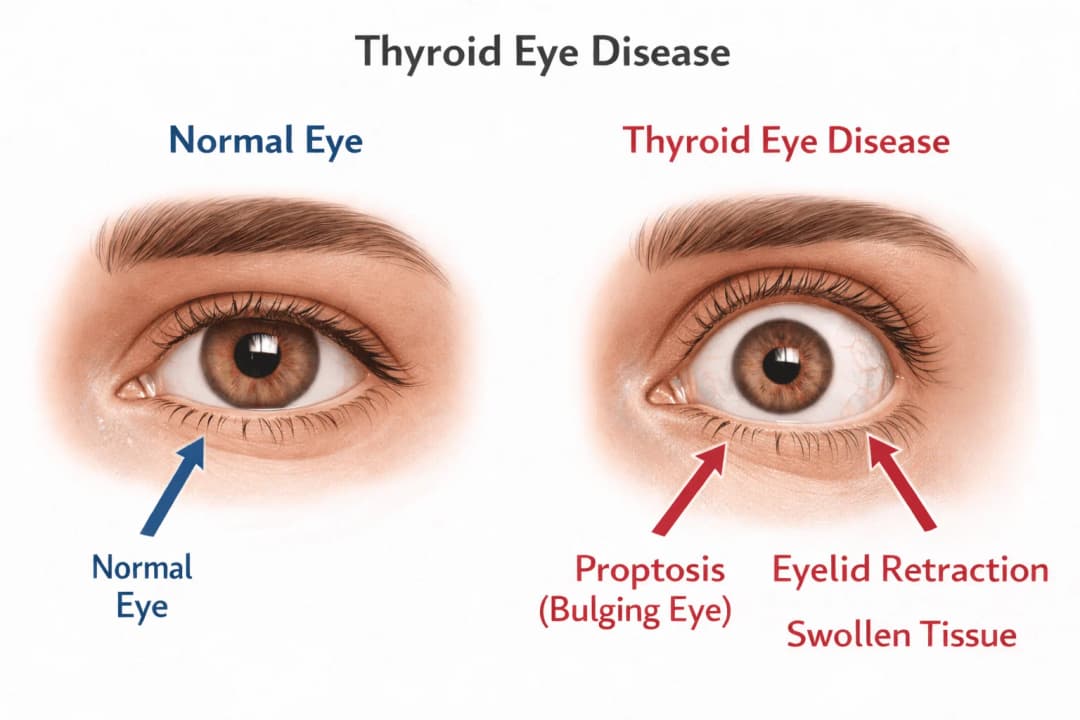
In TED, antibodies that attack the thyroid also attack tissues around the eyes. This causes:
- Swelling of eye muscles and fat behind the eye
- Eyes pushed forward (proptosis)
- Eyelids retracted (pulled back)
- Restricted eye movement causing double vision
Phases of TED
Active Phase
- Inflammatory changes occurring
- Symptoms may be progressing or fluctuating
- Eyes may be red, puffy, uncomfortable
- Duration: typically 1-3 years (sometimes longer in smokers)
- This is when anti-inflammatory treatment is most effective
Stable Phase
- Inflammation has "burned out"
- Changes stabilized but may have permanent effects
- No longer actively progressing
- Surgical rehabilitation can be considered
Symptoms
Appearance Changes
- Proptosis (bulging eyes)
- Eyelid retraction-upper lid pulled up, showing white above iris ("stare")
- Lid lag-lid lags behind when looking down
- Periorbital swelling-puffy eyelids
Discomfort
- Dry, gritty eyes (exposure from incomplete lid closure - see medical conditions that cause dry eye)
- Tearing
- Pressure or pain behind eyes
- Light sensitivity
- Red, inflamed appearance
Double Vision
- From swelling and scarring of eye muscles
- Often worse in certain directions
- Can significantly impact quality of life
Vision-Threatening Disease
Go to the emergency department the same day, not urgent care, if you experience:
- Decreasing vision
- Color vision changes
- Visual field loss
These may indicate compressive optic neuropathy from thyroid eye disease-a vision-threatening emergency requiring specialist treatment.
What Doctors Watch Closely
The danger sign in TED is not eye bulging by itself; it is pressure on the optic nerve at the back of the orbit. At visits, clinicians track visual acuity, color vision, pupils, visual fields, optic nerve appearance, eye movement restriction, and proptosis measurements. A small drop in color vision or a new visual field defect can matter even when the eyes look similar in the mirror.
Risk Factors
Major Risk Factor: Smoking
- Smoking is the most modifiable risk factor
- Smokers have worse disease
- Longer active phase
- Poorer response to treatment
- Quitting smoking is essential
Other Factors
- Radioactive iodine treatment-may worsen TED; steroids may prevent
- Poorly controlled thyroid levels-both high and low
- Female sex-more common in women
- Genetics-family history increases risk
Diagnosis
Clinical Evaluation
- Eye appearance assessment
- Eyelid measurements
- Proptosis measurement (exophthalmometry)
- Eye movement assessment
- Visual acuity and color vision
- Pupil examination
- Optic nerve assessment
Thyroid Tests
- TSH, free T4
- Thyroid antibodies (TSI, TPO, TRAb)
- May have TED with normal thyroid function (euthyroid Graves')
Imaging
- CT or MRI of orbits
- Shows enlarged eye muscles
- Evaluates optic nerve compression
- Helps planning for surgery
Assessing Activity
- Clinical Activity Score (CAS)
- Helps determine if disease is active or stable
- Guides treatment decisions
Treatment
For All Patients
- Stop smoking-absolutely essential
- Control thyroid levels-maintain euthyroid state
- Lubricating drops and ointment-for surface dryness
- Elevate head of bed-reduces morning swelling
- Selenium supplementation-may help mild disease
- Sun protection-sunglasses, avoid wind
For Active, Moderate-Severe Disease
Teprotumumab (Tepezza)
- FDA-approved for thyroid eye disease
- Reduces proptosis and inflammation
- Given as an IV infusion every 3 weeks for 8 doses
- Can cause hearing changes, muscle cramps, hyperglycemia
- IV methylprednisolone preferred (77% response rate per EUGOGO guidelines)
- Oral prednisone less effective (51% response rate) but sometimes used
- Reduces inflammation
- Has significant side effects with long-term use
Other immunosuppressive options (limited evidence):
- Rituximab-small conflicting RCTs; not first-line
- Methotrexate-limited to retrospective studies; may be considered as steroid-sparing agent
Orbital radiation
- Sometimes used for muscle involvement
- Combined with steroids
For Stable Disease (Surgical Rehabilitation)
Surgery is done in a specific sequence:
- Orbital decompression-removes bone to reduce proptosis
- Strabismus surgery-realigns eyes for double vision
- Eyelid surgery-corrects retraction and appearance
For Sight-Threatening Disease
Dysthyroid optic neuropathy requires urgent treatment:
- High-dose IV steroids
- May need urgent orbital decompression
- Close monitoring of vision
Living with Thyroid Eye Disease
For comprehensive guidance on managing TED-from understanding active vs. stable phases, teprotumumab treatment, smoking cessation, and the surgical rehabilitation pathway-see our complete patient guide: Thyroid Eye Disease - Active Treatment and Rehabilitation Guide.
During Active Phase
- Don't smoke
- Keep thyroid levels stable
- Use lubricating drops frequently
- Sleep with head elevated
- Protect eyes from wind and sun
- Take photos to track changes
Long-Term
- Regular follow-up even after stabilization
- May need ongoing lubrication
- Possible need for surgery
- Monitor thyroid function
Frequently Asked Questions
Can thyroid eye disease occur with normal thyroid levels?
Yes. About 10% of people with TED have normal thyroid function (euthyroid Graves'). The antibodies causing eye disease are related to but not the same as those causing thyroid dysfunction.
Why is quitting smoking so important?
Smoking dramatically worsens thyroid eye disease. Smokers have more severe disease, longer active phase, and respond less well to treatment. Quitting is one of the most important modifiable steps you can take.
Will my eyes go back to normal?
Some changes (like proptosis and eyelid retraction) may persist after the active phase. However, treatment during the active phase and surgical rehabilitation after stabilization can significantly improve appearance and function.
When can I have surgery?
Most surgery is done during the stable phase (typically after the disease has been stable for 6 months). However, urgent orbital decompression may be needed during active phase if vision is threatened.
Is teprotumumab (Tepezza) right for me?
Teprotumumab can reduce proptosis and inflammatory signs in selected patients, especially during the active phase, but benefits and risks vary and monitoring is required. Your doctor will consider your disease activity, overall health, and insurance coverage to help decide if it's appropriate.
Can thyroid eye disease come back?
Reactivation can occur, especially if thyroid levels become uncontrolled or with certain triggers. Long-term monitoring is important.
Why are color vision and visual fields checked?
Compressive optic neuropathy can start subtly. Patients may notice dimmer colors, missing side vision, or a duller image before central acuity drops. These tests help catch optic nerve compression early enough for urgent steroids or decompression.
References
Medical Disclaimer: This information is for educational purposes only and does not replace professional medical advice, diagnosis, or treatment. If you have concerns about thyroid eye disease or any symptoms, please consult a qualified healthcare provider.
Sources:
- Bartalena L, et al. The 2021 European Group on Graves' Orbitopathy (EUGOGO) guidelines for the medical management of Graves' orbitopathy. Eur J Endocrinol. 2021;185(4):G43-G67.
- Douglas RS, et al. Teprotumumab for the treatment of active thyroid eye disease. N Engl J Med. 2020;382(4):341-352.
- American Thyroid Association. Graves' Eye Disease.
- American Academy of Ophthalmology EyeWiki. Thyroid Eye Disease.