

Adie's Tonic Pupil
A dilated pupil that reacts slowly to light due to damage to the nerve fibers controlling pupil constriction. Usually benign and often occurs in young women.
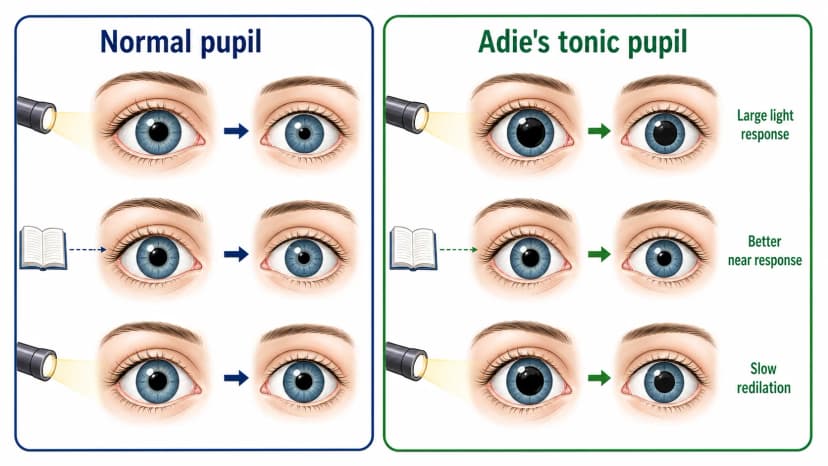
Adie's tonic pupil is a neurological condition affecting the pupil and sometimes the focusing ability of the eye. It causes one pupil to be larger than the other and to react very slowly (or not at all) to light. Despite the dramatic appearance, it's usually a benign condition that doesn't affect vision significantly.
Key Takeaways
- One pupil larger than the other with slow/absent light response
- Usually benign-not a sign of brain disease
- More common in young women
- May cause near vision difficulty or photophobia
- Often remains stable or improves over time
Understanding Adie's Tonic Pupil
The pupil size is controlled by muscles in the iris. The sphincter muscle (which constricts the pupil) is controlled by nerve fibers that travel through the ciliary ganglion near the eye. In Adie's pupil, these nerve fibers are damaged, causing the sphincter to lose its normal responsiveness. The pupil becomes dilated and reacts sluggishly or not at all to light.
Symptoms
Pupil Appearance
- Unequal pupils (anisocoria)-affected pupil larger (see understanding pupil abnormalities)
- Difference more noticeable in bright light
- Slow, delayed, or absent response to light
- Better (but still slow) response to near focus
Visual Symptoms
- Photophobia-light sensitivity (dilated pupil lets in more light)
- Blurred vision at near (accommodation affected)
- Usually mild or not noticed
- Vision at distance typically normal
Associated Features (Adie Syndrome)
Some patients also have:
- Absent ankle reflexes
- Absent knee reflexes
- Called "Holmes-Adie syndrome" when reflexes affected
What Patients Notice
- May be told by others their pupil looks large
- May notice in photographs
- Difficulty with near reading (need reading glasses)
- Light seems too bright
Who Gets Adie's Pupil?
- Young to middle-aged adults
- Women more than men (70%)
- Usually no identifiable cause
- Sometimes after viral illness
Diagnosis
Clinical Examination
- Pupil size comparison
- Light response testing (slow, segmental movement)
- Near response (may be better than light response)
- Accommodation testing
- Reflex examination
Pharmacologic Testing
Dilute pilocarpine test
- 0.1% pilocarpine (very dilute)
- Normal pupil: no response
- Adie's pupil: constricts (supersensitivity)
- Supports diagnosis in the right clinical context
Differentiate from Dangerous Causes
A dilated, unreactive pupil can also indicate third nerve palsy from aneurysm or other serious causes. Important differences: third nerve palsy causes eye misalignment, droopy eyelid, and double vision-Adie's pupil does not.
Causes
Typical Adie's Pupil
- Damage to ciliary ganglion (near the eye)
- Usually idiopathic (unknown cause)
- Sometimes post-viral
- May follow eye surgery or trauma
Secondary Causes (Less Common)
- Orbital trauma or surgery
- Viral infections
- Giant cell arteritis
- Diabetes (rarely)
Treatment
Usually None Needed
- Adie's pupil is benign
- Vision usually not significantly affected
- Often improves somewhat over time
If Symptomatic
For photophobia:
- Sunglasses
- Photochromic lenses
For near blur:
- Reading glasses
- Pilocarpine drops (rarely used-causes more problems)
Reassurance
- Most important "treatment"
- Explaining benign nature reduces anxiety
- Monitoring if desired
Natural History
Over Time
- Pupil may become smaller (years later)
- May eventually become smaller than normal
- Light response may partially return
- Second eye affected in ~4% per year
Accommodation
- May recover partially
- Reading glasses often sufficient
Frequently Asked Questions
Is Adie's pupil dangerous?
No. Adie's pupil is a benign condition that doesn't affect your health or threaten your vision. It's important mainly to distinguish it from more serious causes of a dilated pupil, which is done during the examination.
Why did this happen?
In most cases, we don't know. It's thought to result from minor damage to nerve fibers near the eye, possibly from a viral infection that went unnoticed. It's not inherited and not caused by anything you did.
Will my other eye get this too?
There's about a 4% chance per year of the other eye developing Adie's pupil. Even if both pupils are affected, vision remains good and the condition remains benign.
Will my pupil go back to normal?
The pupil typically improves somewhat over years-it may become smaller and slightly more reactive. However, it usually doesn't return completely to normal. Most people adapt and don't notice it over time.
Do I need any treatment?
Usually not. Sunglasses help with light sensitivity, and reading glasses help with near vision if needed. No treatment is necessary for the pupil itself.
References
Medical Disclaimer: This information is for educational purposes only and does not replace professional medical advice, diagnosis, or treatment. If you have concerns about your pupils or any symptoms, please consult a qualified healthcare provider.
Sources:
- Thompson HS, et al. Adie syndrome: a complete form and its variants. Neuroophthalmology. 1993;13:189-195.
- Loewenfeld IE. The Pupil: Anatomy, Physiology, and Clinical Applications. Butterworth-Heinemann. 1999.
- American Academy of Ophthalmology EyeWiki. Adie Pupil.