

Third Cranial Nerve Palsy (Oculomotor Nerve Palsy)
Weakness of the third cranial nerve causing droopy eyelid, double vision, and sometimes pupil abnormalities. Pupil involvement may indicate aneurysm-a medical emergency.
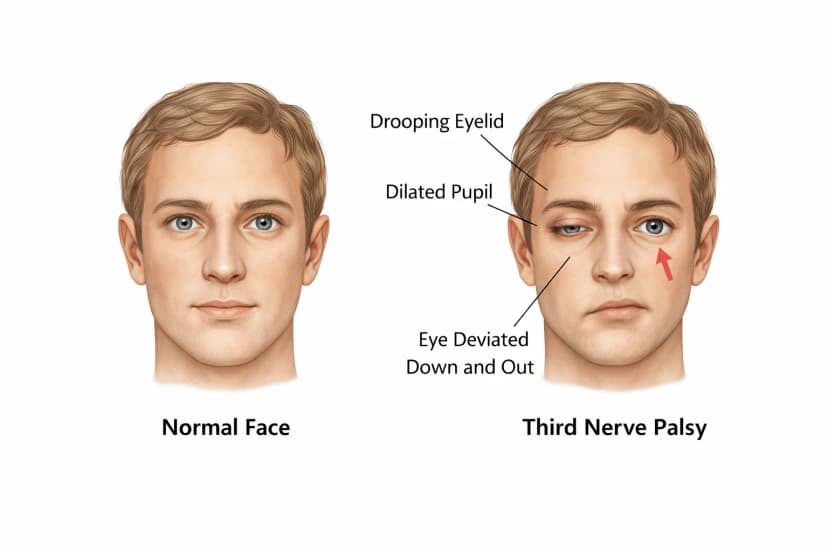
Third cranial nerve palsy affects the oculomotor nerve, which controls most eye movements, eyelid elevation, and pupil constriction. This causes droopy eyelid (ptosis), double vision, and a characteristic eye position. When the pupil is also affected, an aneurysm must be urgently ruled out.
Key Takeaways
- Classic triad: ptosis, eye deviated outward/downward, double vision
- Pupil involvement is critical-dilated pupil suggests possible aneurysm (emergency)
- Pupil-sparing third nerve palsy in older patients often microvascular (better prognosis)
- All new third nerve palsies need evaluation
- With pupil involvement: emergency imaging for aneurysm
What the Third Nerve Controls
The third cranial nerve (oculomotor nerve) controls:
- Eyelid elevation (levator muscle)
- Most eye movements (up, down, inward)
- Pupil constriction (parasympathetic fibers)
- Focusing (accommodation)
When the nerve is damaged, these functions are impaired.
Symptoms
Eye Appearance and Movement
- Complete ptosis-eyelid droops completely
- Eye turned outward and downward-"down and out" position
- Limited eye movement-can't look up, down, or inward
- When lid is lifted: double vision in most directions
Pupil Findings
Pupil-involving (dilated pupil):
- Larger pupil on affected side
- Pupil doesn't react to light
- Concerning for aneurysm-emergency
Pupil-sparing:
- Pupil normal size and reactive
- More likely microvascular cause
- Better prognosis
Causes
With Pupil Involvement (Emergency)
Any pupil-involving third nerve palsy needs emergency aneurysm imaging. Call 911 immediately if a new droopy eyelid or double vision occurs with a larger pupil, severe headache, confusion, weakness, or trouble walking.
The most feared cause is a posterior communicating artery (PCOM) aneurysm, which can rupture and cause catastrophic brain bleeding. Same-day CT angiography (CTA) or MR angiography (MRA) is standard of care.
Important: aneurysms do not always cause a thunderclap headache. The absence of severe headache does not rule one out. If the pupil is large or poorly reactive on the same side as the droopy eyelid and double vision, treat the presentation as a potential aneurysm until imaging proves otherwise.
Other causes of pupil-involving third nerve palsy:
- Uncal herniation (brain swelling)
- Cavernous sinus lesions
- Compressive tumors
- Trauma
Pupil-Sparing (More Reassuring)
Microvascular/ischemic
- Most common in older adults
- Associated with diabetes, hypertension
- Typically pupil-sparing
- Usually recovers in 2-3 months
- "Microvascular cranial nerve palsy"
Other causes:
- Inflammation
- Infection
- Demyelination
Other Causes
- Trauma
- Tumors
- Inflammation (orbital, cavernous sinus)
- Post-surgical
- Giant cell arteritis (in older patients)
Pupil Involvement: Why It Matters
The pupil-controlling fibers run on the outside of the third nerve. They're affected by:
- Compression (aneurysm, tumor)-fibers are superficial, affected early
- Often spared in microvascular ischemia (affects center of nerve first)
This is why pupil involvement demands emergency evaluation for aneurysm.
However, exceptions exist-some aneurysms can initially spare the pupil, and some microvascular palsies can involve it. For a broader overview of how pupil findings guide diagnosis, see understanding pupil abnormalities.
Evaluation
Urgent Questions
- Is the pupil involved?
- Any severe headache?
- Any other neurological symptoms?
Eye Examination
- Degree of ptosis
- Eye position and movements
- Pupil size and reactivity
- Other cranial nerves
Imaging
For pupil-involving third nerve palsy:
- Emergency CTA or MRA-looking for aneurysm
- If negative but suspicion high: catheter angiography
For pupil-sparing third nerve palsy in older adults with vascular risk factors:
- May observe carefully
- MRI/MRA often still performed
- Closer observation of pupil over first week
Blood Tests
- Blood sugar, HbA1c
- ESR, CRP (if GCA suspected in older patients)
- Other tests based on suspected cause
Treatment
For Aneurysm
- Neurosurgical or endovascular treatment
- Clipping or coiling to prevent rupture
- Urgent referral to neurosurgery/neurointerventional
For Microvascular
- Control underlying risk factors (diabetes, hypertension)
- Observation-usually recovers in 2-3 months
- Follow-up to confirm improvement
- If no improvement by 3 months, reconsider diagnosis
Symptomatic Management
For ptosis:
- May help diplopia by covering affected eye
- Ptosis crutch on glasses if needed long-term
- Surgery only if stable and persistent
For double vision:
- Eye patch when needed (alternating eyes)
- Fresnel prism if stable pattern
- Strabismus surgery only after stable for months
Recovery
Microvascular Third Nerve Palsy
- Most begin improving within weeks
- Full recovery typically by 3 months
- May have aberrant regeneration (rare in microvascular)
Compressive Causes
- Depends on treatment of underlying cause
- May have incomplete recovery
- May develop aberrant regeneration (misdirected nerve growth)
Aberrant Regeneration
Signs that nerve fibers regrew to wrong targets:
- Lid raises when looking down or inward
- Pupil constricts with eye movement
- Suggests prior compression-not typical of microvascular
Frequently Asked Questions
Why is pupil involvement so important?
The pupil fibers are on the outside of the nerve and are first affected by compression (like from an aneurysm). A dilated, unreactive pupil with third nerve palsy could mean a life-threatening aneurysm is pressing on the nerve.
If my pupil is normal, do I still need imaging?
If there is any doubt, yes. Any pupil involvement mandates same-day vascular imaging (CTA or MRA) to rule out an aneurysm. Pupil-sparing cases in patients under 50, without classic vascular risk factors, or with atypical features are usually imaged as well. Your doctor will decide based on your age, risk factors, and exam.
How long until I recover?
Microvascular third nerve palsies typically improve over 2-3 months. If recovery doesn't begin within this timeframe, your doctor may want to repeat imaging or reconsider the diagnosis.
Can I drive with a third nerve palsy?
The ptosis and double vision make driving unsafe. Once recovered, or if symptoms are adequately managed (patch, prism), you may be able to drive-discuss with your doctor.
Can I wait overnight if the pupil looks normal?
Do not decide this at home. Some aneurysms initially spare the pupil, and subtle pupil asymmetry is easy to miss. New third nerve palsy should be triaged by an emergency clinician, ophthalmologist, neurologist, or neuro-ophthalmologist the same day.
Will this happen again?
Microvascular palsies can recur, especially if risk factors (diabetes, hypertension) aren't controlled. However, most people don't have recurrence. Keeping blood sugar and blood pressure controlled reduces risk.
What is "aberrant regeneration"?
When the nerve regrows, fibers sometimes connect to wrong targets-for example, the lid may lift when looking down. This suggests the cause was compressive, not microvascular. It requires evaluation if discovered.
Where should I go for evaluation of a third nerve palsy?
A third nerve palsy requires urgent neuro-ophthalmological evaluation, especially with pupil involvement. If you've had initial imaging but need ongoing management, a neuro-ophthalmologist can monitor recovery and manage residual double vision. Hashemi Eye Care evaluates cranial nerve palsies and coordinates urgent neuroimaging when needed.
References
Medical Disclaimer: This information is for educational purposes only and does not replace professional medical advice, diagnosis, or treatment. If you have concerns about third nerve palsy or any symptoms, please consult a qualified healthcare provider.
Sources:
- Fang C, et al. Third, fourth, and sixth cranial nerve palsies. Curr Opin Ophthalmol. 2019;30(6):491-497.
- StatPearls/NCBI Bookshelf. Cranial Nerve III Palsy.
- Bruce BB, et al. Diagnostic accuracy and use of nonmydriatic ocular fundus photography by emergency physicians. Ann Emerg Med. 2011;58(4):374-381.
- North American Neuro-Ophthalmology Society. Microvascular Cranial Nerve Palsy.
- MedlinePlus. Cranial Mononeuropathy III.