

Open Globe Injury
A full-thickness wound of the eye wall requiring emergency surgery. Learn about recognition, first aid, and why immediate action is critical.
An open globe injury is a full-thickness wound of the eye wall (cornea or sclera), meaning the integrity of the eye has been breached. This is an ocular emergency requiring immediate surgical repair to prevent permanent vision loss and save the eye. Recognition and appropriate initial management are critical-what happens in the first minutes to hours significantly affects outcomes.
Key Takeaways
- Full-thickness wound of the cornea or sclera
- Surgical emergency-requires repair within hours
- Do not press on the eye-this expels contents and worsens injury
- Place a rigid shield (cup, paper cup cut-out) over the eye
- Keep patient NPO (nothing to eat or drink) for surgery
- Tetanus prophylaxis and IV antibiotics needed
- Prognosis depends on initial injury severity and time to repair
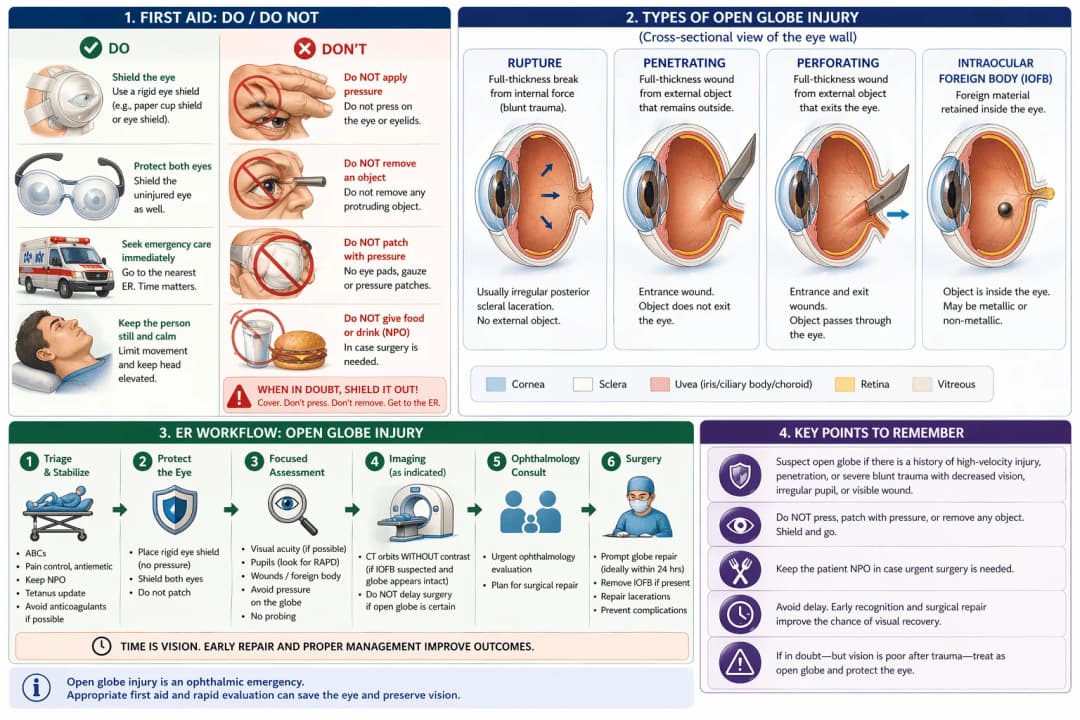
What Is an Open Globe?
Anatomy
The eye wall consists of:
- Cornea: clear front portion
- Sclera: white outer coat
An open globe means this wall has been completely penetrated-the inside of the eye is exposed to the outside.
Types of Open Globe
Rupture:
- Blunt trauma causes the eye to burst
- Often at weakest point (limbus, previous surgical site, sclera behind muscle insertions)
- Inside-out injury
Laceration:
- Sharp object cuts through the eye wall
- Penetrating: object enters but doesn't exit
- Perforating: object enters AND exits (through-and-through)
Intraocular Foreign Body (IOFB):
- Object penetrates and remains inside the eye
- Metal, glass, stone, etc.
- Special considerations for removal
Causes
Common Mechanisms
- Assault: punches, thrown objects
- Sports: balls, bats, racquets
- Motor vehicle accidents: windshield, projectiles
- Work injuries: hammering metal on metal, power tools, explosions
- Falls: especially in elderly
- Penetrating objects: knives, scissors, pens, pencils
- Projectiles: BBs, pellets, shrapnel
High-Risk Activities
- Hammering metal on metal (IOFB risk)
- Using power tools without eye protection
- Explosions, fireworks
- Combat/military injuries
Recognition
Signs Suggestive of Open Globe
Suspect open globe with any of these findings:
- Visible wound on cornea or sclera
- Prolapsed (exposed) uveal tissue (dark tissue)
- Irregular or teardrop-shaped pupil (pointing to wound)
- Flat or shallow anterior chamber
- Very low intraocular pressure (soft eye)
- Vitreous on surface of eye
- Hyphema (blood in anterior chamber)
- Severe subconjunctival hemorrhage (may hide scleral wound)
- 360-degree subconjunctival hemorrhage (concerning)
- Loss of red reflex
- Severe vision loss
Don't Be Fooled
- Small wounds can be easily missed
- Conjunctival hemorrhage may hide scleral laceration
- Wound may self-seal, masking severity
- CT scan may be needed to rule out IOFB
Emergency First Aid
DO NOT:
- Press on the eye
- Attempt to remove protruding objects
- Apply direct pressure
- Let patient rub the eye
- Give food or water (NPO for surgery)
What TO Do
-
Protect the eye
- Place a rigid shield (cut paper cup, commercial shield) over the eye
- DO NOT use a pressure patch
- Tape shield to brow and cheek
-
Keep the patient calm
- Vomiting increases pressure on the eye
- Do not give food, drink, or oral medication. EMS or emergency-department clinicians may give anti-nausea and pain medication to prevent vomiting.
-
Position
- Keep head elevated (reduces pressure)
- Avoid bending over
-
Do not remove foreign objects
- If object is protruding, stabilize it
- Do NOT attempt to pull it out
-
Get to emergency care immediately
Hospital Evaluation
Initial Assessment
- History: mechanism of injury, time, tetanus status
- Visual acuity: even if just light perception
- External exam: don't open lids forcefully if globe rupture suspected
- Shield the eye if not already done
Imaging
CT Orbit (Non-Contrast):
- Mandatory before MRI
- Detects intraocular foreign bodies
- Shows extent of injury
- Identifies orbital fractures
NO MRI if metallic foreign body possible (magnet can cause catastrophic damage)
Preoperative Preparation
- NPO (nothing by mouth)
- Tetanus prophylaxis
- IV antibiotics (reduces endophthalmitis risk)
- Anti-nausea medication (prevent vomiting)
- Pain control
- Consent for surgery
Surgical Repair
Timing
Surgery should occur as soon as safely possible:
- Primary repair within 24 hours is ideal
- Earlier is generally better
- Delay increases infection risk
Goals of Surgery
- Close the wound (restore globe integrity)
- Remove any foreign body
- Minimize further damage
- Set stage for future visual rehabilitation
Procedures May Include
- Wound closure (suturing)
- Removal of prolapsed, nonviable tissue
- Vitrectomy (removal of vitreous gel)
- Removal of intraocular foreign body
- Repair of associated injuries (iris, lens, retina)
- Possible lensectomy (removal of damaged lens)
What to Expect
- General anesthesia usually required
- Surgery may be lengthy
- May need additional surgeries later
Complications
Infection (Endophthalmitis)
Endophthalmitis is a devastating complication:
- Infection inside the eye
- Can occur despite antibiotics
- Risk higher with dirty/organic wounds, delayed repair, IOFB
- Can cause blindness
- May require vitrectomy and intravitreal antibiotics
Sympathetic Ophthalmia
- Rare but serious
- Autoimmune inflammation affecting the uninjured eye
- Can occur weeks to years after injury
- May require immunosuppression
- Historically a reason for removing severely injured eyes
Other Complications
- Retinal detachment: may occur at time of injury or later
- Cataract: from trauma to lens or surgery
- Glaucoma: from angle damage or inflammation
- Corneal scarring: may obstruct vision
- Phthisis bulbi: shrinkage of the eye (end-stage)
- Vision loss: varies widely based on injury
Prognosis
Factors Affecting Outcome
Better Prognosis:
- Better initial visual acuity
- Wound limited to cornea (zone I)
- Smaller wound
- No retinal detachment
- No IOFB
- No endophthalmitis
- Rapid repair
Worse Prognosis:
- No light perception at presentation
- Large wound
- Posterior wound (zones II-III)
- Retinal detachment
- Vitreous hemorrhage
- Lens damage
- IOFB (especially organic)
- Endophthalmitis
- Delay in repair
Ocular Trauma Score
A prognostic scoring system based on:
- Initial visual acuity
- Presence of rupture vs. penetrating
- Endophthalmitis
- Perforating injury
- Retinal detachment
- Relative afferent pupillary defect
Higher score = better visual prognosis.
Visual Outcomes
- Highly variable (from 20/20 to no light perception)
- Many patients achieve functional vision
- Some injuries too severe for visual recovery
- Multiple surgeries often needed
Recovery and Rehabilitation
Immediate Postoperative
- Frequent eye drops (antibiotics, steroids, cycloplegics)
- Eye shield at all times
- Activity restriction
- Frequent follow-up visits
Long-Term
- May need additional surgeries (retinal, cataract, glaucoma)
- Visual rehabilitation (glasses, contacts, low vision aids)
- Psychological support (vision loss is traumatic)
- Return to work/activity gradual
When the Eye Can't Be Saved
If the eye is too severely damaged or develops complications:
- Evisceration or enucleation (removal) may be necessary
- Prosthetic eye fitting
- Counseling and support
Prevention
Eye Protection
- Polycarbonate safety glasses for hazardous activities
- ANSI-approved protective eyewear
- Sports goggles for high-risk sports
- Full face shields when appropriate
Occupational Safety
- Mandatory eye protection in industrial settings
- Proper training on tool use
- Machine guards where appropriate
Home Safety
- Eye protection when using power tools
- Supervise children with sharp objects
- Secure fireworks from children
Frequently Asked Questions
Will I lose my eye?
Many open globe injuries can be repaired and the eye saved. However, severely damaged eyes or those with severe complications may eventually need to be removed. Your surgeon will do everything possible to save the eye and restore vision.
Will I be able to see again?
This depends on the severity of the injury. Some patients recover excellent vision; others have permanent vision loss. Initial visual acuity is one of the best predictors of final outcome. Your surgeon can give you a better idea after evaluating the injury.
How long is recovery?
Recovery is a long process, often months to years. You may need multiple surgeries. Even after the eye has healed, visual rehabilitation (glasses, contacts, low vision services) continues.
Why can't I eat or drink?
You need emergency surgery, which requires anesthesia. Eating or drinking before anesthesia risks aspiration (inhaling stomach contents), which is dangerous. Stay NPO until your surgery team clears you.
What if something is stuck in my eye?
Do NOT try to remove it. Stabilize the object if possible, place a rigid shield over the eye without pressing on it, and get to the emergency room immediately. Removal requires controlled conditions in the operating room.
Can I prevent infection?
IV antibiotics given before surgery significantly reduce infection risk. Timely surgical repair also helps. Despite these measures, infection can still occur. Watch for worsening pain, vision, or discharge after surgery and report immediately.
References
Medical Disclaimer: This information is for educational purposes only and does not replace professional medical advice, diagnosis, or treatment. Open globe injury is a surgical emergency-seek immediate medical attention.
Sources:
- American Academy of Ophthalmology. Eye Trauma.
- University of Iowa EyeRounds. Assessment and Management of Ocular Trauma.
- Kuhn F, et al. The Birmingham Eye Trauma Terminology (BETT). J Fr Ophtalmol. 2004;27(2):206-210.
- Pieramici DJ, et al. A system for classifying mechanical injuries of the eye (globe). Am J Ophthalmol. 1997;123(6):820-831.
- MedlinePlus. Eye Emergencies.