

Vitrectomy
A retina surgery that removes the vitreous gel from inside the eye to treat retinal detachment, vitreous hemorrhage, macular holes, and other conditions.
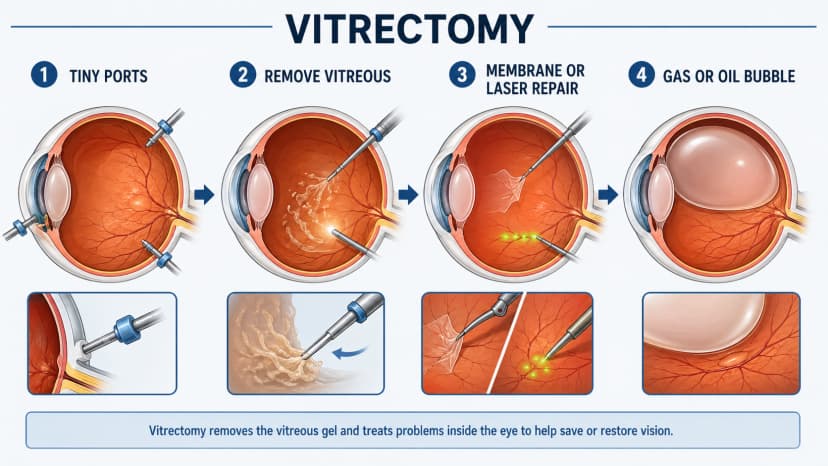
Vitrectomy is a surgical procedure in which the vitreous gel, the clear jelly-like substance that fills the inside of the eye, is removed. The vitreous is replaced with saline solution, a gas bubble, or silicone oil to help maintain the eye's shape and, when needed, hold the retina in place. Vitrectomy is used to treat serious conditions including retinal detachment, macular hole, epiretinal membrane, and vitreous hemorrhage.
Key Takeaways
- Removes the vitreous gel so the surgeon can access and treat the retina
- Treats multiple conditions including retinal detachment, vitreous hemorrhage, macular holes, and diabetic eye disease
- Performed under local anesthesia as an outpatient procedure lasting 1-3 hours
- Gas bubble or silicone oil may be placed to support retinal healing; this may require face-down positioning
- High success rates-90%+ for retinal detachment repair and macular hole closure
- Cataract development is the most common long-term side effect in patients who have not already had cataract surgery
When Is Vitrectomy Needed?
Vitrectomy is performed when conditions inside the eye require direct surgical access to the vitreous cavity or retina. Your ophthalmologist may recommend vitrectomy for any of the following:
Retinal Detachment
Retinal detachment occurs when the retina separates from the underlying tissue. Without treatment, it leads to permanent vision loss. Vitrectomy allows the surgeon to remove any vitreous traction pulling on the retina, drain fluid from beneath the retina, apply laser treatment or cryotherapy to seal retinal tears, and place a gas bubble or silicone oil tamponade to hold the retina flat while it heals.
Vitreous Hemorrhage
Bleeding into the vitreous cavity can obscure vision significantly. Common causes include proliferative diabetic retinopathy, retinal tears, and retinal vein occlusion. When the hemorrhage does not clear on its own within a reasonable time, vitrectomy removes the blood-filled vitreous, restoring a clear visual pathway and allowing the surgeon to treat the underlying cause.
Macular Hole
A macular hole is a small break in the macula-the central part of the retina responsible for sharp, detailed vision. Vitrectomy with membrane peeling and gas bubble placement is the standard treatment. The gas bubble provides internal tamponade against the macular hole, encouraging it to close. Success rates for macular hole closure exceed 90%.
Epiretinal Membrane
An epiretinal membrane (also called macular pucker) is a thin layer of scar-like tissue that forms on the surface of the macula, causing distorted or blurred central vision. During vitrectomy, the surgeon carefully peels this membrane off the retina using fine forceps, relieving the traction and allowing the macula to recover.
Proliferative Diabetic Retinopathy
Proliferative diabetic retinopathy is an advanced complication of diabetes in which abnormal blood vessels grow on the retina and into the vitreous. These fragile vessels bleed easily and can cause tractional retinal detachment. Vitrectomy removes hemorrhage, cuts fibrovascular bands causing traction, and allows delivery of panretinal laser photocoagulation to prevent further abnormal vessel growth.
Endophthalmitis
Endophthalmitis is a severe infection inside the eye, most often occurring after intraocular surgery or penetrating eye injury. It is an emergency. Vitrectomy may be performed to remove infected vitreous, obtain cultures, and deliver intravitreal antibiotics directly into the eye. Prompt treatment is critical to saving vision.
Dislocated Lens or IOL
The natural lens or an artificial intraocular lens (IOL) can dislocate and fall into the vitreous cavity. This may occur due to trauma, pseudoexfoliation syndrome, or weakened zonular fibers. Vitrectomy allows the surgeon to retrieve the dislocated lens or IOL, which can then be repositioned, exchanged, or removed.
Before Surgery
Preoperative Evaluation
Your retinal specialist will perform a thorough evaluation to plan the surgery:
- Dilated fundus examination - Detailed view of the retina, vitreous, and optic nerve
- OCT (optical coherence tomography) - High-resolution cross-sectional imaging of the retina and macula
- Fluorescein angiography - May be used to evaluate retinal blood vessel health and leakage, particularly in diabetic eye disease
- B-scan ultrasonography - Used when the vitreous is too opaque (from hemorrhage) to visualize the retina directly
- Visual acuity and intraocular pressure measurement
What to Expect
- Your surgeon will explain the specific goals of your procedure, the type of tamponade (gas or oil) that may be used, and the positioning requirements afterward
- You will receive instructions about eating and drinking before surgery
- Arrange for someone to drive you home
- Plan for time off work-the recovery period varies depending on the condition being treated and whether face-down positioning is required
Medications
- Inform your surgeon of all medications, including blood thinners (aspirin, warfarin, clopidogrel)
- Your surgeon will advise which medications to stop and when
- You may be prescribed pre-operative antibiotic or anti-inflammatory eye drops
- Continue other regular medications unless specifically told to stop
The Procedure
Vitrectomy is typically performed as an outpatient procedure. Here is what happens step by step:
Step 1: Anesthesia
Local anesthesia (retrobulbar or peribulbar block) numbs the eye and the area around it. You are awake but feel no pain. Intravenous sedation is given to keep you relaxed and comfortable. General anesthesia is used in rare cases.
Step 2: Preparation
The area around the eye is cleaned with antiseptic solution. A sterile drape is placed over the face with an opening for the eye. A lid speculum holds the eyelids open.
Step 3: Trocar Placement (Three Small Incisions)
Three tiny incisions (0.5-0.6 mm each) are made in the pars plana-a safe zone of the eye wall behind the iris and in front of the retina. Small cannulas called trocars are inserted through these incisions. Each trocar has a specific purpose:
- Infusion line - Maintains the eye's pressure and shape by continuously infusing balanced saline solution
- Light pipe - Provides illumination inside the eye
- Vitrectomy cutter/instruments - A high-speed cutting and suction device that removes the vitreous gel
Modern vitrectomy uses 25-gauge or 27-gauge instruments. These small openings often do not require stitches at the end of surgery.
Step 4: Vitreous Removal
The vitrectomy cutter removes the vitreous gel in a controlled fashion. The surgeon visualizes the procedure through a microscope and a wide-angle viewing system. The infusion line simultaneously replaces the removed vitreous with saline to maintain the eye's pressure and structure.
Step 5: Treating the Underlying Condition
Once the vitreous is removed, the surgeon addresses the specific problem:
- Membrane peeling - Delicate forceps peel epiretinal membranes or internal limiting membrane (ILM) from the retinal surface
- Laser treatment - Endolaser photocoagulation seals retinal tears, treats ischemic retina, or creates a chorioretinal adhesion around the detached area
- Fluid-air exchange - Fluid beneath a detached retina is drained and replaced with air
- Removal of scar tissue - Fibrovascular membranes or tractional bands are carefully dissected and removed
- Retrieval of dislocated lens/IOL - The lens material is engaged and removed or repositioned
Step 6: Tamponade
Depending on the condition, the surgeon may place a tamponade agent inside the eye to support the retina during healing:
- Gas bubble (SF6 or C3F8) - Provides temporary internal support; gradually absorbs on its own over days to weeks
- Silicone oil - Provides long-term support; must be surgically removed in a separate procedure (usually after 3-6 months)
- Balanced saline solution - In some cases, no tamponade is needed beyond the saline already infusing
Step 7: Closure
The trocars are removed. With small-gauge instruments (25g or 27g), the incisions are often self-sealing. Occasionally, a single absorbable suture is placed. An antibiotic is administered, and the eye is patched and shielded.
Duration
- The procedure typically takes 1-3 hours, depending on the complexity
- Simple vitreous hemorrhage removal may take about 1 hour
- Complex retinal detachment repair with membrane peeling may take 2-3 hours or longer
Gas Bubble vs Silicone Oil
When a tamponade is needed, the choice between a gas bubble and silicone oil is an important decision your surgeon will make based on the specific condition.
Gas Bubble
- Types: SF6 (sulfur hexafluoride) expands for 1-2 days then absorbs over 2-3 weeks. C3F8 (perfluoropropane) expands for 2-3 days then absorbs over 6-8 weeks.
- Advantage: Absorbs on its own-no second surgery needed
- Positioning: You may need to maintain a specific head position (often face-down) so the gas bubble presses against the area of the retina being treated
- Air travel restriction: You cannot fly or travel to high altitudes while the gas bubble is present. Altitude changes cause the gas to expand, which can dangerously raise eye pressure. This restriction is in effect until the gas has fully absorbed.
- Nitrous oxide restriction: If you need any other surgery while the gas is in your eye, inform the anesthesiologist-nitrous oxide anesthetic gas can cause the bubble to expand
- Vision during absorption: Vision is very blurry while the gas is present. As the bubble shrinks, you will see a horizontal line (the bubble edge) that gradually lowers until the gas is completely absorbed
Silicone Oil
- Advantage: Provides long-term tamponade; useful for complex retinal detachments, patients who cannot position, or cases requiring prolonged support
- Positioning: Generally less strict positioning requirements compared to gas
- Requires removal: A second, shorter surgery is needed to remove the oil, typically 3-6 months later
- Vision with oil: Vision is somewhat blurred but more functional than with a gas bubble. The oil causes a hyperopic (farsighted) shift
- Air travel: Flying is safe with silicone oil in place
- Complications of prolonged oil retention: Elevated intraocular pressure, oil emulsification, corneal changes
Comparison Table
| Feature | Gas Bubble (SF6) | Gas Bubble (C3F8) | Silicone Oil |
|---|---|---|---|
| Duration in eye | 2-3 weeks | 6-8 weeks | Until surgically removed |
| Second surgery needed | No | No | Yes |
| Face-down positioning | Often required | Often required | Less strict |
| Air travel | Prohibited until absorbed | Prohibited until absorbed | Allowed |
| Vision during tamponade | Very blurry | Very blurry | Somewhat blurry |
| Best for | Simple detachments, macular holes | Complex detachments, macular holes | Complex/recurrent detachments, patients who cannot position |
After Surgery
First 24 Hours
- Expect the eye to be sore, red, and swollen-this is normal
- Mild to moderate pain is common; take prescribed pain medication as directed
- Vision will be very poor, especially if a gas bubble or silicone oil was placed
- Begin prescribed eye drops-typically an antibiotic and a steroid anti-inflammatory
- Keep the eye shield on
- Begin any required positioning immediately
Face-Down Positioning (If Applicable)
For many retinal detachment repairs and macular hole closures, face-down (prone) positioning is critical:
- Why: The gas bubble floats upward. When you position face-down, the bubble rises against the back of the eye (where the retina is located), providing maximum tamponade where it is needed.
- Duration: Your surgeon will specify-commonly 50 minutes of each hour for 1-2 weeks, depending on the condition
- Equipment: Special face-down chairs, pillows, and table attachments are available to rent and make positioning more manageable
- Sleeping: Sleep face-down or on the side your surgeon recommends-never on your back if a gas bubble is present (this would push the bubble against the lens and can cause cataracts or elevated eye pressure)
- Compliance matters: Proper positioning significantly improves surgical success rates
First Week
- Attend your post-operative appointment (usually 1 day and 1 week after surgery)
- Continue all prescribed eye drops as directed
- You may notice the gas bubble as a dark, wobbly line or circle in your vision-this is normal
- Pain should gradually decrease over the first few days
- Keep water, soap, and shampoo out of the eye
- Avoid strenuous activity and heavy lifting (greater than 10-15 pounds)
- Do not rub the eye
- Wear the eye shield at night for the period your surgeon recommends
First Month
- Vision gradually begins to improve as inflammation subsides and the gas bubble (if used) absorbs
- Continue eye drops as directed; your surgeon will taper the steroid drops over several weeks
- Intraocular pressure will be monitored at follow-up visits
- Resume light activities as approved by your surgeon
- Avoid contact sports and swimming until cleared
- Report any sudden increase in pain, sudden decrease in vision, new floaters, or flashes of light immediately-these could indicate a complication
Long-Term Recovery
- Visual recovery timeline varies widely depending on the underlying condition. Some patients see improvement within weeks; others may take 3-6 months or longer.
- Macular conditions (macular hole, epiretinal membrane) may take several months for the macula to fully recover. Final vision depends on how long the condition was present before surgery.
- Retinal detachment outcomes depend on whether the macula was detached (macula-off vs. macula-on). Macula-on detachments generally have better visual outcomes.
- Cataract formation is very common after vitrectomy in patients who still have their natural lens-the majority develop cataracts within 1-2 years. Cataract surgery can be performed later to restore clarity.
- Silicone oil removal is typically scheduled 3-6 months after the initial vitrectomy, once the retina is stable.
- Annual dilated eye exams remain important to monitor for recurrence or new problems.
Risks and Complications
Common
- Cataract progression - The most common long-term side effect. Many patients who have not already had cataract surgery develop faster cataract progression after vitrectomy, often within the first few years. This is treated with standard cataract surgery.
- Elevated intraocular pressure - Can occur in the early post-operative period, especially with gas tamponade. Managed with pressure-lowering eye drops or, rarely, additional procedures.
- Inflammation - Expected after any intraocular surgery. Controlled with steroid eye drops.
Uncommon
- Retinal tear or new retinal detachment - The surgery itself can occasionally cause new tears. If detected during surgery, they are treated immediately with laser. Post-operative retinal detachment occurs in a small percentage of cases and may require additional surgery.
- Vitreous hemorrhage - Bleeding can recur, particularly in diabetic patients. It may clear on its own or require additional treatment.
- Hypotony - Low eye pressure, usually temporary. Can occur if the sclerotomy sites leak.
- Persistent macular edema - Swelling of the central retina that can limit visual recovery.
Rare
- Endophthalmitis - Infection inside the eye. Very rare (less than 1 in 1,000) but serious. Signs include increasing pain, worsening vision, and significant redness days after surgery. Requires urgent treatment.
- Suprachoroidal hemorrhage - Bleeding beneath the retina during or after surgery. More common in patients on blood thinners.
- Sympathetic ophthalmia - Extremely rare autoimmune inflammation that can affect the other eye. Almost never seen with modern surgical techniques.
- Permanent vision loss - While very uncommon, severe complications can result in significant or permanent vision loss.
Results
Success rates vary by indication:
Retinal Detachment
- 90-95% reattachment rate with a single vitrectomy procedure
- Visual recovery depends on macular involvement-macula-on detachments have better visual outcomes than macula-off detachments
- If the macula was detached for a short time (days rather than weeks), visual recovery is generally better
- Some patients may require a second surgery for re-detachment
Macular Hole
- 90-95% closure rate for stage 2-3 macular holes with primary surgery
- Smaller and shorter-duration holes have better visual outcomes
- Most patients experience meaningful improvement in central vision, though full recovery may take months
- Visual distortion may improve but not always resolve completely
Epiretinal Membrane
- 80-90% of patients experience improved vision after membrane peeling
- Visual improvement is gradual over weeks to months
- Distortion typically improves but may not fully resolve
- Recurrence is uncommon (less than 5%)
Vitreous Hemorrhage
- Vitrectomy effectively clears the hemorrhage in most cases
- Visual outcome depends primarily on the health of the underlying retina
- Treating the underlying cause (diabetic retinopathy, retinal tear) during surgery reduces the chance of recurrent bleeding
Diabetic Traction Detachment
- Anatomic success rates of 80-90%
- Visual improvement depends on the severity and duration of macular involvement
- May require additional anti-VEGF injections or laser treatment
Frequently Asked Questions
How long do I need to do face-down positioning?
It depends on your specific condition and surgeon's preference. For macular hole repair, positioning is commonly recommended for 3-7 days. For retinal detachment with gas tamponade, positioning may be recommended for 1-2 weeks. Some surgeons require strict positioning (50 minutes per hour), while others allow breaks. Your surgeon will give you specific instructions based on your case. Proper compliance with positioning significantly improves outcomes.
When can I fly after vitrectomy?
If you have a gas bubble in your eye, you must not fly or travel to high altitudes until the gas has fully absorbed. For SF6 gas, this is approximately 2-3 weeks. For C3F8 gas, this is approximately 6-8 weeks. The reduced cabin pressure at altitude causes the gas to expand, which can dangerously increase eye pressure and damage the optic nerve. If silicone oil was used, flying is safe. Your surgeon will tell you when the gas has absorbed and it is safe to fly.
Will I need cataract surgery after vitrectomy?
If you still have your natural lens, it is very likely. The majority of patients develop visually significant cataracts within 1-2 years after vitrectomy. The vitrectomy procedure accelerates cataract formation. The good news is that cataract surgery is a very common and highly successful procedure that can restore the clarity lost to the cataract. Some surgeons perform combined vitrectomy and cataract surgery at the same time, especially in older patients or those with existing cataracts.
How long until my vision improves?
This varies considerably depending on the condition treated. If the vitrectomy was performed for vitreous hemorrhage alone, vision often improves within days once the blood is removed. For macular conditions (macular hole, epiretinal membrane), improvement is gradual and may take 3-6 months or longer as the macula heals. For retinal detachment, visual recovery depends on whether the macula was involved and for how long. Your surgeon can give you a realistic expectation based on your specific situation. If a gas bubble was placed, your vision will be very poor until the gas absorbs.
Can the vitreous grow back?
No. The vitreous gel does not regenerate after removal. The eye fills with aqueous fluid (the clear fluid naturally produced inside the eye), which takes the place of the vitreous and maintains the eye's shape and pressure. This does not impair the eye's function. You will not feel any difference-the eye adapts well to the absence of vitreous gel.
References
Medical Disclaimer: This information is for educational purposes only and does not replace professional medical advice, diagnosis, or treatment. If you have questions about vitrectomy or vitreoretinal surgery, please consult your ophthalmologist or retinal specialist.
Sources:
- American Academy of Ophthalmology. Vitrectomy.
- American Society of Retina Specialists. Vitrectomy Surgery.
- Michels RG, et al. Vitreous Surgery. In: Ryan's Retina. 6th ed. Elsevier; 2018.
- Elhusseiny AM, et al. Current and Future Management of Macular Hole. Surv Ophthalmol. 2022;67(4):1059-1083.
- Feltgen N, Walter P. Rhegmatogenous retinal detachment-an ophthalmologic emergency. Dtsch Arztebl Int. 2014;111(1-2):12-22.
- Storey PP, et al. Pars Plana Vitrectomy and Scleral Buckle Versus Pars Plana Vitrectomy Alone for Primary Rhegmatogenous Retinal Detachment. Ophthalmology. 2019;126(9):1264-1271.