

Subconjunctival Hemorrhage
A bright red patch on the white of the eye from a broken blood vessel. Learn why it looks alarming but is usually not dangerous by itself, and when to seek care.
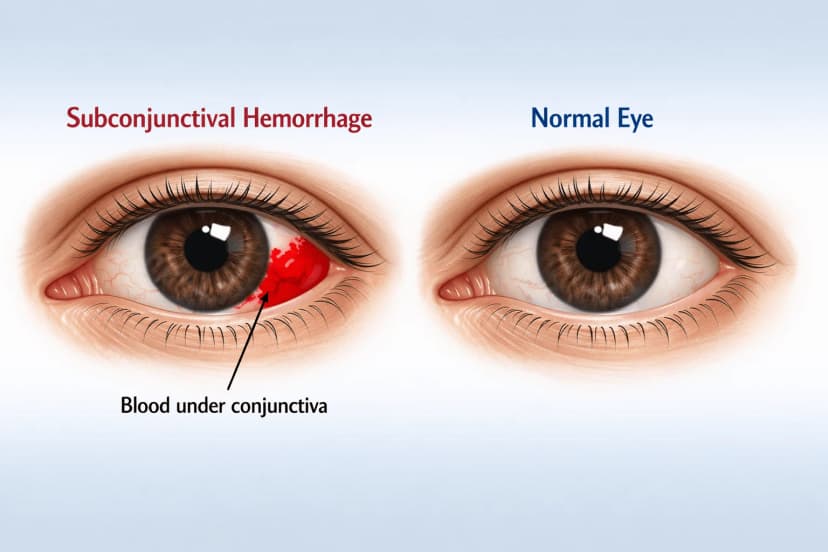
A subconjunctival hemorrhage is bleeding under the conjunctiva - the clear membrane covering the white of the eye. It produces a dramatic bright red or dark red patch that can look alarming, but is usually not dangerous by itself and often resolves on its own without treatment. It is one of the most common reasons people urgently seek eye care.
Key Takeaways
- Looks alarming but is usually not dangerous by itself - a broken blood vessel under the conjunctiva
- No pain and no vision change - if either is present, see a doctor
- No treatment needed - resolves on its own in 1-2 weeks
- Common triggers: coughing, sneezing, straining, vomiting, blood thinners
- Usually happens spontaneously with no identifiable cause
- See a doctor if: caused by trauma, recurrent, or you take blood thinners
Overview
Think of a subconjunctival hemorrhage as a bruise on the white of your eye. Just as a bruise under the skin occurs when a small blood vessel breaks, a subconjunctival hemorrhage occurs when a tiny blood vessel under the conjunctiva ruptures and blood spreads out in a flat layer. Because the conjunctiva is transparent, the blood is vividly visible.
Symptoms
What You'll Notice
- Bright red or dark red patch on the white of the eye
- Flat, smooth blood - not raised or bumpy
- May cover a small area or the entire white of the eye
- No pain - this is a key feature
- No vision changes
- No discharge
- May notice it upon waking or when looking in a mirror
What You Won't Have
- No pain (if painful, it may be something else)
- No vision changes (if vision is affected, see a doctor)
- No discharge or crusting
- No effect on the other eye's appearance
Don't panic. A subconjunctival hemorrhage looks much worse than it is. If you have no pain and your vision is normal, the redness will resolve on its own.
Causes
Common Triggers
- Straining - heavy lifting, coughing, sneezing, vomiting, constipation
- Rubbing the eye vigorously
- Minor trauma - bumping the eye
- Contact lens insertion or removal
- Blood thinners - aspirin, warfarin, clopidogrel, direct oral anticoagulants
- High blood pressure (uncontrolled)
- Blood clotting disorders (rare)
Often Spontaneous
In many cases, no specific cause is identified. The tiny blood vessels under the conjunctiva are fragile and can break easily, especially with age.
Risk Factors
- Age - more common in older adults (fragile blood vessels)
- Blood thinner medications
- Uncontrolled hypertension
- Diabetes
- Blood clotting disorders
Diagnosis
A subconjunctival hemorrhage is diagnosed by its characteristic appearance - no special testing is usually needed.
Your doctor may:
- Check blood pressure - especially if recurrent
- Review medications - particularly blood thinners
- Order blood tests (CBC, coagulation studies) - only if recurrent or spontaneous in younger patients without risk factors
- Examine the eye - to rule out other conditions that can cause a red eye
Treatment
No Treatment Needed
- The blood is reabsorbed naturally by the body over 1-2 weeks
- The red color may change to yellow, brown, or green as it clears (like a bruise)
- Artificial tears can be used if the eye feels mildly irritated or dry
- Cool compresses in the first 24-48 hours may limit further bleeding
- Warm compresses after 48 hours may speed reabsorption
What NOT to Do
- Do not rub the eye
- Do not use redness-relieving eye drops (they won't help and are not needed)
- Do not stop prescribed blood thinners without consulting your doctor
- Do not worry - it will resolve
When to See a Doctor
Routine Evaluation
See your doctor if:
- Subconjunctival hemorrhages are recurrent (happening frequently)
- You take blood thinners (doctor may want to check medication levels)
- You have uncontrolled high blood pressure or diabetes
- The hemorrhage occurred with no identifiable cause and you are under 40
Urgent Evaluation
Seek prompt eye care if the red eye is accompanied by:
- Pain - suggests a different or additional condition
- Vision changes - not typical of a simple subconjunctival hemorrhage
- Trauma to the eye - must rule out more serious injury
- Blood in front of the iris (inside the eye) - this is a hyphema, not a subconjunctival hemorrhage
- Bleeding from other sites (nosebleeds, gum bleeding, easy bruising) - may suggest a systemic bleeding disorder
Frequently Asked Questions
Should I go to the emergency room?
For a painless red patch with normal vision and no trauma, an emergency room visit is usually not necessary. However, if there is pain, vision change, or significant trauma, you should be seen promptly.
How long does it take to go away?
Most subconjunctival hemorrhages resolve within 1-2 weeks. Larger hemorrhages may take 2-3 weeks. The color changes from red to yellow-green as the blood is reabsorbed, similar to a bruise.
Can I still wear my contact lenses?
You can usually continue wearing contact lenses if comfortable. However, if the hemorrhage was caused by contact lens insertion/removal, it may be wise to be more gentle or take a short break.
Will it happen again?
Some people have isolated episodes, while others experience recurrences, especially if they take blood thinners, have high blood pressure, or are prone to eye rubbing. Addressing underlying causes can reduce recurrence.
Is it related to a stroke?
A subconjunctival hemorrhage itself is not related to stroke. However, uncontrolled high blood pressure is a risk factor for both. If you have recurrent subconjunctival hemorrhages, having your blood pressure checked is a good idea.
Can other people catch it?
No. Unlike conjunctivitis (pink eye), a subconjunctival hemorrhage is not infectious or contagious.
References
Medical Disclaimer: This information is for educational purposes only and does not replace professional medical advice, diagnosis, or treatment. If you are concerned about a red eye, please consult a qualified healthcare provider.
Sources:
- American Academy of Ophthalmology. Subconjunctival Hemorrhage.
- Tarlan B, Kiratli H. Subconjunctival hemorrhage: risk factors and potential indicators. Clin Ophthalmol. 2013;7:1163-1170.
- Mimura T, et al. Risk factors for subconjunctival hemorrhage. Ophthalmologica. 2010;224(3):178-182.
- American Academy of Ophthalmology EyeWiki. Subconjunctival Hemorrhage.