
Skew Deviation
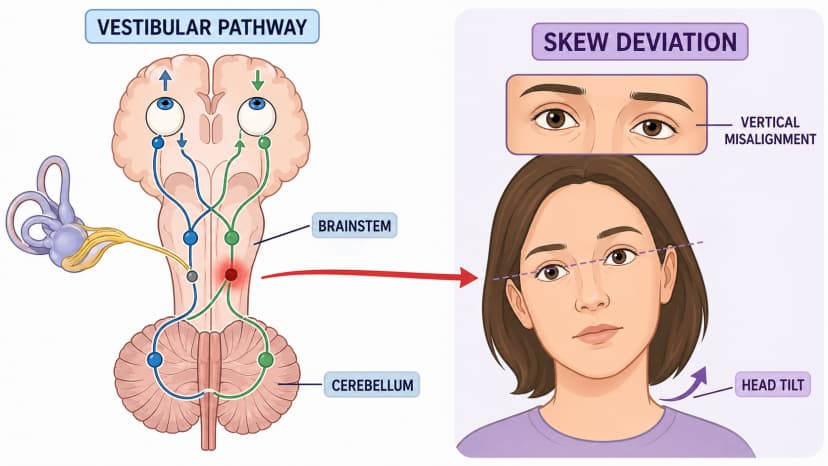
Vertical eye misalignment caused by brainstem or cerebellar lesions. The eyes are misaligned up and down rather than side to side.
Skew deviation is a vertical misalignment of the eyes caused by damage to parts of the brainstem or cerebellum that control vertical eye position. Unlike other causes of vertical double vision, skew deviation results from disruption of the vestibular (balance) pathways that help keep the eyes level.
Key Takeaways
- Vertical eye misalignment from brainstem/cerebellar lesion
- Causes vertical double vision
- Often associated with other neurological symptoms
- Important to distinguish from fourth nerve palsy
- Treatment focuses on underlying cause
Understanding Skew Deviation
The vestibular system helps keep your eyes level, even when your head tilts. Signals travel from the inner ear through the brainstem to the eye muscles. When this pathway is damaged, one eye may drift up or down relative to the other, causing the eyes to be vertically misaligned.
Symptoms
Primary Symptom
Vertical double vision
- One image appears above the other
- Present in most or all gaze directions
- May change with head position
Associated Symptoms
Depends on cause, but may include:
- Dizziness or vertigo
- Imbalance
- Head tilt
- Other brainstem symptoms (weakness, numbness, difficulty swallowing)
- Oscillopsia
Key Features
- Comitant (similar in all directions) or incomitant misalignment
- Often associated with head tilt
- Ocular torsion (eyes rotated)
- Associated with ocular tilt reaction
Causes
Brainstem Lesions
- Stroke (most common in elderly)
- Multiple sclerosis (common in young adults)
- Tumors
- Infection
Cerebellar Lesions
- Stroke
- Tumors
- Degenerative conditions
Peripheral Vestibular
- Inner ear disorders (less common cause)
Other
- Trauma
- Arnold-Chiari malformation
- Increased intracranial pressure
Diagnosis
Clinical Examination
Distinguishing skew deviation from fourth nerve palsy is clinically important. Two bedside tests help:
- Upright-supine test - a skew deviation typically decreases or resolves when the patient lies flat, while a fourth nerve palsy does not change with position.
- Alternate cover test in lateral gaze - fourth nerve palsy worsens the hypertropia in the opposite direction of gaze and with head tilt toward the affected side (Bielschowsky three-step), whereas skew deviation does not follow that pattern and often has associated brainstem or cerebellar signs (ocular tilt reaction, nystagmus, INO).
New vertical misalignment, especially when skew deviation or neurologic signs are suspected, warrants neurologic evaluation and often MRI; see Imaging below.
Imaging
- Essential to identify underlying lesion
- Focus on brainstem and cerebellum
- May reveal stroke, MS plaques, tumor
Vestibular Testing
- May be done to evaluate inner ear function
- Helps distinguish peripheral from central cause
Treatment
Treat Underlying Cause
- Stroke management
- MS treatment
- Tumor treatment
- Address any treatable condition
Manage Double Vision
- Can be effective for stable skew deviation
- May need adjustment as condition changes
- Temporary measure for diplopia
Observation
- Some cases resolve as underlying condition improves
- Monitor for stability or change
Prognosis
Variable
- Depends on underlying cause
- Stroke-related may improve over time
- MS-related may resolve with treatment
- Some cases persist
Recovery Factors
- Time since onset
- Underlying cause and its treatment
- Extent of brainstem/cerebellar damage
Frequently Asked Questions
How is skew deviation different from other causes of double vision?
Skew deviation is a specific type of vertical misalignment caused by damage to vestibular pathways in the brainstem. Unlike fourth nerve palsy, which affects a specific eye muscle, skew deviation results from disordered vestibular control of eye position. The distinction matters because skew deviation usually indicates a brainstem problem.
Is skew deviation serious?
Skew deviation itself causes double vision, which is bothersome but not dangerous. However, it indicates a problem in the brainstem or cerebellum, which may be serious (like stroke). The underlying cause needs to be identified and treated.
Will my double vision go away?
Possibly. If the underlying cause improves (like recovery from stroke or treatment of MS), the skew deviation may resolve. In other cases, it may persist but can often be managed with prism glasses.
References
Medical Disclaimer: This information is for educational purposes only and does not replace professional medical advice, diagnosis, or treatment. If you have concerns about double vision or any symptoms, please consult a qualified healthcare provider.
Sources:
- Brodsky MC, et al. Skew deviation: clinical features, diagnosis, and treatment. Strabismus. 2003;11(1):45-52.
- Brandt T, Dieterich M. Skew deviation with ocular torsion: a vestibular brainstem sign of topographic diagnostic value. Ann Neurol. 1993;33(5):528-534.
- Wong AM. Eye Movement Disorders. Oxford University Press. 2008.
- American Academy of Ophthalmology EyeWiki. Skew Deviation.
- MedlinePlus. Double Vision.