

How to Choose Eye Drops for Dry Eyes
How to choose dry eye drops by preservative status, thickness, contact lens use, dosing frequency, and when prescription treatment may be needed.
The right drop for dry eyes depends on how often you need it, whether you wear contacts, whether preservatives irritate your eyes, and whether the problem is mostly tear deficiency or evaporation. Redness-reliever drops are a separate category and can worsen rebound redness with repeated use.
Key Takeaways
- Use preservative-free drops if you need artificial tears more than 4 times daily - preservatives can irritate sensitive eyes with frequent use
- Lipid-based drops work best for evaporative dry eye caused by meibomian gland dysfunction - they supplement the oil layer of your tears
- Redness-reliever drops are not dry eye treatments - products like Visine and Clear Eyes contain vasoconstrictors that cause rebound redness with regular use
- Gels and ointments provide longer-lasting relief - use gels for extended comfort during the day and ointments at bedtime for overnight protection
- Give a new drop 2-4 weeks before deciding it doesn't work - your eyes need time to adjust
Understanding Drop Types
Not every bottle in the eye care aisle treats dry eye. There are three main categories:
Lubricating Drops (Artificial Tears)
These are true dry eye treatments. They supplement your natural tear film with moisture, and some also add oils or other components to improve tear stability. Available over the counter.
Redness Relievers
Products marketed as "redness relief" or "get the red out" (Visine Original, Clear Eyes) contain vasoconstrictors that temporarily shrink blood vessels. They do nothing for the underlying dryness.
Avoid redness-reliever drops for dry eye. Products like Visine Original and Clear Eyes contain vasoconstrictors (tetrahydrozoline, naphazoline) that mask redness temporarily but cause rebound redness with regular use - meaning your eyes become redder than before. If you have chronic redness from dry eye, use lubricating artificial tears instead. If redness persists, see your doctor.
Prescription Drops
When OTC drops aren't sufficient, prescription medications target the underlying cause of dryness - usually inflammation. For a full comparison of available prescriptions, see our guide on comparing dry eye prescription drops.
Preserved vs Preservative-Free
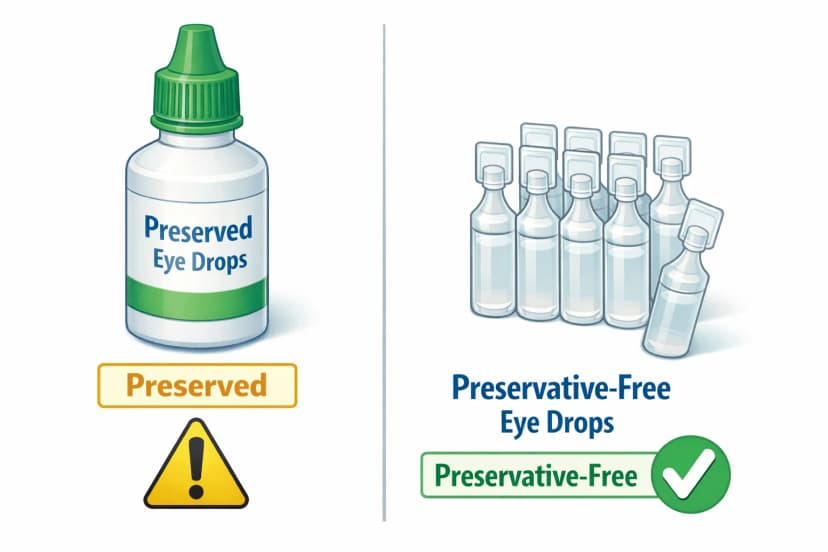
This is one of the most important decisions when choosing eye drops.
Preserved Drops
- Come in multi-use bottles
- Contain preservatives (most commonly BAK - benzalkonium chloride) to prevent bacterial growth after opening
- Fine for occasional use (1-3 times daily)
- Less expensive and more convenient
- Can irritate the eye surface with frequent use, especially in patients who already have compromised tear films
Preservative-Free Drops
- Typically packaged in single-use vials
- No preservatives that can accumulate on the eye surface
- Recommended if you use drops more than 4 times daily
- Required for use with contact lenses
- Better tolerated by sensitive eyes
- Cost more per dose but avoid preservative-related irritation
If you're reaching for drops frequently, preservative-free drops are usually safer for the eye surface. The added cost helps avoid preservative toxicity that can worsen dry eye over time.
Choosing by Your Type of Dryness
The best drop depends on which part of your tear film is deficient.
Aqueous-Deficient Dry Eye (Low Tear Volume)
Your eyes don't produce enough of the watery component. Look for:
- Water-based artificial tears - Refresh Tears, Systane Ultra, TheraTears
- These add moisture directly to the eye surface
- Preservative-free formulations (Refresh Optive Sensitive, Systane Ultra PF) are ideal for frequent use
Evaporative Dry Eye (Tear Film Instability)
Your tears evaporate too quickly, usually due to MGD. Look for:
- Lipid-based drops - Systane Balance, Systane Complete, Refresh Optive Mega-3
- These supplement the oil layer and slow evaporation
- Particularly effective when combined with warm compresses and lid hygiene to treat the underlying gland dysfunction
Mixed Dry Eye
If you have both types (common), a lipid-enhanced drop like Systane Complete provides broad coverage. Your doctor can help determine which component is most deficient.
Drops vs Gels vs Ointments
| Form | Best For | Duration | Vision Blur | When to Use |
|---|---|---|---|---|
| Drops | Mild-moderate dryness, daytime use | 1-2 hours | Minimal | Throughout the day as needed |
| Gels | Moderate dryness, extended relief | 2-4 hours | Brief (1-2 min) | When drops don't last long enough; good for work/screen sessions |
| Ointments | Severe dryness, overnight | 6-8 hours | Significant | At bedtime only (too blurry for daytime) |
- Drops are the workhorse for daytime use - thin, quick to clear, minimal vision disruption
- Gels (GenTeal Gel, Refresh Celluvisc, Systane Gel) are thicker and last longer, with brief blurring after instillation
- Ointments (Refresh PM, GenTeal Severe) coat the eye overnight and prevent drying during sleep - use only at bedtime
Decision Tree: Finding Your Best Drop
Follow these steps to narrow your choice:
-
How often do you need drops?
- Fewer than 4 times daily → preserved drops are fine
- 4 or more times daily → switch to preservative-free
-
What type of dryness do you have?
- Aqueous-deficient → water-based drops (Refresh, Systane Ultra, TheraTears)
- Evaporative/MGD → lipid-based drops (Systane Balance, Systane Complete)
- Not sure → try Systane Complete (covers both types)
-
Do you wear contact lenses?
- Yes → use preservative-free drops labeled safe for contacts
- No → any appropriate formulation
-
Are your symptoms worst at night or first thing in the morning?
- Yes → add a gel or ointment at bedtime
- No → daytime drops may be sufficient
-
Are OTC drops not controlling your symptoms?
- Yes → talk to your doctor about prescription options or see our newly diagnosed guide for next steps
It's fine to use different drops at different times of day. Many patients use a thin artificial tear during the day for quick, clear relief and a thicker gel or ointment at bedtime for overnight protection. You can also combine OTC drops with prescription medications - just separate them by at least 5-10 minutes.
Tips for Getting the Most from Your Eye Drops
Proper Instillation Technique
- Wash your hands before handling drops
- Tilt your head back and pull down the lower lid to create a small pocket
- Look up and place one drop in the pocket - avoid touching the dropper tip to your eye
- Close your eyes gently (don't squeeze) for 30-60 seconds
- Press gently on the inner corner of the eye (punctal occlusion) to keep the drop on the surface longer
Storage
- Most drops are stored at room temperature
- Some preservative-free vials can be recapped and used for up to 24 hours - check the label
- Discard any drop that looks cloudy or has particles floating in it
- Don't share eye drops
Frequency
- Start with the recommended frequency on the label or from your doctor
- You can increase frequency with preservative-free drops - they won't cause harm
- If you're using drops more than 6 times daily with minimal relief, it's time to discuss additional treatments with your doctor
Combining Products
- Separate different eye drops by at least 5 minutes
- Apply thinner drops before thicker ones
- If using a prescription drop, apply artificial tears first, wait 5-10 minutes, then apply the prescription
Frequently Asked Questions
What's the best eye drop for dry eyes?
There's no single best drop - it depends on your type of dryness, how often you use drops, and whether you wear contacts. For most people, preservative-free artificial tears (such as Refresh Optive PF or Systane Ultra PF) are a good starting point. If you have evaporative dry eye from MGD, a lipid-based drop like Systane Complete may work better.
Are preservative-free drops worth the extra cost?
If you use drops more than 3-4 times daily, yes. Preservatives (especially BAK) can damage the corneal surface with frequent use and actually worsen dry eye symptoms. The added cost of preservative-free drops is offset by avoiding preservative-related irritation.
Can I use eye drops with contact lenses?
Only preservative-free drops labeled as safe for contact lenses. Never use preserved drops or redness relievers with contacts in. Apply rewetting drops as needed throughout the day while wearing lenses.
How often can I use artificial tears?
Preservative-free drops can be used as often as needed - every hour if necessary. Preserved drops should be limited to 4 times daily. If you need drops more frequently than that, switch to preservative-free.
Is a thicker drop always better?
Not necessarily. Thicker drops (gels) last longer but temporarily blur vision and are impractical for frequent daytime use. A thin drop used consistently is often more effective than a thick drop used only when symptoms are severe. Many patients benefit from thin drops during the day and a gel or ointment at bedtime.
Can I use two different brands of eye drops?
Yes. You might use a water-based drop during the day and a lipid-based drop when evaporation is a bigger issue (windy conditions, long screen sessions). Just separate applications by 5 minutes so the first drop has time to absorb.
When should I switch from OTC to prescription drops?
If you've been using artificial tears consistently for 4-6 weeks along with warm compresses and lid hygiene, and your symptoms still significantly affect daily activities, talk to your doctor about prescription options. Signs include needing drops more than 6 times daily, persistent blurred vision, and ongoing redness or discomfort.
Do redness-reliever drops treat dry eye?
No. Redness-reliever drops (Visine Original, Clear Eyes) contain vasoconstrictors that shrink blood vessels to temporarily whiten the eye. They do not add moisture or treat dryness. Regular use causes rebound redness, meaning your eyes become redder over time. Use lubricating artificial tears instead.
References
Medical Disclaimer: This information is for educational purposes only and does not replace professional medical advice, diagnosis, or treatment. If you are unsure which eye drops are right for you, consult a qualified healthcare provider.
Sources:
- American Academy of Ophthalmology. Dry Eye Preferred Practice Pattern.
- National Eye Institute. Dry Eye.
- Jones L, et al. TFOS DEWS II Management and Therapy Report. Ocul Surf. 2017;15(3):575-628.