

Comparing Dry Eye Prescription Drops
Compare common prescription dry eye treatments by mechanism, onset, dosing, side effects, and cost.
If over-the-counter artificial tears aren't controlling your dry eye symptoms, your doctor may recommend prescription treatment. The right choice depends on the dry eye pattern: inflammation, rapid tear evaporation, poor tear production, or a short flare that needs temporary anti-inflammatory treatment.
Key Takeaways
- Restasis (cyclosporine 0.05%) - the original prescription dry eye drop; reduces inflammation and increases tear production over 3-6 months
- Cequa (cyclosporine 0.09%) - a higher-concentration cyclosporine with better penetration; same mechanism as Restasis
- Xiidra (lifitegrast) - targets a different inflammatory pathway; may show improvement within 2-4 weeks
- Miebo (perfluorohexyloctane) - a non-aqueous drop that directly stabilizes the tear film's oil layer; best for evaporative dry eye
- Tyrvaya (varenicline nasal spray) - the first nasal spray for dry eye; stimulates natural tear production through nerve activation
- Eysuvis (loteprednol 0.25%) - a short-term steroid for dry eye flare-ups; used for 2 weeks only
- Tryptyr (acoltremon) - a newer TRPM8 receptor agonist eye drop that stimulates natural tear production through corneal sensory nerves
How Prescription Dry Eye Drops Work
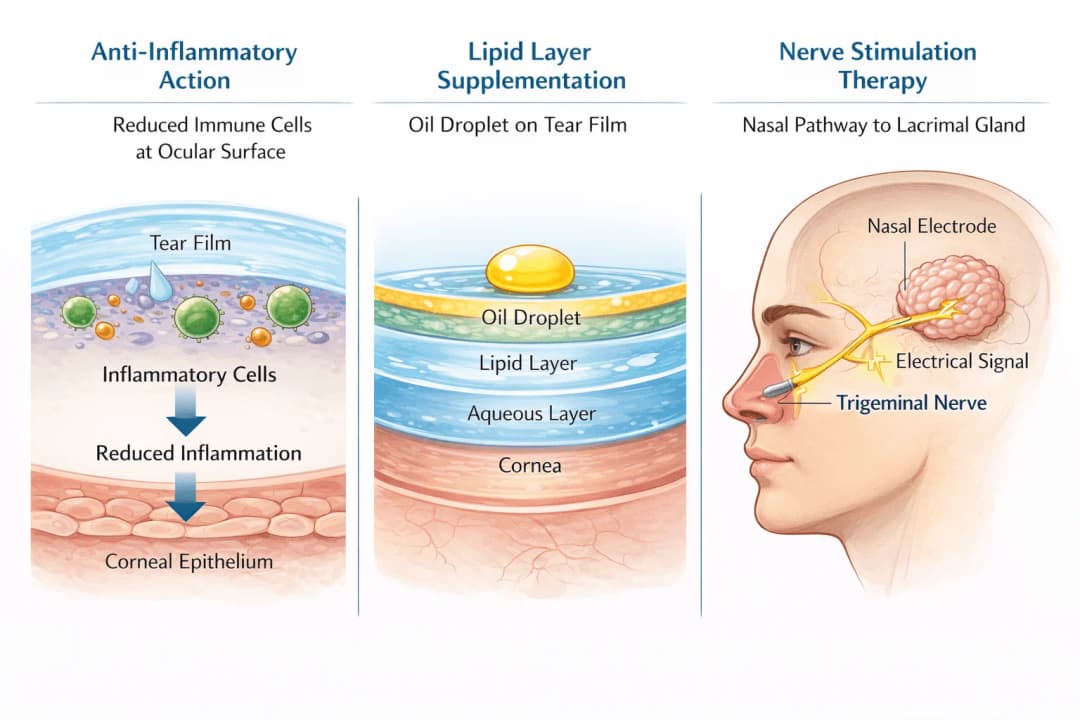
Prescription dry eye medications fall into four categories based on their mechanism:
- Anti-inflammatory drops - Restasis, Cequa, and Xiidra reduce the chronic inflammation that drives dry eye disease. They don't just relieve symptoms - they treat the underlying cause.
- Tear film stabilizer - Miebo is a non-aqueous lipid drop that supplements the oil layer of the tear film, slowing evaporation. It works differently from all other options.
- Tear stimulator - Tyrvaya is a nasal spray that activates a nerve pathway to stimulate natural tear production from the lacrimal gland.
- Short-term steroid - Eysuvis (a low-dose loteprednol) rapidly reduces inflammation during flare-ups but is not for long-term use.
Head-to-Head Comparison
Most prescribing decisions start with the mechanism and symptom pattern:
- Often first: Restasis or generic cyclosporine, especially when long-term inflammatory control and insurance coverage matter
- Faster anti-inflammatory pathway: Xiidra, which targets LFA-1/ICAM-1 rather than calcineurin
- Evaporative dry eye: Miebo, especially when meibomian gland dysfunction causes rapid tear breakup
- Drop-free route: Tyrvaya, a nasal spray that stimulates tear production
| Medication | Generic name | Drug class | Main action | Common use case | Delivery and dose | Typical onset | Common side effects | Contacts | Cost tier | Duration |
|---|---|---|---|---|---|---|---|---|---|---|
| Restasis | Cyclosporine 0.05% | Calcineurin inhibitor | Reduces T-cell inflammation | Inflammatory dry eye when long-term control and generic access matter | Eye drop twice daily | 3-6 months | Burning or stinging on instillation | Remove first; reinsert after 15 minutes | $$$; generics available | Long-term |
| Cequa | Cyclosporine 0.09% | Calcineurin inhibitor | Reduces T-cell inflammation | Inflammatory dry eye when a higher-strength cyclosporine formulation is preferred | Eye drop twice daily | 3-6 months | Burning, stinging, or irritation | Remove first; reinsert after 15 minutes | $$$$ | Long-term |
| Xiidra | Lifitegrast 5% | LFA-1 antagonist | Blocks LFA-1/ICAM-1 inflammation | Inflammatory dry eye when a different pathway or faster onset is desired | Eye drop twice daily | 2-12 weeks | Altered taste, irritation | Remove first; reinsert after 15 minutes | $$$$ | Long-term |
| Miebo | Perfluorohexyloctane | Semifluorinated alkane | Stabilizes tear lipid layer | Evaporative or MGD-related dry eye with rapid tear breakup | Eye drop four times daily | 1-4 weeks | Brief blurred vision | Remove first; reinsert after 15 minutes | $$$$ | Long-term |
| Tyrvaya | Varenicline 0.03 mg | Nicotinic agonist | Stimulates basal tear secretion | Patients who want to avoid eye drops or need tear stimulation | Nasal spray twice daily, one spray per nostril | 1-2 weeks | Sneezing, cough, throat irritation | No restriction because it is a nasal spray | $$$ | Long-term |
| Eysuvis | Loteprednol 0.25% | Corticosteroid | Suppresses broad inflammation | Short dry-eye flare bridge while longer-term therapy builds effect | Eye drop four times daily for 2 weeks | Days | Elevated IOP is rare at this dose | Remove first; reinsert after 15 minutes | $$$ | Short-term, usually 2 weeks |
Choosing the Right Prescription
The best prescription depends on your type of dry eye, how quickly you need relief, and your tolerance for different side effects.
If Your Primary Problem Is Inflammation
Most dry eye involves chronic inflammation. Anti-inflammatory drops are the mainstay:
- Restasis - well-established, now available as generic cyclosporine 0.05%; most insurance-friendly option
- Cequa - higher concentration with nanomicellar technology for better penetration; may be tried if Restasis is insufficient
- Xiidra - works through a different pathway (LFA-1/ICAM-1); reasonable first choice or alternative if cyclosporine causes too much burning
If Your Primary Problem Is Tear Evaporation
When MGD causes rapid evaporation:
- Miebo - specifically targets tear evaporation and the lipid layer; does not usually sting on instillation; particularly suited for evaporative dry eye
- Combine with warm compresses and lid hygiene for comprehensive MGD management
If You Can't Tolerate Eye Drops
Some patients dislike or can't tolerate drops of any kind:
- Tyrvaya - delivered as a nasal spray, completely bypassing the eye; works by stimulating the trigeminal nerve to increase natural tear production
If You're Having a Flare-Up
When symptoms suddenly worsen:
- Eysuvis - a short-term (2-week) steroid pulse to rapidly control inflammation; often used to "bridge" while a long-term medication builds its effect
Combination Approaches
Many patients benefit from combining treatments under clinician direction:
- An anti-inflammatory drop (Restasis, Cequa, or Xiidra) plus Miebo for combined anti-inflammatory and lipid support
- An anti-inflammatory drop plus OTC artificial tears for immediate comfort while the Rx builds effect
- Eysuvis as a 2-week bridge plus starting a long-term anti-inflammatory drop simultaneously
Many patients combine prescription and OTC drops. Artificial tears provide immediate moisture, while prescription drops work on the underlying disease. Use artificial tears as needed for comfort and your prescription drop on its scheduled twice-daily basis. Just separate them by 5-10 minutes.
What to Expect When Starting a Prescription
Adjustment Period
- Stinging or burning is common with Restasis, Cequa, and Xiidra, especially during the first few weeks. This usually improves as the eye surface heals.
- Refrigerating cyclosporine drops can reduce stinging.
- Dysgeusia (altered taste) occurs especially with Xiidra; unusual taste can also happen when drops drain through the tear duct into the throat.
- Sneezing is common with Tyrvaya when first starting.
When to Reassess
- If burning from cyclosporine drops is intolerable after 2-3 weeks, discuss switching to Xiidra or Tyrvaya
- If you see no improvement after 3 months on Xiidra, discuss Restasis/Cequa or adding Miebo
- If you see no improvement after 6 months on any regimen, ask about combination therapy or in-office procedures like punctal plugs
Give anti-inflammatory drops enough time to work. Restasis, Cequa, and Xiidra build effect over weeks to months. If side effects are tolerable, discuss the expected trial period before switching medications.
Frequently Asked Questions
What's the difference between Restasis and Xiidra?
Both reduce inflammation but through different mechanisms. Restasis (cyclosporine) is a calcineurin inhibitor that suppresses T-cell activation. Xiidra (lifitegrast) blocks the LFA-1/ICAM-1 interaction. Xiidra may work faster (weeks vs months), while Restasis has a longer track record. Some patients respond better to one than the other, and specialist-directed combination therapy is sometimes used in refractory cases.
Can I use Restasis and Xiidra together?
Sometimes, though this is off-label and typically reserved for moderate to severe cases that don't respond to a single agent. Some doctors prescribe one in the morning and the other in the evening. Discuss this with your ophthalmologist.
What's the difference between Cequa and Restasis?
Both contain cyclosporine. Cequa uses nanomicellar technology to deliver a higher concentration (0.09% vs 0.05%) with potentially better tissue penetration. Cequa may be tried when Restasis alone provides incomplete relief.
Is Miebo better than Xiidra?
They treat different aspects of dry eye. Miebo stabilizes the lipid layer (best for evaporative/MGD-related dry eye), while Xiidra reduces inflammation. They're not interchangeable - the choice depends on your type of dryness. They can also be combined.
How does a nasal spray treat dry eyes?
Tyrvaya (varenicline) activates the trigeminal nerve in the nasal passages, which triggers the lacrimal gland to produce natural tears. It's based on the same reflex pathway that makes your eyes water when you smell something strong.
Can I use artificial tears with my prescription drops?
Absolutely. Artificial tears provide immediate comfort while your prescription works on the underlying disease. Use them as needed for symptom relief. Just wait 5-10 minutes between different drops.
How long do I need to stay on prescription dry eye drops?
Most patients use anti-inflammatory drops (Restasis, Cequa, Xiidra) long-term - often indefinitely. Dry eye is a chronic condition, and stopping the medication typically causes symptoms to return. Your doctor may reduce frequency over time if your eye surface stabilizes.
Will insurance cover these medications?
Coverage varies widely. Generic cyclosporine (Restasis equivalent) is the most commonly covered option. Many brand-name drops require prior authorization or step therapy (trying a less expensive option first). Manufacturer copay cards and patient assistance programs can help reduce out-of-pocket costs - ask your doctor or pharmacist.
References
Medical Disclaimer: This information is for educational purposes only and does not replace professional medical advice, diagnosis, or treatment. Prescription medications should only be used under the supervision of a qualified healthcare provider.
Sources:
- American Academy of Ophthalmology. Dry Eye Preferred Practice Pattern.
- Jones L, et al. TFOS DEWS II Management and Therapy Report. Ocul Surf. 2017;15(3):575-628.
- Restasis (cyclosporine ophthalmic emulsion) [prescribing information]. Allergan, Inc.
- Xiidra (lifitegrast ophthalmic solution) [prescribing information]. Novartis Pharmaceuticals.
- Cequa (cyclosporine ophthalmic solution) [prescribing information]. Sun Pharmaceutical Industries.
- Miebo (perfluorohexyloctane ophthalmic solution) [prescribing information]. Bausch + Lomb.
- Tyrvaya (varenicline nasal spray) [prescribing information]. Viatris Inc.
- Eysuvis (loteprednol etabonate ophthalmic suspension) [prescribing information]. Kala Pharmaceuticals.