

Color Vision Testing
Tests to evaluate your ability to distinguish colors, which can be affected by optic nerve and retinal conditions.
Color vision testing assesses your ability to see and distinguish different colors. Color vision problems can be inherited (color blindness) or acquired from optic nerve and retinal conditions.
Key Takeaways
- Tests ability to distinguish colors
- Acquired color loss suggests optic nerve disease
- Quick and painless office test
- Several different tests available
- Helps monitor optic nerve conditions
Why It's Done
- Detect optic nerve problems (optic neuritis, compressive neuropathy)
- Monitor LHON and other optic neuropathies
- Assess dominant optic atrophy
- Distinguish inherited from acquired color deficiency
- Screen for certain retinal conditions
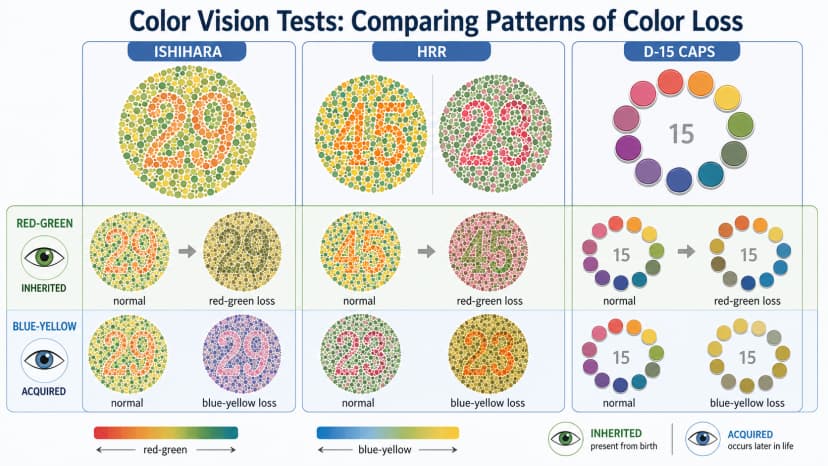
Types of Color Vision Problems
Inherited (Color Blindness)
- Present from birth
- Usually red-green confusion
- Doesn't change over time
- More common in males
Acquired
- Develops later in life
- Suggests optic nerve or retinal disease
- May be red-green OR blue-yellow
- Can change with disease activity
Common Tests
Ishihara Plates
- Most common screening test
- Colored dots forming numbers
- Must identify number hidden in dots
- Primarily detects red-green problems
HRR (Hardy-Rand-Rittler) Plates
- Detects both red-green and blue-yellow
- Better for acquired color deficiency
Farnsworth D-15
- Arrange colored caps in order
- Detects moderate to severe problems
Farnsworth-Munsell 100 Hue
- Most sensitive test
- 85 colored caps to arrange
- Takes longer but very detailed
What to Expect
- Test done in good lighting
- Each eye tested separately
- Takes 5-15 minutes depending on test
- Wear any corrective lenses needed
- Your clinician may compare each eye because acquired optic nerve problems often show a side-to-side difference
Understanding Results
- Number of errors recorded
- Pattern of errors (which colors confused)
- Compared to previous tests if monitoring
- Helps track optic nerve function
What Results Can Change
Color testing is most useful when it is interpreted with the rest of the exam, not as an isolated score. Reduced color vision in one eye, especially with eye pain, dimming, or an RAPD, pushes the workup toward optic nerve disease such as optic neuritis or compressive optic neuropathy. Symmetric lifelong red-green errors point more toward inherited color vision deficiency.
If the result changes over time, your doctor may repeat OCT, visual field testing, or MRI of the brain and orbits, depending on the pattern.
Frequently Asked Questions
Can a color vision test diagnose optic neuritis by itself?
No. It can show that optic nerve function is reduced, but the diagnosis still depends on the history, pupil exam, visual field pattern, OCT, and often MRI.
Why does my doctor test one eye at a time?
Testing each eye separately is important because optic nerve disease often affects one eye more than the other. If both eyes are tested together, the better eye can hide the problem.
If I have inherited color blindness, will these tests still help?
Yes, but the interpretation changes. A stable lifelong pattern is different from a new or worsening color problem. Tell your clinician if you have known color blindness or a family history of it.
Medical Disclaimer: This information is for educational purposes only and does not replace professional medical advice.
Sources:
- National Eye Institute. Color Blindness.
- American Academy of Ophthalmology EyeWiki. Color Vision.