

Dominant Optic Atrophy (Kjer Disease)
An inherited condition causing progressive bilateral vision loss from childhood due to optic nerve degeneration.
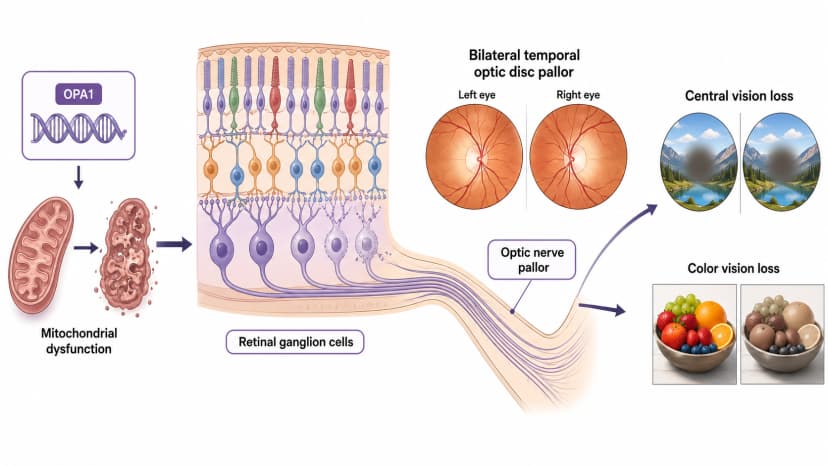
Dominant optic atrophy (DOA), also known as Kjer disease, is the most common inherited optic neuropathy. It causes gradual, usually mild to moderate vision loss starting in childhood. The condition is caused by genetic mutations that affect the optic nerve's mitochondrial function.
Key Takeaways
- Inherited condition-autosomal dominant (50% chance of passing to children)
- Affects both eyes symmetrically
- Begins in childhood-often not noticed until school age
- Usually mild to moderate vision loss
- Color vision affected, especially blue-yellow
- No cure but usually compatible with normal life activities
Understanding Dominant Optic Atrophy
DOA is caused by mutations in genes (most commonly OPA1) that affect how mitochondria-the energy-producing parts of cells-function and divide. The optic nerve cells are especially vulnerable to this dysfunction because they require large amounts of energy. Over time, these cells slowly degenerate.
Symptoms
Visual Symptoms
- Gradual vision loss-often 20/40 to 20/200
- Color vision deficits-blue-yellow most affected
- Central or cecocentral visual field defects
- Reduced contrast sensitivity
- Symptoms symmetric between eyes
Age of Onset
- Usually noticed in first decade of life
- May be detected at school eye screening
- Sometimes not diagnosed until adulthood
- Vision loss often very slow
Severity
- Highly variable-even within same family
- Most maintain functional vision for daily activities
- Severe vision loss is uncommon but can occur
- About 15% have additional neurological features (DOA plus)
DOA Plus Syndrome
Some patients with DOA have additional features:
- Hearing loss (sensorineural)
- Muscle problems (myopathy)
- Nerve problems (peripheral neuropathy)
- Ataxia (balance problems)
- Chronic progressive external ophthalmoplegia
These patients are described as having "DOA plus" syndrome.
Diagnosis
Clinical Examination
- Visual acuity testing-usually reduced
- Color vision testing-blue-yellow defects
- Visual field testing-central scotomas
- Fundus examination-temporal pallor of optic disc
- OCT-thinning of retinal nerve fiber layer
Genetic Testing
- Confirms diagnosis
- OPA1 mutations most common
- Other genes (OPA3, etc.) in some families
- Important for family counseling
Family History
- Autosomal dominant pattern
- May see affected relatives across generations
- Variable expression-some family members more affected
Treatment
Current Management
No proven treatment to reverse or halt progression
Supportive measures:
- Regular monitoring of vision
- Low vision aids when needed
- Genetic counseling for family planning
- Career counseling (consider visual demands)
Avoid
- Smoking
- Excessive alcohol
- Nutritional deficiencies
Research
- Gene therapy trials in development
- Mitochondrial-targeted treatments being studied
Living with DOA
Practical Considerations
- Most people maintain functional vision
- Reading aids, magnification may help
- Good lighting important
- Consider career paths compatible with vision level
Driving
- Many patients can drive with corrective lenses
- Depends on visual acuity and field
- Regular vision checks important
Family Planning
- 50% chance of passing to each child
- Genetic counseling recommended
- Prenatal testing available
What Makes the Diagnosis More Useful
A genetic result helps clarify whether this is classic OPA1-related DOA, a DOA-plus pattern, or another inherited optic neuropathy. It can also prevent repeated testing for conditions the family does not have. The most useful visit usually includes old eye records, school vision screening results, family history on both sides, and whether anyone has hearing loss, balance problems, neuropathy, or CPEO-like eye movement limitation.
Prognosis
Natural History
- Slowly progressive throughout life
- Most maintain useful vision
- Stabilization may occur
- Severe vision loss uncommon
Quality of Life
- Generally good with adaptation
- Most can read, work, and live independently
- Low vision services helpful for those with significant loss
Frequently Asked Questions
Will I go blind?
Most people with DOA do not become legally blind. While vision is reduced, the majority maintain functional vision adequate for daily activities, though reading may require aids and driving may eventually become difficult for some.
Can my children inherit this?
Yes, there is a 50% chance of passing the mutation to each child. However, even within families, the severity varies greatly-a mildly affected parent may have a more severely affected child, or vice versa.
Is there any treatment?
Currently, no treatment has been proven to stop or reverse DOA. Research is ongoing, including gene therapy trials. Supporting overall health and avoiding toxins (tobacco, excess alcohol) is recommended.
How is this different from LHON?
Both are inherited optic neuropathies affecting mitochondria, but they differ in:
- Inheritance: DOA is autosomal dominant; LHON is mitochondrial
- Onset: DOA is gradual from childhood; LHON is typically sudden in young adults
- Severity: DOA usually milder; LHON typically more severe
- Gender: DOA affects both equally; LHON predominantly affects males
References
Medical Disclaimer: This information is for educational purposes only and does not replace professional medical advice, diagnosis, or treatment. If you have concerns about inherited vision problems or any symptoms, please consult a qualified healthcare provider.
Sources:
- Yu-Wai-Man P, et al. Dominant optic atrophy. GeneReviews. 2023.
- Lenaers G, et al. Dominant optic atrophy: pathogenesis and therapeutic prospects. Acta Neuropathol. 2012;124(1):3-14.
- MedlinePlus Genetics. Dominant Optic Atrophy.