

Leber Hereditary Optic Neuropathy (LHON)
A genetic mitochondrial disorder causing rapid, severe vision loss in young adults, primarily affecting males.
Leber hereditary optic neuropathy (LHON) is a maternally inherited mitochondrial genetic disorder that causes rapid, severe, and often permanent vision loss in young adults. It predominantly affects males and is one of the most common inherited optic neuropathies, with an estimated prevalence of 1 in 30,000 to 50,000 people.
Key Takeaways
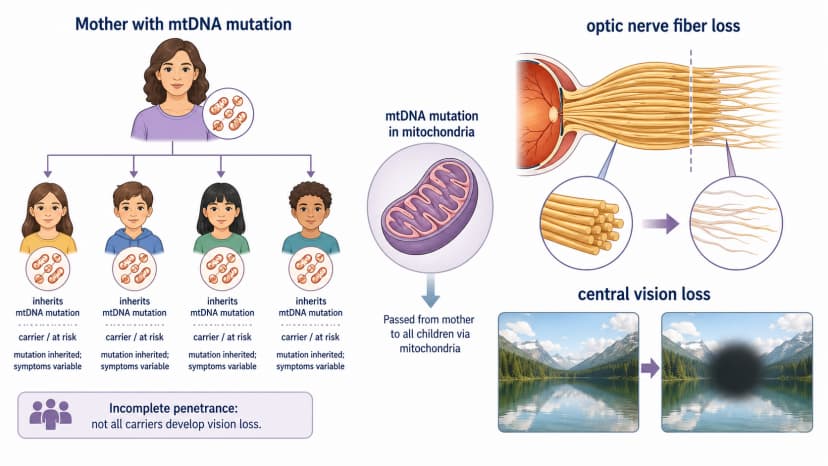
- Inherited through mothers (mitochondrial DNA)-all children of carrier mothers inherit the mutation, but only some develop symptoms
- Primarily affects young men ages 15-35, though women and older adults can also be affected
- Rapid sequential vision loss-one eye affected first, second eye typically within weeks to months
- Caused by specific mitochondrial DNA mutations-three mutations account for 90% of cases
- Avoid alcohol, tobacco, and certain medications-may trigger or worsen the disease
- Idebenone (Raxone) may help some patients if started early in the disease course
Understanding the Disease
Pathophysiology
LHON results from mutations in mitochondrial DNA (mtDNA) that encode subunits of Complex I of the electron transport chain. This impairs cellular energy production (ATP synthesis) specifically in retinal ganglion cells, which have high energy demands. The optic nerve, composed of retinal ganglion cell axons, is particularly vulnerable to this energy failure.
The selective vulnerability of certain cells despite a systemic genetic defect remains an area of active research. Current theories suggest that retinal ganglion cells are especially susceptible due to:
- High metabolic demands from continuous neural signaling
- Long unmyelinated axon segments within the retina
- Unique structural features requiring robust energy supply
Genetics
LHON follows mitochondrial inheritance:
- Mitochondria (and their DNA) come only from the mother
- All children of an affected/carrier mother inherit the mutation
- Fathers cannot pass the mutation to their children
- Having the mutation doesn't guarantee developing symptoms (incomplete penetrance)
Three primary mutations cause approximately 90% of LHON cases:
- m.11778G>A (ND4 gene)-most common, ~70% of cases, worst prognosis
- m.3460G>A (ND1 gene)-~15% of cases
- m.14484T>C (ND6 gene)-~15% of cases, best prognosis for spontaneous recovery
Penetrance
Not everyone with the mutation develops vision loss:
- ~50% of males with the mutation develop LHON
- ~15% of females with the mutation develop LHON
- Reasons for incomplete penetrance not fully understood
- Environmental and other genetic factors likely play a role
Epidemiology
- Prevalence: 1 in 30,000 to 50,000 in most populations
- Higher in certain regions: More common in Northern Europe
- Age of onset: Peak 15-35 years (range: childhood to 60+)
- Male predominance: Male-to-female ratio approximately 4:1
Symptoms
Initial Presentation
- Sudden, painless central vision loss in one eye
- Often noticed upon waking or when covering the other eye
- No eye pain or discomfort (unlike optic neuritis)
- Vision may seem "foggy" or "washed out"
Progression
- Second eye involvement typically within 2-3 months (range: days to years)
- Bilateral simultaneous onset occurs in ~25% of cases
- Vision usually declines to 20/200 or worse (legal blindness)
- Central scotoma (blind spot) develops in each eye
- Color vision severely affected-dyschromatopsia, especially red-green
What's Preserved
- Peripheral vision typically remains intact
- Pupils remain reactive (though may show RAPD)
- No double vision or other neurological symptoms
Risk Factors and Triggers
Several factors may trigger vision loss in genetically susceptible individuals:
Strongly Associated
- Tobacco smoking-significantly increases risk
- Heavy alcohol use-especially in combination with smoking
- Male sex-higher penetrance in males
Potentially Associated
- Certain medications (ethambutol, linezolid, erythromycin)
- Nutritional deficiencies (B vitamins, folate)
- Environmental toxins
- Psychological stress
- Head trauma
Prevention in Mutation Carriers
If you carry an LHON mutation but haven't developed vision loss:
- Do not smoke (most important)
- Avoid heavy alcohol consumption
- Discuss all medications with your doctor before starting
- Consider idebenone supplementation (discuss with physician)
- Genetic counseling for family planning
Diagnosis
Clinical Features
- Young adult (typically male) with acute/subacute painless vision loss
- Characteristic fundus appearance early: circumpapillary telangiectasia, pseudoedema of the disc
- Later: optic disc pallor (atrophy)
- Central scotoma on visual field testing
- RAPD when asymmetric
Genetic Testing
- Confirmatory: Blood test for mtDNA mutations
- Tests for the three common mutations and can include full mtDNA sequencing
- Turnaround time typically 2-4 weeks
- Should be offered to family members
Imaging and Other Tests
- OCT: Shows characteristic retinal nerve fiber layer (RNFL) changes-initial swelling followed by progressive thinning
- MRI brain and orbits: Usually normal; rules out other causes of optic neuropathy
- Visual field testing: Central or cecocentral scotomas
- Color vision testing: Marked dyschromatopsia
Differential Diagnosis
Other conditions to consider:
- Optic neuritis-typically painful, MS-associated
- Ischemic optic neuropathy-usually older patients, sudden onset
- Compressive optic neuropathy-from tumors or other masses
- Toxic/nutritional optic neuropathy-medication or deficiency history
- Autosomal dominant optic atrophy (Kjer disease)-different inheritance pattern
Treatment
Idebenone (Raxone)
An approved treatment in many countries, with availability varying by region:
- Synthetic analogue of coenzyme Q10
- Bypasses defective Complex I in electron transport chain
- Most effective when started early in disease course (within first year)
- Dose: 900 mg/day (300 mg three times daily)
- Best evidence in patients with discordant visual acuity between eyes
- May prevent or reduce second eye involvement if started after first eye affected
Supportive Care
- Low vision rehabilitation-essential for adapting to vision loss
- Occupational therapy-for daily living skills
- Assistive devices-magnifiers, screen readers, audio descriptions
- Counseling and support groups-emotional adjustment
Investigational Therapies
- Gene therapy-clinical trials ongoing with promising early results
- Intravitreal injection of viral vector carrying normal gene
- Stem cell therapy-in early research stages
- EPI-743-antioxidant under investigation
What to Avoid
- Tobacco (essential to stop completely)
- Excessive alcohol
- Medications that may worsen: ethambutol, linezolid, certain antibiotics (discuss all medications with your doctor)
Prognosis
Visual Outcomes
- Final visual acuity typically 20/200 or worse in most patients
- Central scotoma usually permanent
- Spontaneous recovery occurs in some patients:
- ~4% with m.11778G>A mutation
- ~15-25% with m.3460G>A mutation
- ~37-65% with m.14484T>C mutation (best prognosis)
- Recovery, if it occurs, typically begins 1-2 years after onset
- Younger age at onset associated with better recovery rates
With Treatment
- Idebenone may improve outcomes in some patients
- Best results when started early and in patients with recent vision loss
- May prevent or reduce severity in second eye
Living with LHON
Adapting to Vision Loss
- Central vision loss with preserved peripheral vision creates unique challenges
- Face recognition, reading, and driving are most affected
- Many people adapt well and maintain independence with proper support
Practical Strategies
- Use high-contrast materials and good lighting
- Magnification devices for reading
- Audiobooks and text-to-speech technology
- Eccentric viewing training
- Mobility training if needed
Emotional Support
- Sudden severe vision loss is emotionally challenging
- Grief and adjustment are normal processes
- Support groups for LHON patients and families exist
- Mental health support may be helpful
Genetic Implications for Family
- All maternal relatives should be informed of their risk
- Genetic testing available for family members
- Carrier status doesn't predict if/when symptoms will develop
- Female carriers have lower but real risk of vision loss
- Genetic counseling recommended for family planning
Frequently Asked Questions
Can LHON affect both eyes at the same time?
Yes, in about 25% of cases, both eyes are affected simultaneously. More commonly, one eye is affected first, followed by the second eye weeks to months later.
Is there any way to prevent vision loss if I carry the mutation?
Complete prevention isn't guaranteed, but avoiding smoking, limiting alcohol, and possibly taking idebenone may reduce your risk or the severity of vision loss. Not everyone with the mutation develops symptoms.
Will I go completely blind?
No. LHON affects central vision, but peripheral vision is typically preserved. This means you can usually navigate and see objects around you, but fine detail and reading become very difficult.
Can my children develop LHON?
If you are female with the mutation, all your children will inherit it (but may not develop symptoms). If you are male, you cannot pass the mutation to your children since mitochondria come from the mother.
Should my family members get tested?
Yes, genetic counseling and testing should be offered to maternal relatives. This allows for appropriate lifestyle modifications and monitoring.
Are there clinical trials I can participate in?
Yes, several clinical trials are ongoing, particularly for gene therapy. Your neuro-ophthalmologist can provide information about current trials. ClinicalTrials.gov lists ongoing studies.
Is LHON the same as Leber congenital amaurosis?
No. Despite similar names, these are different conditions. Leber congenital amaurosis (LCA) causes blindness from birth or early infancy and involves different genes.
References
Medical Disclaimer: This information is for educational purposes only and does not replace professional medical advice, diagnosis, or treatment.
Sources:
- Yu-Wai-Man P, Chinnery PF. Leber Hereditary Optic Neuropathy. GeneReviews. Updated 2021.
- Carelli V, et al. Mitochondrial dysfunction as a cause of optic neuropathies. Prog Retin Eye Res. 2004;23(1):53-89.
- Newman NJ, et al. Efficacy and Safety of Intravitreal Gene Therapy for Leber Hereditary Optic Neuropathy (REFLECT). J Neuroophthalmol. 2023.
- North American Neuro-Ophthalmology Society. Leber Hereditary Optic Neuropathy.
- American Academy of Ophthalmology. Leber Hereditary Optic Neuropathy.