

Corneal Topography
A non-invasive imaging test that maps the curvature and shape of the cornea to diagnose astigmatism, keratoconus, and other corneal conditions.
Corneal topography is a non-invasive imaging technique that creates a detailed map of the surface curvature of the cornea-the clear front window of the eye. It helps diagnose and monitor conditions like astigmatism, keratoconus, and corneal irregularities.
Key Takeaways
- Maps the shape and curvature of the cornea
- Non-invasive and painless-takes just a few minutes
- Essential for diagnosing irregular astigmatism and keratoconus
- Used before and after refractive and cataract surgery
- Color-coded maps make results easy to visualize
Why It's Done
Corneal topography is performed to:
- Evaluate astigmatism-regular vs. irregular
- Screen for keratoconus and other corneal ectasias
- Plan refractive surgery (LASIK, PRK)
- Fit specialty contact lenses
- Monitor corneal ulcer healing and scarring
- Assess corneal shape after surgery or injury
- Evaluate corneal transplant outcomes
What to Expect
Before the Test
- Remove contact lenses ahead of time (soft lenses: 1-2 weeks; rigid lenses: 3-4 weeks before refractive surgery evaluation)
- No special preparation for routine topography
- No eye drops are needed
During the Test
- Sit comfortably with chin on the chin rest
- Look at a target (usually a central fixation light)
- The instrument projects rings of light onto your cornea
- A camera captures the reflected pattern
- The computer generates a map from the reflections
- Both eyes are typically tested
- Takes approximately 5-10 minutes total
After the Test
- No recovery time needed
- Resume all normal activities immediately
- Results are available right away
- No side effects
Understanding Results
Color-Coded Maps
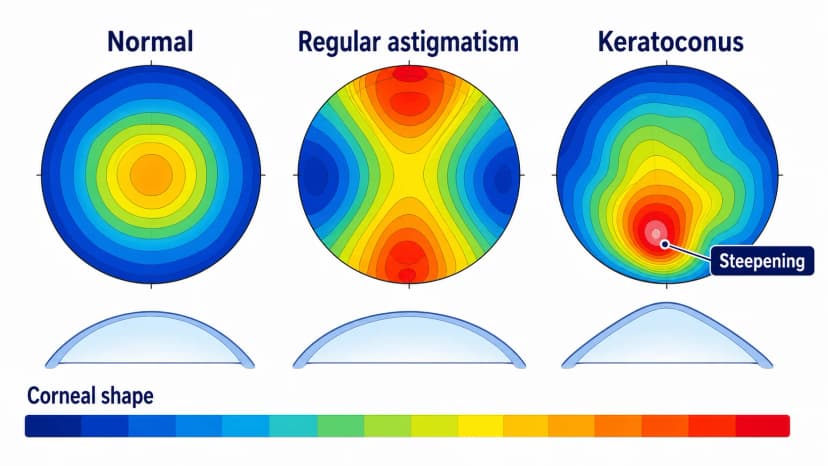
Topography maps use colors to represent curvature:
| Color | Meaning |
|---|---|
| Cool colors (blue/green) | Flatter areas |
| Warm colors (red/orange) | Steeper areas |
| Uniform colors | Regular corneal shape |
| Irregular patterns | Corneal irregularity |
Common Patterns
Normal Cornea:
- Symmetric bowtie pattern
- Slightly steeper centrally
- Regular, smooth contours
Regular Astigmatism:
- Symmetric bowtie pattern
- Steepest and flattest meridians 90° apart
- Correctable with glasses or standard contacts
Irregular Astigmatism:
- Asymmetric or skewed patterns
- May indicate keratoconus or corneal scarring
- Often requires specialty contact lenses
- Inferior steepening
- Asymmetric bowtie
- Progressive thinning and protrusion
Corneal Topography vs. Other Corneal Tests
| Test | What It Measures |
|---|---|
| Corneal topography | Front surface curvature |
| Corneal tomography (Pentacam) | Front and back surface + thickness |
| Corneal pachymetry | Corneal thickness only |
| OCT | Cross-sectional corneal layers |
Frequently Asked Questions
Is corneal topography the same as corneal tomography?
No. Topography maps only the front surface of the cornea. Tomography (such as Pentacam) maps both front and back surfaces and also measures corneal thickness, providing more comprehensive information.
How often do I need corneal topography?
Frequency depends on your condition. For stable conditions, annual testing may be sufficient. For progressive conditions like keratoconus or after surgery, more frequent testing may be needed.
Will I need this test before cataract surgery?
Often yes. Corneal topography helps your surgeon select the best intraocular lens and plan the surgical approach, especially if you have astigmatism.
Can I wear contacts before the test?
For routine monitoring, your doctor may test with your usual lens wear schedule. For refractive surgery evaluation, contacts must be removed well in advance because they temporarily reshape the cornea.
Is the test safe?
Yes. Corneal topography is non-invasive. No instruments touch your eye and no drops are usually needed; the main inconvenience is briefly looking at lights while images are captured.
Medical Disclaimer: This information is for educational purposes only and does not replace professional medical advice, diagnosis, or treatment. Discuss your results with your eye care provider.
Sources:
- American Academy of Ophthalmology. Corneal Topography.
- Wikipedia. Keratoconus.