

Keratoconus
A progressive condition where the cornea thins and bulges into a cone shape, causing distorted vision. Learn about stages, treatment with cross-linking, and lens options.
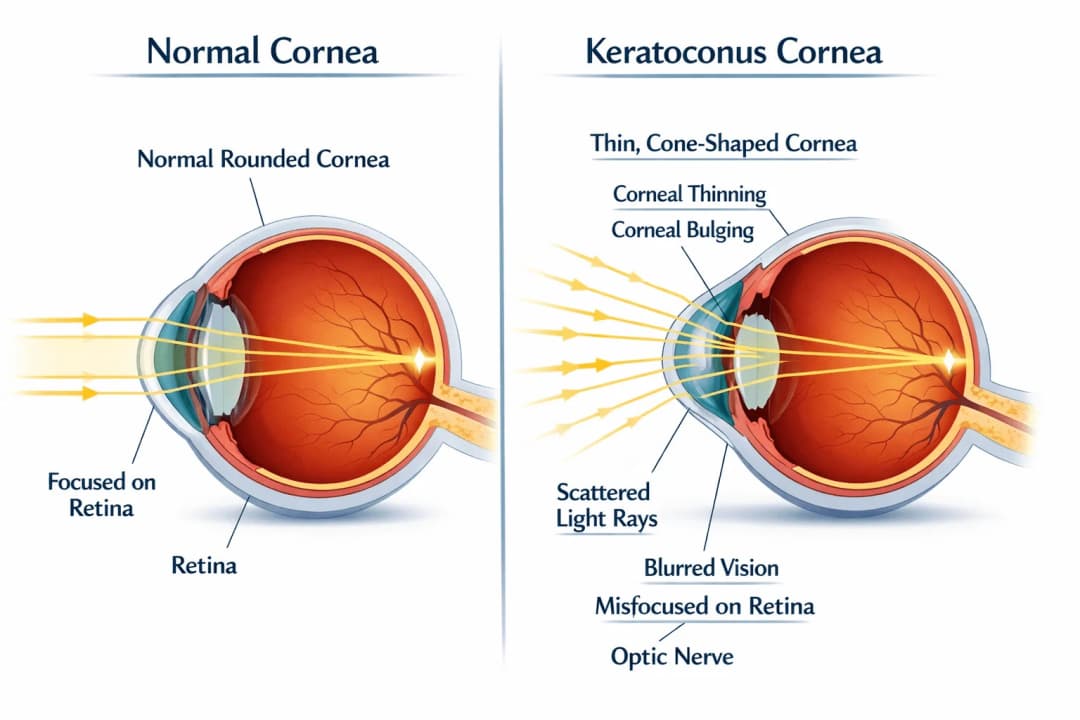
Keratoconus is a progressive eye condition in which the normally round cornea thins and bulges outward into a cone-like shape. This irregular shape prevents light from focusing correctly on the retina, causing distorted and blurry vision that glasses alone often cannot fully correct.
Key Takeaways
- Progressive corneal thinning causes the cornea to bulge into a cone shape
- Usually begins in teens or early twenties and may progress for 10-20 years
- Causes irregular astigmatism that worsens over time
- Eye rubbing is a major risk factor and should be avoided
- Corneal cross-linking (CXL) can halt progression
- Specialty contact lenses (scleral, rigid gas-permeable) provide the best vision correction
- Corneal transplant is needed in severe cases (about 10-20% of patients)
Overview
Keratoconus affects roughly 1 in 2,000 people, though recent studies suggest it may be more common. The condition typically starts during puberty and progresses through the 20s and 30s before stabilizing. Early detection is important because corneal cross-linking can stop the disease from getting worse.
Stages of Keratoconus
| Stage | Corneal Changes | Vision | Treatment |
|---|---|---|---|
| Mild | Slight thinning, mild steepening | Correctable with glasses or soft contacts | Monitor; cross-linking if progressing |
| Moderate | Noticeable cone, thinning on pachymetry | Requires rigid or scleral lenses | Cross-linking to halt; specialty lenses |
| Advanced | Significant cone, possible scarring | Poor even with lenses | May need corneal transplant |
| Hydrops | Acute rupture of Descemet's membrane | Sudden clouding, pain | Emergency management; eventual transplant |
Causes and Risk Factors
What Causes Keratoconus
The exact cause is not fully understood, but it involves a combination of genetic susceptibility and environmental triggers that weaken the structural proteins (collagen) in the cornea.
Key Risk Factors
- Eye rubbing-the single most important modifiable risk factor
- Family history-first-degree relatives have 15-67× increased risk
- Atopy (allergies, eczema, asthma)-itchy eyes lead to rubbing
- Down syndrome-significantly higher prevalence
- Connective tissue disorders (Ehlers-Danlos, Marfan syndrome)
- Sleep position-sleeping face-down may contribute
Stop rubbing your eyes. If you have keratoconus or are at risk, eye rubbing can accelerate progression. If allergies cause itching, treat the allergies aggressively with antihistamine drops.
Symptoms
- Blurred or distorted vision that worsens over time
- Increasing astigmatism with frequent prescription changes
- Ghost images or multiple images from a single object
- Glare and halos around lights, especially at night
- Difficulty with night driving
- Light sensitivity
- Eye strain and headaches
Diagnosis
Key Tests
- Corneal topography-a key test for detecting and monitoring keratoconus; maps the curvature of the cornea and reveals the characteristic cone pattern
- Pachymetry-measures corneal thickness, which is reduced in keratoconus
- Slit-lamp exam-may reveal Vogt striae, Fleischer ring, or corneal scarring
- Corneal tomography (Pentacam/Orbscan)-provides front and back surface maps along with thickness profiles
Early Detection
Topographic changes can be detected before symptoms appear, which is why screening is recommended for:
- Family members of keratoconus patients
- Patients with progressive or irregular astigmatism
- Anyone considering refractive surgery (LASIK is contraindicated in keratoconus)
Treatment
Corneal Cross-Linking (CXL)
The only treatment that halts keratoconus progression:
- Riboflavin (vitamin B2) drops are applied to the cornea
- UV-A light activates the riboflavin
- Creates new collagen bonds that stiffen the cornea
- Outpatient procedure taking about 60-90 minutes
- Most effective when done early, before significant damage
Vision Correction
Glasses and soft contacts - adequate for mild cases only
Rigid gas-permeable (RGP) lenses - provide better vision by creating a smooth optical surface over the irregular cornea
Scleral lenses - large-diameter lenses that vault over the entire cornea:
- Rest on the white of the eye (sclera)
- Very comfortable despite their size
- Provide excellent vision
- Hold a fluid reservoir that keeps the cornea hydrated
- The preferred lens option for most moderate-to-advanced cases
Hybrid lenses - rigid center with soft skirt for comfort
Piggyback lenses - soft lens underneath with RGP on top
Intrastromal Corneal Ring Segments (Intacs)
- Small plastic inserts placed within the cornea
- Flatten the cone to improve shape
- May improve contact lens fit
- Less commonly used since cross-linking became available
Corneal Transplant
For severe keratoconus that cannot be managed with lenses:
- Penetrating keratoplasty (PK)-full-thickness transplant
- Deep anterior lamellar keratoplasty (DALK)-partial-thickness, preserves patient's endothelium (lower rejection risk)
- High success rate (>90% graft survival at 10 years)
- Recovery takes months; sutures remain for 1+ year
- Glasses or contact lenses still usually needed after transplant
When to See a Doctor
Schedule an eye exam if you notice:
- Rapidly changing eyeglass prescription, especially increasing astigmatism
- Vision that glasses can't fully correct
- Distortion or ghosting of images
- Family history of keratoconus
Seek urgent care if:
- Sudden onset of eye pain with clouding of vision (possible hydrops)
- Significant sudden vision loss in a keratoconus eye
Frequently Asked Questions
Can keratoconus be cured?
Keratoconus cannot be cured, but it can be effectively managed. Corneal cross-linking can stop progression, and specialty contact lenses can restore excellent functional vision for most patients.
Will I go blind from keratoconus?
Keratoconus very rarely causes total blindness. Even in advanced cases, corneal transplant surgery has a high success rate. With modern treatments including cross-linking and scleral lenses, most patients maintain good functional vision.
Can I have LASIK if I have keratoconus?
No. LASIK and other corneal refractive surgeries that thin the cornea are contraindicated in keratoconus. These procedures can worsen the condition. This is why corneal topography screening is done before LASIK.
Does keratoconus affect both eyes?
Yes, keratoconus is bilateral in about 96% of cases, though one eye is usually more advanced than the other. If diagnosed in one eye, the other should be monitored closely.
At what age does keratoconus stop progressing?
Keratoconus typically stabilizes by the late 30s to 40s, but there is no guaranteed age. Cross-linking is recommended for progressive cases rather than waiting for natural stabilization.
References
Medical Disclaimer: This information is for educational purposes only and does not replace professional medical advice, diagnosis, or treatment. If you have concerns about keratoconus or changes in your vision, please consult a qualified healthcare provider.
Sources:
- Wikipedia. Keratoconus.
- National Keratoconus Foundation. Keratoconus overview.
- Gomes JA, et al. Global consensus on keratoconus and ectatic diseases. Cornea. 2015;34(4):359-369.
- Romero-Jiménez M, et al. Keratoconus: a review. Cont Lens Anterior Eye. 2010;33(4):157-166.