

OCT (Optical Coherence Tomography)
A non-invasive imaging scan that provides detailed cross-sectional images of the retina and optic nerve.
Optical coherence tomography (OCT) is a non-invasive imaging technology that uses light waves to create detailed cross-sectional images of the retina and optic nerve. Think of it like an ultrasound, but using light instead of sound - it produces microscopic-level detail of the layers within your eye without touching it.
Key Takeaways
- Non-invasive, painless, and quick - takes just a few minutes
- Shows the individual layers of the retina and optic nerve in cross-section
- Essential for diagnosing and monitoring glaucoma, optic neuritis, papilledema, and macular conditions
- Color-coded results compare your measurements to a normative database
- No recovery time - you can drive home immediately (unless your pupils were dilated for other tests)
- Tracked over time to detect subtle changes visit to visit
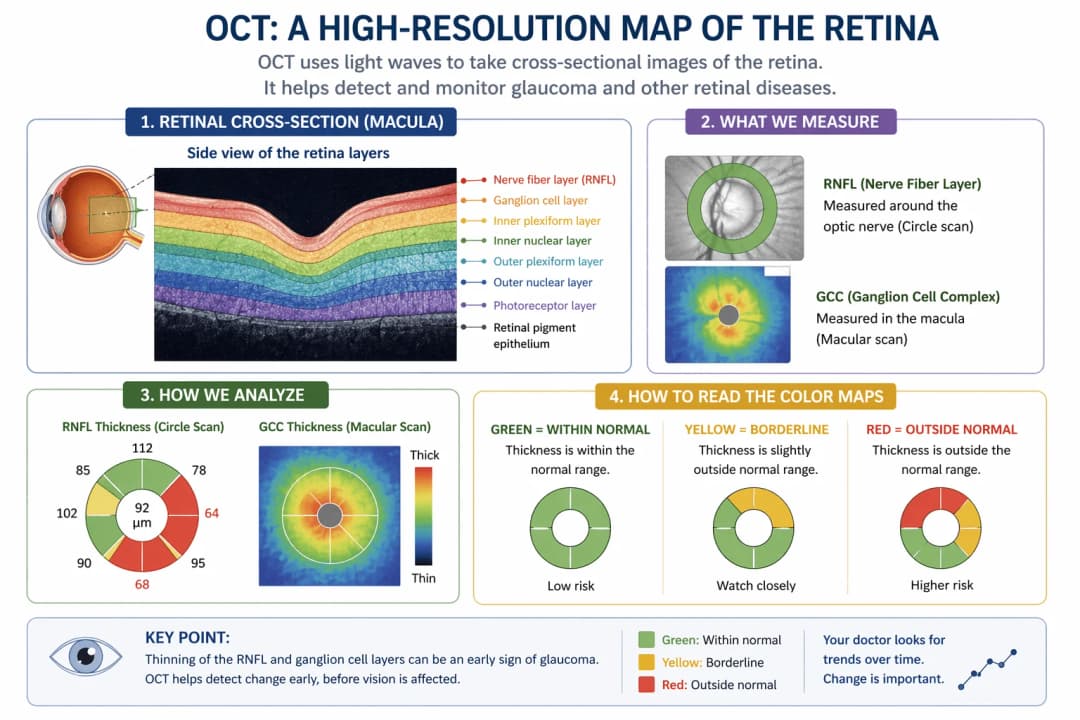
How OCT Works
OCT works by directing a safe, low-power beam of light into your eye and measuring the reflections from different retinal layers. The technology is similar to how ultrasound uses sound echoes - but because light has a much shorter wavelength, OCT captures far finer detail. A computer assembles these reflections into a cross-sectional image that shows each layer of the retina and optic nerve, much like viewing a thin slice under a microscope.
Why It's Done
OCT is one of the most frequently ordered tests in both general ophthalmology and neuro-ophthalmology. Your doctor may order it to:
- Evaluate optic nerve damage in optic neuritis, ischemic optic neuropathy, or LHON
- Measure retinal nerve fiber layer (RNFL) thickness - a key marker of optic nerve health
- Detect and monitor papilledema and disc swelling from raised intracranial pressure (IIH)
- Track glaucoma progression by measuring nerve fiber and ganglion cell thinning over time
- Assess the macula for macular degeneration, diabetic macular edema, epiretinal membrane, or macular hole
- Monitor treatment response - for example, whether anti-VEGF injections are reducing macular swelling
- Distinguish real disc swelling from pseudo-swelling caused by optic disc drusen
What to Expect
Before the Test
- No special preparation is needed
- Your pupils may or may not be dilated - OCT can often be done without dilation
- You can wear your glasses or contacts; you will look into the machine without them
- There is no fasting or medication restriction
During the Test
- Sit with your chin on a padded rest and your forehead against a bar
- Look at a green or red target light inside the machine
- The OCT scans your eye with a safe, painless beam of light - you will see a thin line sweep across your vision
- The technician may take several scans of each eye
- The entire process takes 5-10 minutes for both eyes
After the Test
- No recovery time - your vision is unaffected by the scan
- Results are available immediately and displayed on screen
- You can drive home right away (unless your pupils were dilated for other tests during the same visit)
What It Shows
Retinal Nerve Fiber Layer (RNFL)
- Measures the thickness of the nerve fiber layer around the optic disc
- Thinning suggests nerve fiber loss - seen in optic atrophy, glaucoma, and after optic neuritis
- Thickening suggests swelling - seen in papilledema and acute disc edema
Ganglion Cell Analysis (GCA)
- Measures the inner retinal layers in the macula, where ganglion cell bodies reside
- Early damage from optic nerve disease may show up here before RNFL thinning is detectable
- Useful for distinguishing glaucoma from other causes of nerve damage
Optic Nerve Head
Macula
- Cross-sectional view of the central retina
- Detects fluid, thickening, holes, or membrane formation
- Essential for managing diabetic macular edema, wet AMD, and epiretinal membrane
Understanding Your Results
OCT results are typically displayed as color-coded maps that compare your measurements to a database of normal values for your age:
- Green - within normal limits (within the 5th-95th percentile)
- Yellow - borderline (between the 1st and 5th percentile)
- Red - outside normal limits (below the 1st percentile)
What the Numbers Mean
- RNFL thickness is measured in microns (μm). A normal average RNFL thickness is roughly 90-110 μm, but this varies by age, ethnicity, and even disc size
- A change of more than about 5 μm between visits may be meaningful, though the machine's own measurement variability must be considered
- Your doctor compares your numbers to both the normative database and your own prior scans - trends matter more than a single measurement
What "Red" Does Not Mean
A red zone on your OCT does not automatically mean you have a disease. Some healthy people naturally fall outside the normative range. Similarly, a "green" result does not guarantee everything is normal - early disease can exist before measurements cross the statistical threshold. Your doctor interprets OCT results alongside your visual field test, fundoscopic exam, and clinical picture.
Why Trend and Context Matter
OCT numbers can move in more than one direction for more than one reason. In papilledema, RNFL thickness may fall because swelling is improving, but it can also fall because optic nerve fibers have been damaged and are thinning. In optic neuritis, RNFL thinning may not be obvious right away; ganglion cell analysis and visual field testing often help show whether the nerve is recovering or losing function over time.
This is why a neuro-ophthalmologist usually looks at:
- Scan quality - motion blur, dry eye, cataract, and poor fixation can distort measurements
- Both eyes together - asymmetry can be more meaningful than a single number
- RNFL plus ganglion cell layers - swelling can hide early nerve fiber loss on RNFL alone
- Structure plus function - OCT should make sense next to visual acuity, color vision, and visual field results
How Often You'll Need OCT
The frequency depends on your condition:
- Glaucoma - every 6-12 months to track progression
- Optic neuritis - at diagnosis, then at follow-up visits to monitor for nerve fiber thinning (which can develop over months)
- Papilledema / IIH - at each visit to monitor swelling and treatment response
- Macular conditions - may be done monthly during active treatment (e.g., injection series), then less frequently once stable
- Routine monitoring - some patients with stable conditions need OCT only annually
Your doctor will set a schedule based on how active or stable your condition is.
Comparing Over Time
One of OCT's greatest strengths is tracking changes across visits:
- The software aligns scans from different dates so the same location is compared each time
- Progression analysis highlights areas that have changed significantly
- Subtle thinning of a few microns per year - invisible on a standard exam - can be detected and tracked
- This information helps guide treatment decisions, such as when to start or escalate therapy in glaucoma or IIH
OCT vs Other Eye Imaging
| Test | What It Shows | Invasive? | Time |
|---|---|---|---|
| OCT | Cross-sectional retinal and optic nerve layers, thickness measurements | No | 5-10 min |
| Fundus Photography | Color photo of the retinal surface | No | 1-2 min |
| OCT Angiography | Blood flow in retinal and choroidal vessels without dye | No | 5-10 min |
| Fluorescein Angiography | Blood vessel leakage and circulation (requires IV dye) | Yes (IV dye) | 15-30 min |
Limitations
OCT is powerful but has some limitations:
- Dense cataracts can block the light beam, producing poor-quality images
- Poor fixation - if you have difficulty looking at the target steadily, the scan may be less accurate
- Cannot test visual function - OCT measures structure, not how well you can see. It is used alongside functional tests like visual field testing and visual acuity
- Normative database limitations - the comparison database may not represent all ethnicities equally, so your doctor considers your individual baseline
Frequently Asked Questions
Does OCT hurt?
No. There is no contact with your eye and nothing touches your face other than the chin rest. The light beam is completely painless.
Do I need dilating drops for OCT?
Usually not. Most modern OCT machines can capture images through an undilated pupil. If your doctor dilates your eyes for other parts of the exam, the OCT can be done before or after dilation.
Can I drive home after the scan?
Yes. OCT itself does not affect your vision. If your pupils were dilated for other tests during the same visit, you may have temporary light sensitivity and blurred near vision - in that case, bring sunglasses and consider having someone drive you.
How is OCT different from a regular eye exam?
During a standard fundoscopic exam, your doctor views the surface of your retina and optic nerve. OCT goes deeper - it shows the individual microscopic layers within the retina. Think of it as the difference between looking at the cover of a book versus reading the pages inside.
What if my results show "red" zones?
Red zones mean some of your measurements fall below the 1st percentile of the normal population. This does not always indicate disease - some healthy eyes naturally measure outside the standard range. Your doctor will interpret the OCT alongside your symptoms, exam, and other tests before drawing conclusions.
Can OCT diagnose papilledema by itself?
No. OCT is very useful for measuring optic nerve swelling and tracking change, but it cannot by itself prove that swelling is true papilledema from raised intracranial pressure. Your doctor still uses the exam, symptoms, visual field testing, and sometimes MRI/MRV or lumbar puncture to separate papilledema from mimics such as optic disc drusen.
Do I need to remove my contact lenses?
It depends on the clinic's preference. Some centers ask you to remove contacts, while others can scan through them. Ask when you schedule your appointment.
How long does the scan take?
The actual scan takes only a few minutes for both eyes. Including setup and positioning, expect to be at the machine for about 5-10 minutes total.
Medical Disclaimer: This information is for educational purposes only and does not replace professional medical advice.
Sources:
- American Academy of Ophthalmology. What Is Optical Coherence Tomography?.
- Huang D, et al. Optical coherence tomography. Science. 1991;254(5035):1178-1181.
- Minakaran N, et al. Optical coherence tomography (OCT) in neuro-ophthalmology. Eye (Lond). 2021;35(1):17-32.
- Schuman JS, et al. Optical Coherence Tomography of Ocular Diseases. 3rd ed. Slack Incorporated; 2013.