

Pachymetry (Corneal Thickness Measurement)
A test measuring corneal thickness, important for glaucoma assessment and refractive surgery planning. Learn what to expect and what results mean.
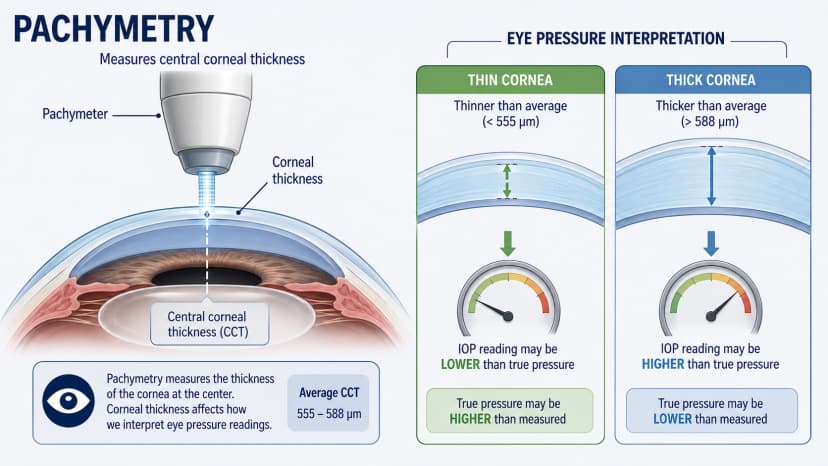
Pachymetry is the measurement of corneal thickness (from the Greek "pachys" meaning thick). This quick, painless test is essential for accurate glaucoma assessment and determining candidacy for refractive surgery like LASIK. Corneal thickness affects eye pressure measurements and provides important information about corneal health.
Key Takeaways
- Measures corneal thickness (normal: approximately 520-560 microns centrally)
- Important for glaucoma-thick corneas can cause falsely high IOP readings
- Essential for refractive surgery-determines if enough tissue for safe LASIK
- Quick and painless test
- Done with ultrasound probe or optical imaging
- Single measurement usually sufficient (doesn't change much over time)
Why Corneal Thickness Matters
Glaucoma Assessment
The Problem:
- Intraocular pressure (IOP) is measured through the cornea
- Standard tonometry assumes average corneal thickness
- Thicker corneas give falsely HIGH IOP readings
- Thinner corneas give falsely LOW IOP readings
The Solution:
- Measuring corneal thickness allows IOP interpretation in context
- Thin corneas are an independent risk factor for glaucoma progression
- Helps determine true glaucoma risk
Refractive Surgery Planning
For LASIK/PRK:
- Laser removes corneal tissue to reshape it
- Must leave enough residual thickness (typically >250 microns)
- Thinner corneas may not be safe candidates
- Determines amount of correction safely possible
Corneal Disease
Indicates Corneal Health:
- Thin cornea may indicate keratoconus
- Thick/swollen cornea may indicate corneal edema
- Helps monitor conditions affecting corneal health
How Pachymetry Is Performed
Ultrasound Pachymetry (Contact)
The traditional and most common method:
Procedure:
- Numbing drops are placed in the eye
- A small ultrasound probe gently touches the center of the cornea
- Sound waves measure the corneal thickness
- Multiple readings are taken and averaged
- Takes only a few seconds per eye
What to Expect:
- No pain (cornea is numbed)
- Brief touch sensation
- Very quick (less than a minute)
Optical Pachymetry (Non-Contact)
Methods Include:
- Optical coherence tomography (OCT)
- Scheimpflug imaging (Pentacam)
- Specular microscopy
Advantages:
- No contact with eye
- Can map thickness across entire cornea
- Often done as part of other imaging
Normal Values
Average Central Corneal Thickness
| Category | Thickness (microns) |
|---|---|
| Below average | < 520 µm |
| Average | 520-560 µm |
| Above average | > 560 µm |
Important Notes
- There's a normal range-not everyone is "average"
- Varies by ethnicity (African Americans tend to have thinner corneas)
- Generally stable throughout adulthood
- May change with certain conditions or surgeries
Effect on IOP Readings
The Correction Factor
While there's no universally accepted formula, general guidelines:
| Corneal Thickness | Effect on IOP |
|---|---|
| 545 µm (average) | Measured IOP accurate |
| Each 25 µm thinner | True IOP ~1 mmHg higher |
| Each 25 µm thicker | True IOP ~1 mmHg lower |
Example:
- Measured IOP: 22 mmHg
- Corneal thickness: 495 µm (50 µm thinner than average)
- True IOP may be approximately 24 mmHg
Important: IOP "correction" is a rough estimate.
The relationship between corneal thickness and IOP measurement error isn't perfectly linear. Doctors use pachymetry as one factor in assessing glaucoma risk, not as a precise mathematical correction.
Clinical Applications
Glaucoma Suspect Evaluation
When IOP is borderline elevated:
- Thick corneas may explain "high" IOP readings
- May mean less aggressive treatment needed
- Thin corneas suggest higher actual risk
Ocular Hypertension
Patients with elevated IOP but no glaucoma damage:
- Pachymetry helps stratify risk
- Thin corneas = higher risk of developing glaucoma
- Influences treatment decisions
Refractive Surgery Screening
LASIK Criteria:
- Generally need >500 µm for standard LASIK
- Must leave >250 µm after ablation
- Higher prescriptions need more tissue
- Thin corneas may need surface ablation (PRK) instead
Keratoconus Screening
Keratoconus causes progressive corneal thinning:
- Pachymetry part of screening protocol
- Thinnest point location is important
- Serial measurements can monitor progression
Corneal Edema Monitoring
In conditions causing corneal swelling:
- Fuchs' dystrophy
- Post-surgical edema
- Contact lens-related edema
- Pachymetry tracks swelling
What Affects Corneal Thickness
Factors That Thin the Cornea
- Keratoconus
- Refractive surgery history (LASIK, PRK)
- Some medications
- Contact lens wear (temporarily)
- Dehydration
Factors That Thicken the Cornea
- Corneal edema (various causes)
- Morning measurement (cornea swells overnight)
- High altitude
- Fuchs' dystrophy (early stages-edema)
When Pachymetry Is Ordered
Common Indications
- Glaucoma evaluation
- Ocular hypertension assessment
- Refractive surgery consultation
- Keratoconus screening
- Corneal dystrophy evaluation
- Monitoring corneal conditions
Frequency
- Usually done once (measurement doesn't change much)
- May be repeated if:
- Monitoring keratoconus
- Following corneal edema
- Unexplained change in IOP readings
Frequently Asked Questions
Does pachymetry hurt?
No. Numbing drops are used for the contact (ultrasound) method, so you feel only light pressure. Optical methods don't touch the eye at all. The test is quick and painless.
Why do I only need this test once?
Corneal thickness is largely stable throughout adulthood. Unless you have a condition affecting corneal thickness (like keratoconus or edema), the measurement won't change significantly.
My cornea is thin-does that mean I have glaucoma?
Not necessarily. Thin corneas are a risk factor for glaucoma and can make IOP readings appear lower than they actually are. Your doctor considers pachymetry along with other factors (optic nerve appearance, visual field, etc.) to assess your glaucoma risk.
Can I still have LASIK with thin corneas?
It depends. Thin corneas don't automatically disqualify you, but they limit how much correction is safe. Your surgeon will calculate whether adequate tissue remains after the procedure. Surface procedures (PRK) may be an alternative.
My IOP was high but my corneas are thick-should I be worried?
Thick corneas cause IOP to measure higher than it actually is. Your doctor will interpret your IOP in light of your corneal thickness. You may have lower true IOP than the measurement suggests, which is reassuring.
Is corneal thickness related to overall eye health?
Corneal thickness is one piece of information about your eyes. Abnormally thin corneas may indicate conditions like keratoconus. Abnormally thick corneas may indicate edema. Normal thickness doesn't guarantee eye health, and abnormal thickness doesn't mean disease-it's interpreted in context.
References
Medical Disclaimer: This information is for educational purposes only and does not replace professional medical advice, diagnosis, or treatment. Discuss pachymetry results with your eye care provider for interpretation specific to your situation.
Sources:
- NCBI Bookshelf. Pachymetry.
- Gordon MO, et al. The Ocular Hypertension Treatment Study: baseline factors that predict the onset of primary open-angle glaucoma. Arch Ophthalmol. 2002;120(6):714-720.
- Doughty MJ, Zaman ML. Human corneal thickness and its impact on intraocular pressure measures: a review and meta-analysis approach. Surv Ophthalmol. 2000;44(5):367-408.
- National Eye Institute. Glaucoma.