

Tonometry (Eye Pressure Measurement)
A test to measure the pressure inside your eye. Learn about different types of tonometry and why it's essential for glaucoma screening.
Tonometry measures the intraocular pressure (IOP)-the fluid pressure inside your eye. This is a crucial test for detecting and monitoring glaucoma, a condition where elevated eye pressure can damage the optic nerve. Tonometry is quick, painless, and performed during routine eye exams.
Key Takeaways
- Measures pressure inside the eye (intraocular pressure or IOP)
- Essential for glaucoma screening and monitoring
- Normal range typically 10-21 mmHg-but "normal" pressure doesn't rule out glaucoma
- Several methods available-applanation (reference standard), non-contact ("air puff"), rebound
- Quick and painless with numbing drops
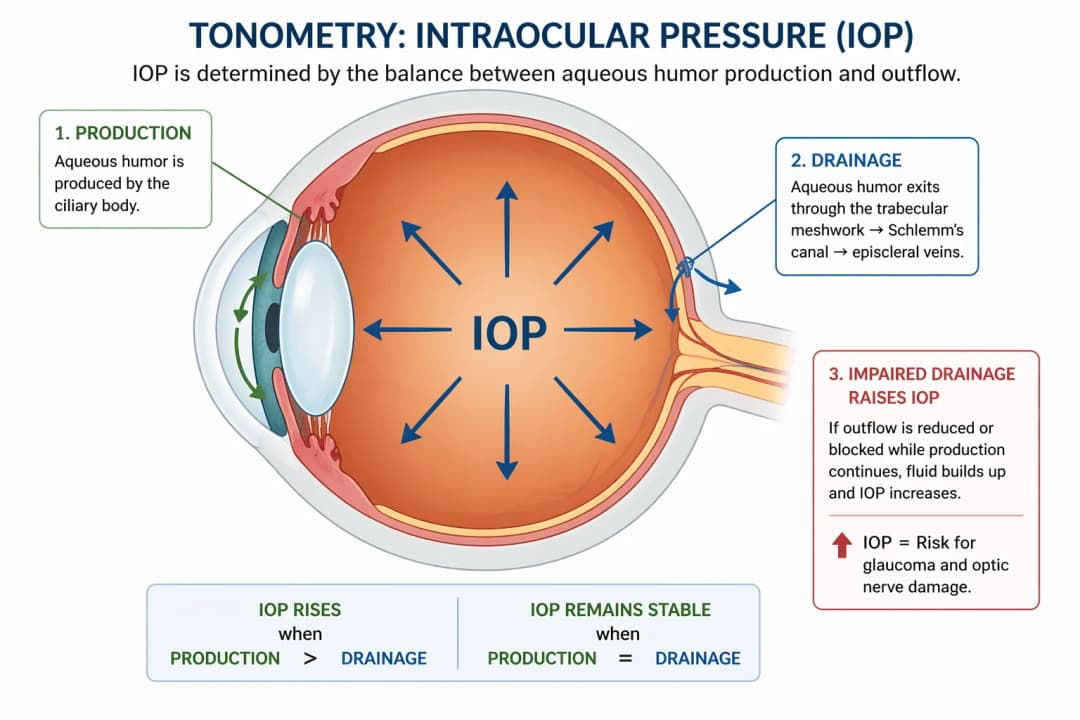
Why Eye Pressure Matters
The eye constantly produces a clear fluid called aqueous humor that:
- Nourishes the front of the eye
- Maintains eye shape
- Drains through a meshwork at the front of the eye
When drainage is impaired or production exceeds drainage, pressure rises. Elevated IOP is the main modifiable risk factor for glaucoma-a leading cause of blindness.
Types of Tonometry
Goldmann Applanation Tonometry (GAT)
The Gold Standard
- Most accurate and reproducible method
- Used at slit lamp
- Small probe gently touches cornea
- Eye numbed with drops
- Blue light used for measurement
- Measures force needed to flatten a small area of cornea
What to Expect:
- Numbing drops placed in eye
- Fluorescein dye added (glows under blue light)
- Probe gently touches cornea
- Examiner adjusts until proper measurement
- Takes just seconds per eye
Non-Contact Tonometry ("Air Puff")
Common Screening Method
- No contact with eye
- Brief puff of air flattens cornea
- Machine measures response
- No numbing drops needed
- Often used for screening
What to Expect:
- Chin on rest, forehead against band
- Focus on target light
- Brief puff of air
- May startle but not painful
- Repeated for each eye
Limitations:
- Less accurate than applanation
- May overestimate in some cases
- If abnormal, usually confirmed with applanation
Rebound Tonometry (iCare)
Portable and Drop-Free
- Small handheld device
- Tiny probe briefly touches cornea
- No numbing drops usually needed
- Very quick
- Good for children and special populations
- Can be used for home monitoring
What to Expect:
- Look straight ahead
- Small probe briefly contacts cornea
- Multiple readings averaged
- Quick and generally comfortable
Other Methods
- Tono-Pen-portable handheld device with numbing drops
- Pneumotonometry-air pressure-based
- Dynamic contour tonometry (Pascal)-continuous pressure measurement
Understanding Your Results
Normal Range
- Typical normal: 10-21 mmHg (millimeters of mercury)
- Average is approximately 15-16 mmHg
Important Considerations
"Normal" pressure doesn't guarantee you don't have glaucoma. Some people develop glaucoma damage at "normal" pressures (normal-tension glaucoma), while others tolerate higher pressures without damage. IOP is just one part of glaucoma assessment.
Factors Affecting IOP
- Time of day-often higher in morning
- Corneal thickness-affects measurement accuracy
- Body position-higher when lying down
- Caffeine, exercise-can temporarily affect readings
- Medications-some raise IOP, some lower it
- Valsalva maneuver-straining can raise IOP
- Tight collar or tie-may slightly increase reading
What Happens If Pressure Is High
If IOP is elevated, your doctor may:
- Repeat the measurement to confirm
- Perform pachymetry-measure corneal thickness (thin corneas can underestimate pressure)
- Examine the optic nerve for damage
- Order visual field testing and OCT
- Perform gonioscopy to examine drainage angle
Ocular Hypertension
Some people have elevated IOP without glaucoma damage. This is called ocular hypertension. These patients:
- Need regular monitoring
- May or may not require treatment
- Have increased glaucoma risk
High Pressure Requiring Urgent Attention
Seek immediate care if eye pressure is very elevated (above 40-50 mmHg) with symptoms such as:
- Severe eye pain
- Blurred vision
- Halos around lights
- Nausea/vomiting
- Headache
This may indicate acute angle-closure glaucoma, an emergency.
Accuracy Factors
Corneal Thickness
- Standard tonometry is calibrated for average corneal thickness (~545 microns)
- Thin corneas may give falsely low readings
- Thick corneas may give falsely high readings
- Pachymetry helps interpret results
Previous Eye Surgery
- LASIK and other corneal surgery affect readings
- Usually causes artificially low readings
- Inform your doctor of any prior surgeries
Tonometry for Glaucoma Monitoring
For glaucoma patients, regular IOP checks are essential:
- At diagnosis-establish baseline
- When changing medications-assess response
- Regular monitoring-varies by disease stage
- Target pressure-individualized goal to prevent progression
Frequently Asked Questions
Does tonometry hurt?
No. With numbing drops, you feel minimal to nothing during applanation tonometry. Air puff tonometry involves a brief startle but no pain. Rebound tonometry is so quick most people barely notice it.
How often should I have my eye pressure checked?
For routine screening, every 1-2 years after age 40 (more often if high-risk). Glaucoma patients may need checks every few weeks to months depending on their situation.
Can I measure my eye pressure at home?
Home tonometers (like iCare HOME) are available for some patients, typically those with glaucoma needing frequent monitoring. Your doctor can discuss if this is appropriate for you.
Will numbing drops affect my vision?
You may have slightly blurry vision for 15-20 minutes after numbing drops. Wait until your vision clears before driving if affected.
Does one high reading mean I have glaucoma?
Not necessarily. IOP varies throughout the day and can be temporarily elevated for various reasons. A single high reading will prompt further evaluation, but glaucoma diagnosis requires evidence of optic nerve damage or visual field loss.
Why does the air puff test startle me?
The puff activates the blink reflex, which can be surprising. Try to hold your eye open and expect the puff-knowing it's coming often reduces the startle response.
References
Medical Disclaimer: This information is for educational purposes only and does not replace professional medical advice, diagnosis, or treatment. If you have concerns about your eye pressure, please consult a qualified healthcare provider.
Sources:
- StatPearls. Tonometry. NCBI Bookshelf.
- Glaucoma Research Foundation. Eye Pressure.
- National Eye Institute. Glaucoma.